EU CBAM – Complete Guide to Carbon Border Adjustment Mechanism, Compliance, Certificates & Indian Exporters
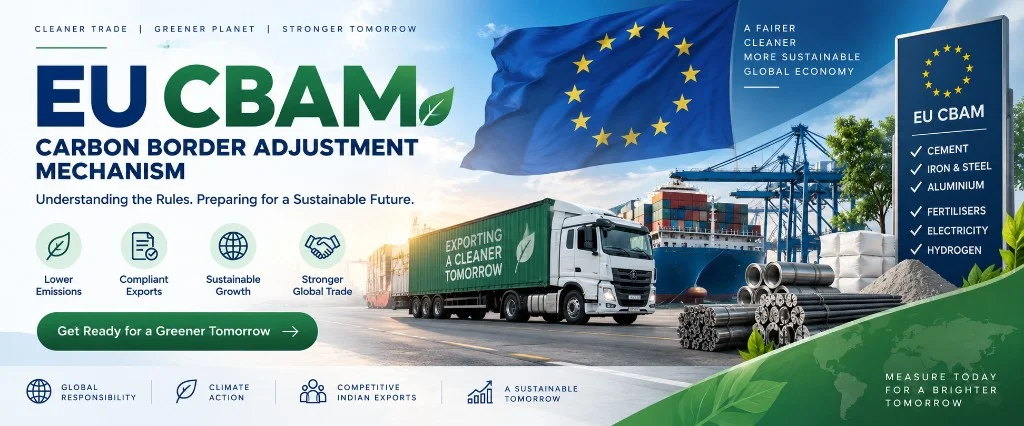
The European Union Carbon Border Adjustment Mechanism (EU CBAM) is an EU climate policy mechanism that places a carbon-related cost on certain carbon-intensive goods imported into the European Union.
CBAM is designed to address the risk of carbon leakage by ensuring that the carbon emissions embedded in certain imported goods are reflected in the cost faced by importers, alongside the carbon costs applicable to production within the EU under the EU Emissions Trading System (EU ETS).
The CBAM framework initially covered six major sectors:
- Iron and steel
- Aluminium
- Cement
- Fertilisers
- Electricity
- Hydrogen
The definitive CBAM regime began on 1 January 2026, following the transitional period that ran from October 2023 through December 2025.
For manufacturers and exporters outside the EU, including businesses in India, CBAM is particularly important because EU importers may require detailed information about the greenhouse-gas emissions embedded in imported products.
Although the formal CBAM declaration and certificate obligations generally sit with the EU importer or authorised CBAM declarant, non-EU manufacturers can have an important role in supplying accurate production and emissions information for their exported goods. The European Commission has published dedicated guidance for non-EU installation operators for the definitive period.
What Is EU CBAM?
CBAM stands for Carbon Border Adjustment Mechanism.
It is a European Union mechanism established by Regulation (EU) 2023/956 to address greenhouse-gas emissions embedded in certain goods imported into the EU.
The regulation states that CBAM is intended to address the risk of carbon leakage, reduce global emissions and support the objectives of the Paris Agreement by creating incentives for emissions reductions in third countries.
Why Was the EU CBAM Introduced?
One of the principal policy objectives behind CBAM is addressing carbon leakage.
Carbon leakage can occur when production moves from jurisdictions with relatively stronger climate policies to jurisdictions with less stringent climate policies, or when lower-carbon EU production is replaced by more carbon-intensive imported products.
CBAM is designed to complement the EU Emissions Trading System (EU ETS).
The basic policy concept is that carbon-intensive products imported into the EU should face a carbon cost that reflects their embedded emissions, while EU producers in relevant sectors are subject to the EU's carbon-pricing framework.
The European Commission describes CBAM as a mechanism intended to ensure that the carbon price of imports is equivalent to the carbon price of domestic production, while supporting the EU's climate objectives.
Which Products Are Covered Under EU CBAM?
CBAM currently covers selected goods in six sectors.
| CBAM Sector | Examples / Scope |
|---|---|
| Cement | Selected cement and clinker products |
| Iron & Steel | Selected iron and steel products |
| Aluminium | Selected aluminium products |
| Fertilisers | Selected fertiliser and precursor products |
| Electricity | Imported electrical energy |
| Hydrogen | Hydrogen falling within the relevant CN classification |
The actual legal scope is determined by the applicable CN codes and CBAM legislation, not merely by the commercial name of a product.
This is an important point for exporters.
For example, saying that a company exports "steel products" is not by itself sufficient to determine whether CBAM applies. The exporter and EU importer should identify the relevant CN/TARIC classification and check the applicable CBAM scope.
Who Is Responsible for CBAM Compliance?
One of the most important points to understand is the distinction between the EU importer/declarant and the non-EU manufacturer or producer.
EU Importer / Authorised CBAM Declarant
The EU-side declarant is responsible for obligations such as:
- obtaining the required authorisation where applicable;
- declaring imported CBAM goods;
- declaring embedded emissions;
- purchasing CBAM certificates;
- surrendering certificates; and
- complying with applicable EU reporting and verification requirements.
The European Commission states that EU importers or their indirect customs representatives importing more than the applicable single mass-based threshold of 50 tonnes of CBAM goods must apply for authorised CBAM declarant status. This threshold applies to the four goods categories of cement, iron and steel, aluminium and fertilisers; electricity and hydrogen are subject to their specific rules.
Non-EU Manufacturer / Exporter
The non-EU producer generally does not become the EU's CBAM declarant merely because it manufactures the product.
However, the producer can be required commercially and operationally to provide information concerning:
- installation;
- production processes;
- quantities produced;
- emissions;
- precursor materials;
- emission factors;
- electricity;
- production routes; and
- other information needed to calculate embedded emissions.
The European Commission has specifically published guidance to help installation operators outside the EU implement CBAM during the definitive period.
What Is the 50-Tonne CBAM Threshold?
The definitive CBAM framework introduced a single mass-based threshold of 50 tonnes for relevant CBAM goods.
The threshold is designed to simplify compliance for smaller import volumes.
Under the current framework, the 50-tonne threshold applies to imports in the:
- cement;
- iron and steel;
- aluminium; and
- fertiliser
categories.
Importers of electricity and hydrogen are subject to the specific rules applicable to those sectors rather than the same 50-tonne threshold.
The threshold should not be interpreted as a general exemption for every CBAM product or every importer. Product classification and the applicable sector-specific provisions must be checked.
How Are CBAM Embedded Emissions Calculated?
The calculation methodology depends on:
- the CBAM sector;
- production process;
- relevant emissions;
- precursor materials;
- applicable calculation methodology;
- available installation data;
- electricity consumption where relevant; and
- whether actual or applicable default values are used.
The EU has established specific calculation rules under its implementing legislation.
The European Commission published Commission Implementing Regulation (EU) 2025/2547 concerning methods for calculating emissions embedded in goods.
The Commission has also published definitive-period guidance covering:
- general CBAM concepts;
- quick guidance for non-EU operators;
- embedded-emissions calculation methods;
- free-allocation adjustment;
- cement;
- hydrogen;
- fertilisers;
- iron and steel;
- aluminium; and
- electricity.
Why Is CBAM Emissions Data Important for Indian Exporters?
India is among the countries identified by the European Commission as a major origin of CBAM-covered imports during the early implementation of the definitive regime.
The EU and India have also engaged in cooperation relating to CBAM.
For Indian exporters, CBAM can create a practical requirement to develop a reliable system for:
Production Data → Energy Data → Emissions Calculation → Product-Level Allocation → Verification/Documentation → EU Customer Reporting
The European Commission has specifically stated that CBAM embedded emissions are calculated at product level and has provided sector-specific information for non-EU producers.
CBAM Compliance for Indian Manufacturers
Indian manufacturers exporting covered goods to the European Union should first determine whether their products actually fall within CBAM scope.
A practical assessment should include:
1. Identify the Export Product
2. Confirm the CN/TARIC Code
3. Determine the Manufacturing Installation
4. Identify the Production Route
5. Collect Energy Data
6. Identify Process Emissions
7. Identify Relevant Precursors
8. Calculate Product-Level Embedded Emissions
9. Maintain Supporting Evidence
10. Coordinate With the EU Importer
CBAM Compliance Documents for Exporters
The exact documentation required can vary depending on the sector, product and calculation methodology.
A CBAM data package may involve:
- product details;
- CN/TARIC classification;
- manufacturing installation information;
- production quantity;
- production process information;
- fuel consumption;
- electricity consumption;
- process emissions;
- precursor information;
- emission factors;
- embedded-emissions calculations;
- supporting records;
- carbon-price information where applicable; and
- verification-related documentation.
The European Commission's definitive-period guidance for non-EU installation operators should be used to determine the detailed information applicable to a particular sector.
What Are CBAM Certificates?
CBAM certificates are used under the definitive regime to cover the embedded emissions associated with CBAM goods imported into the EU.
EU authorised CBAM declarants purchase CBAM certificates from the applicable EU system and surrender the required number in connection with their annual CBAM obligations.
The certificate price is linked to the EU ETS carbon market.
The European Commission calculates the CBAM certificate price based on EU ETS allowance auction prices. In 2026, the price is calculated on a quarterly basis. From 2027, the Commission will calculate and publish prices weekly.
CBAM Compliance Process – Step by Step
A practical CBAM compliance workflow can be represented as:
- Identify exported products
- Verify CN/TARIC classification
- Confirm CBAM applicability
- Identify manufacturing installation
- Map production process
- Collect energy and production data
- Identify relevant direct and indirect emissions
- Identify relevant precursor emissions
- Calculate embedded emissions using applicable methodology
- Prepare supporting documentation
- Verification where applicable
- Share required information with the EU importer/declarant
- EU declarant completes CBAM obligations
Conclusion
The European Union Carbon Border Adjustment Mechanism (EU CBAM) has moved from its transitional reporting phase into its definitive regime from 1 January 2026.
For companies exporting covered products to the European Union, CBAM is no longer simply a future regulatory issue. It is an active part of the EU import and carbon-pricing framework.
The six sectors currently covered are:
Iron & Steel | Aluminium | Cement | Fertilisers | Electricity | Hydrogen
The exact scope, however, must be determined using the applicable CN/TARIC classifications and current CBAM legislation rather than relying solely on a product's commercial description.
For Indian manufacturers, one of the most important practical aspects is the quality of embedded-emissions data. Although the formal CBAM declaration and certificate obligations generally sit with the EU importer or authorised CBAM declarant, the non-EU manufacturer may need to provide reliable information about its production installation, processes and emissions.
Frequently Asked Questions
1. What is EU CBAM?
EU CBAM stands for European Union Carbon Border Adjustment Mechanism. It is an EU mechanism that addresses greenhouse-gas emissions embedded in certain goods imported into the European Union.
2. When did CBAM become mandatory?
The CBAM definitive regime began on 1 January 2026. The preceding transitional phase ran from October 2023 to December 2025.
3. Which products are covered by CBAM?
CBAM currently covers selected products in six sectors: cement, iron and steel, aluminium, fertilisers, electricity and hydrogen. The precise scope is determined by the applicable CN/TARIC codes.
4. Does CBAM apply to Indian exporters?
CBAM applies to covered goods imported into the EU regardless of whether they originate in India or another non-EU country, subject to the applicable rules. India is among the major countries of origin for CBAM-covered imports.
5. Who has to comply with CBAM?
The formal import-side obligations generally fall on the EU importer or authorised CBAM declarant. Non-EU producers can nevertheless have important responsibilities in providing accurate information about embedded emissions in their products.
6. What is the CBAM 50-tonne threshold?
A single mass-based threshold of 50 tonnes applies to relevant imports in the cement, iron and steel, aluminium and fertiliser categories. Electricity and hydrogen are subject to their specific provisions.
7. What are CBAM certificates?
CBAM certificates are used by authorised CBAM declarants to cover the applicable embedded emissions associated with CBAM goods imported into the EU.
8. How is the CBAM certificate price calculated?
In 2026, CBAM certificate prices are calculated quarterly based on EU ETS auction prices. From 2027, prices are calculated and published weekly.
9. What is the CBAM certificate price in 2026?
The European Commission published a Q1 2026 price of €75.36 and a Q2 2026 price of €75.28. The Q3 and Q4 prices are scheduled to be published after the respective quarters.
10. What are embedded emissions under CBAM?
Embedded emissions are the greenhouse-gas emissions associated with the production of covered CBAM goods, calculated according to the applicable EU methodology.
Many of our users also read
This compliance advisory was vetted by our Senior Consultant (Enforcement & Vigilance), a former BIS Director (Enforcement). He specializes in post-certification compliance, helping companies navigate surveillance audits and legal adherence to BIS mandates.
Dhruv Aggarwal
Head of Operations at Sun Certifications India
Experience: 10+ years & Handled 1000+ projects
Awarded by many Indian and International organisations








PT Quty Karunia, BIS Licensee in Vietnam
“Sun Certifications India provided excellent BIS Certification services. Their unparalleled service and sincerity gained our trust. One of the best BIS consultants in India!”

Thantawan Industries Ltd, BIS Licensee in Thailand
“Sun Certifications India supported us throughout the BIS certification process. Their responsive customer service and punctuality are exceptional. Highly recommend for hassle-free BIS certification.”

Leaderart Industries, BIS Licensee in Malaysia
“Sun Certifications India helped us acquire BIS Certification, doubling our engagement in India. Their services are fast, genuine, and up-to-date with latest BIS norms.”

Aluminium Bahrain (ALBA), BIS Licensee in Bahrain
“Excellent BIS certification support, highly reliable consultants.”

Bahrain Aluminium Manufacturing Company, BIS Licensee in Bahrain
“Smooth BIS registration process with expert consultants.”

Daiki Aluminium Japan, BIS Licensee in Japan
“Efficient BIS license assistance, great consultants.”

Trimble Navigation, BIS Licensee in USA
“Seamless BIS certification and registration support.”

Remsa Italia, BIS Licensee in Italy
“Helpful BIS consultants, simplified license process.”

Aquazzura, BIS Licensee in Italy
“We got our BIS certificate well within the timelines and at affordable prices, great work team Sun!”

PT Quty, BIS Licensee in Indonesia
“Excellent BIS registration service, highly recommended.”

Danu Vina, BIS Licensee in Vietnam
“Reliable BIS license consultants, fast process.”

Hanh My Production Company, BIS Licensee in Vietnam
“Expert BIS consultants, certification made easy.”

Sedo Vina, BIS Licensee in Vietnam
“Smooth BIS certificate registration, great support.”

Misumi Japan, BIS Licensee in Japan
“Trusted BIS consultants, quick certification process.”

Thantawan Public Industry Company, BIS Licensee in Thailand
“Professional BIS certification service, very efficient.”

Cortizo Aluminios, BIS Licensee in Spain
“Excellent BIS registration and license guidance.”

Midal Cables, BIS Licensee in Bahrain
“Expert BIS consultants, smooth certification process.”
Years Exp.
Our Clients
Success Rate
Countries Served
Our team brings 10e4+ years of experience in CDSCO and BIS compliance.
We reduce approval time by up to 40% with streamlined processes.
100% success rate with 1500+ successful registrations.
Dedicated account manager ensuring personalized service.
Leave your details below and our experts will call you back within 24 hours to discuss your regulatory compliance needs.
By submitting this form, you agree to our Privacy Policy and consent to being contacted.