BIS certification ensures product quality and safety in India. It is mandatory for many products and requires testing, documentation, and approval.
Want to contact our team and schedule a call? Try Now
BIS Certification in India: Complete Guide to Schemes, Process, Documents & Cost
Last updated: 14 October 2026 · Written and reviewed by Dhruv Aggarwal, Head of Operations, Sun Certifications India (10+ years, 1,000+ BIS projects)
BIS certification is the official approval from the Bureau of Indian Standards (BIS) confirming that a product meets the relevant Indian Standard. A BIS certificate (licence or registration) is mandatory before manufacturing, importing or selling any product covered by a Quality Control Order in India, and voluntary for all other products.
Who needs it: Indian manufacturers, foreign manufacturers exporting to India, and importers of products notified under a QCO (the certificate is held by the manufacturer).
Four schemes: ISI Mark (Scheme I) for Indian factories, FMCS for foreign factories, CRS (Scheme II) for electronics and IT products, and Scheme X for machinery and electrical equipment.
Products covered: 650+ products under mandatory certification, growing every year through new QCOs.
Typical timeline: CRS registration 30 to 60 working days, ISI Mark licence 45 to 90 working days, FMCS licence 3 to 4 months, counted from a complete application.
Validity: 1 to 2 years (ISI Mark/FMCS) or 2 years (CRS), renewable.
Cost: depends on the scheme. ISI Mark/FMCS: ₹1,000 application fee, ₹1,000 licence fee, audit charges of ₹7,000 per man-day plus marking fee and lab testing. CRS: ₹53,000 + GST government fee per test report plus testing. Full breakdown in the cost section below.

What is BIS Certification?
BIS certification in India is a conformity assessment process conducted by the Bureau of Indian Standards (BIS) to ascertain if a product fits the requirements of the applicable Indian Standard and the applicable BIS regulations. The BIS may give a licence to use the BIS Standard Mark or provide other form of conformity assessment permission, as appropriate to the product and the conformity assessment scheme. For manufacturers, it may include application review, product testing, appraisal of manufacturing facilities and continuing compliance obligations.
The BIS certification is normally voluntary but the Central Government can make it compulsory for selected products by issuing Quality Control Orders (QCOs) and other related regulatory restrictions. Where a product has a mandatory certification requirement, the maker or other responsible party must obtain the requisite BIS approval before the product can be lawfully supplied or marketed in India. The exact need varies upon the product, Indian Standard and conformity assessment scheme applied on it.
Therefore, Indian manufacturers and importers should first determine the correct Indian Standard and the appropriate BIS certification scheme to determine whether a BIS licence, registration, Certificate of Conformity or other BIS clearance is necessary. The requirements for testing, factory evaluation, marking and continuing compliance for the products covered by them may vary from scheme to scheme.
Why BIS Certification Matters
BIS certification in India helps the organization to maintain a systematic approach for ascertaining the product conformity with applicable Indian Standards and BIS standards. The acquisition of the required BIS approval may be a prerequisite to the legal manufacture, import, marketing or delivery of the product in India where products are subject to obligatory certification or registration requirements. The exact need depends on the product, the Indian Standard relevant and the conformity assessment method.
For consumers, BIS compliance helps to give more confidence that items covered by the relevant requirements have been tested against defined quality, safety or performance criteria. Where the applicable system so enables or requires, the BIS Standard Mark indicates the extent of the product covered under the relevant BIS conformity assessment program. Consumer protection, safety and reliable quality are aims linked with its standardization and certification activities, according to BIS.
BIS compliance may also have a direct link to regulatory market access for manufacturers and importers. Where a product is subject to a Quality Control Order or any other obligatory BIS requirement, the firm responsible for the product must get the relevant licence, registration or conformity assessment permission before placing the product on the Indian market. BIS says compulsory standards are prescribed by Central Government for certain specified products, keeping in view public interest, health and safety, environmental protection, avoidance of unfair trade practices and national security.
Key Reasons BIS Certification Matters
Consumer Safety: Applicable BIS requirements establish specified safety, quality and performance requirements for products covered by the relevant Indian Standard.
Regulatory Compliance: Businesses dealing with products under mandatory BIS requirements must obtain the applicable BIS approval and maintain continuing compliance.
Market Access: For products covered by compulsory certification or registration, BIS compliance may be a necessary condition for lawful sale or supply in India.
Consumer Confidence: Conformity with applicable Indian Standards can provide buyers with greater confidence in the quality and safety of regulated products.
Fair Competition: Mandatory standards help create common technical requirements for businesses supplying products within regulated categories.
International Market Entry: Foreign manufacturers whose products fall under applicable Indian regulatory requirements may need to complete the relevant BIS conformity assessment process before supplying those products in India.
Difference between BIS Certificate and BIS Certification
There are many people who use BIS Certification and BIS Certificate interchangeably but they do not necessarily signify the same thing. BIS Certification is the entire certification procedure by the Bureau of Indian Standards in practical and regulatory terms. BIS Certificate usually refers to the formal document issued upon successful approval. Knowing this difference helps manufacturers, importers and companies utilize the correct language when seeking product conformity in India.
Why is BIS Certification mandatory in India?
In India, BIS certification is mainly voluntary. However, it is required for certain items if the Central Government mandates compliance to relevant Indian Standards through a Quality Control Order (QCO) or any other legal obligation. For products covered under mandatory requirements, the manufacturer or importer shall comply with the applicable BIS conformity assessment requirements before manufacturing, importing, distributing or selling the product in India, subject to the provisions and exemptions specified in the relevant order
The Central Government may make BIS mandatory in the interest of public interest, protection of human, animal or plant health, environmental safety, avoidance of unfair trade practices and national security. A QCO identifies the regulated product or product category and the relevant Indian Standard and conformance requirements. Depending on the applicable scheme, compliance may require a BIS licence, Certificate of Conformity or other prescribed BIS certification and use of the relevant Standard Mark.
Customer Safety: Mandatory Indian Standards can specify certain requirements of safety, quality and performance of items where non-conformity of such products may cause risk to the customer or the public.
Regulatory Compliance: Manufacturers and Importers of items covered by obligatory requirements shall be required to obtain applicable BIS licence, registration or conformity assessment approval and shall abide by the provisions of the relevant order.
Market Regulation: Quality Control Orders provide for the regulation of specific classes of products by their adherence to the Indian Standards indicated in the relevant order.
Consumer Confidence: The consumer might be more certain that a regulated product conforms to the defined standards if it meets the appropriate Standard Mark and the necessary BIS requirements.
Level Playing Field: Mandatory technical and compliance criteria create a level playing field for companies selling items in the same regulated category.
For example, where a product such as packaged drinking water or a specified electrical appliance is covered by a mandatory BIS requirement, the applicable QCO and Indian Standard determine the conformity requirements that must be met. The obligation therefore does not arise simply because a product belongs to a particular industry; it arises when the product is covered by the applicable mandatory regulatory framework. BIS maintains an official list of products under compulsory certification along with the relevant schemes and QCO information.
BIS Certification Schemes
BIS operates different conformity-assessment schemes depending on the product, applicable Indian Standard, type of conformity assessment and regulatory requirement. For product certification, BIS identifies Scheme I (ISI Mark Scheme), Scheme II (Registration Scheme), Scheme IV (Certificate of Conformity) and Scheme X (Certification). The applicable route depends on the product and the legal or regulatory framework under which it is covered.
Major BIS Product Certification Schemes
ISI Mark Scheme (Scheme I) for Indian Manufacturers
The ISI Mark Scheme, officially referred to as Scheme I under the BIS Conformity Assessment framework, is the product certification route through which BIS grants a licence to a manufacturer to use the applicable BIS Standard Mark (ISI Mark) on products that conform to the relevant Indian Standard. The requirement applies to products covered by the applicable BIS certification framework, and for products under compulsory certification, obtaining the BIS licence is mandatory before the product is placed on the Indian market.
For manufacturers, BIS certification for Indian manufacturers is therefore not simply a one-time product testing exercise. Where certification is mandatory, the manufacturer must maintain the required manufacturing, quality-control and testing systems and continue complying with the conditions of the BIS licence. The exact requirements, testing parameters, documents, marking conditions and surveillance arrangements depend on the applicable Indian Standard and BIS product-specific guidelines.
FMCS – Foreign Manufacturers Certification Scheme
The Foreign Manufacturers Certification Scheme (FMCS) is a BIS licensing route under which eligible foreign manufacturers can obtain a BIS licence for products manufactured outside India and conforming to the applicable Indian Standard and BIS requirements. BIS states that the scheme has been operating since 2000 and that the licence permits the foreign manufacturer to use the applicable Standard Mark on conforming products. FMCS covers eligible products other than Electronics & IT Goods notified by MeitY under the applicable Compulsory Registration Scheme framework.
For a foreign manufacturer, the FMCS process generally involves identifying the applicable Indian Standard, preparing the required documentation, nominating an Authorized Indian Representative (AIR) in India, assessing the manufacturing and testing capabilities of the overseas factory, and establishing product conformity through the prescribed testing and assessment process. BIS requires foreign manufacturers applying under FMCS to have the necessary manufacturing facilities, testing arrangements and competent testing personnel at the manufacturing premises.
The Authorized Indian Representative (AIR) must be an Indian resident nominated by the foreign manufacturer. The AIR acts on behalf of the manufacturer for relevant BIS compliance and communication responsibilities associated with the licence and must meet the conditions specified by BIS.
FMCS is not automatically mandatory for every foreign manufacturer or every imported product. Where a product is covered by a mandatory BIS requirement and FMCS is the applicable conformity-assessment route, the foreign manufacturer must obtain the required BIS licence before supplying the product in India. For Electronics & IT products notified under the applicable CRS framework, the relevant registration route is different.
Scheme X (Omnibus Technical Regulation)
Schome X, or the Omnibus Technical Regulation, is another BIS certification Scheme designed by the Bureau of Indian Standards to help simplify the compliance procedures of industries in mechanical and electrical domains. Unlike the other certification schemes, Scheme X focuses on reducing documentation, assessments, and approvals while ensuring that products adhere to the Indian Standards. The products with the standard mark are of exceptional quality and safety and can be sold after undergoing type testing, factory inspections, and simple certification of mandatory requirements.
The scheme X covers heavy machinery and electrical equipment safety guidelines for products such as pumps, cranes, transformers, machine tools and other heavy engineering products. These are the most pertinent industries and all where reliability and safety is a necessity. Scheme X is convenient as it shortens the time and costs of the complex BIS certification. It aims to streamline the compliance process in order to facilitate quicker clearance for marketing and enhanced reputation without compromising the quality and safety standards. The enduring and traditional reputation of the Bureau of Indian Standards enables easier international trade, indispensable for companies to meet compliance requirements and boost competitiveness.
BIS Scheme X is mandatory to access the Indian heavy machine industry. This new scheme is important for improved market competition, innovation and compliance to regulations which are streamlined through this simplified yet robust structure.
Compulsory Registration Scheme (CRS)
The Compulsory Registration Scheme (CRS) is under Scheme II — Registration Scheme of the BIS Conformity Assessment framework and is applicable to certain product categories notified under the applicable regulations and government decrees.
The applicant is expected to establish compliance to the applicable Indian Standard thru the specified testing process and submit the required documentation and information for BIS CRS registration for the products covered under CRS. After registration is granted, the product registered shall bear the BIS Registration Mark and Registration information as appropriate as per the statutory marking standards.
Electronic products may require BIS registration of Indian and foreign manufacturers where the products fall within the applicable CRS notifications. Foreign manufacturers are required to meet the standards for an Authorized Indian Representative (AIR) in India.
Hallmarking Scheme
In India, hallmarking of gold and silver jewellery is compulsory under the Hallmarking Scheme and regulated by the Bureau of Indian Standards (BIS) which guarantees the purity and genuineness of the jewellery. Precious Metal articles are tested at BIS approved Assaying and Hallmarking Centres (AHC) and are then stamped with hallmark signs. This process is only completed if the articles fulfill the Indian Standards laid out at the start. Jewelers must first acquire a BIS license which allows them to sell hallmarked jewellery. This is the only way to do so legally. The jeweler is obliged to undergo and complete product testing, BIS audits, and continuous compliance monitoring to sell hallmarked jewellery. The process, in the end, protects the consumer and ensures the purity, weight and quality and limits malpractice as well as fraud in the jewellery market.
For Indian consumers, gold and silver are not just ornaments but also major investments, which makes trust and transparency essential. The hallmarking jewelry is a mark of assurance for the common citizen in the country that every piece of jewelry for sale has gone through extensive testing against various national benchmarks and fair trading practices. Jewelers can showcase their credibility and market reputation by hallmarking jewelry. The inability to comply with the rules set brings punishment which can include suspension of license. For hallmarking under BIS, it serves as a fulfillment of principle-based and legal obligations. This not only increases consumer satisfaction but also enhances the Indian jewellery market as a whole. This is also the case for smaller retailers as well as larger scale manufacturers.
Eco Mark Certification
The Eco Mark is an innovation-centered recognition scheme created by the Bureau of Indian Standards (BIS) aimed at the promotion of eco-friendly goods. Unlike the traditional certification which concerns itself prominently with safety and quality parameters, the Eco Mark is awarded to goods which conform to Indian Standards and which show at least some reduced level of the adverse environmental impact during any one or more of the various stages of the life cycle of the goods. Eco Mark certification is awarded only after considerable testing and the proving of criteria - compliance which includes emission levels, non-toxicity, the rate of biodegrade, capacity to recycle and overall interactions with the system. Eco Mark, just like the ISI mark, is an emblem of assurance from the government which has been granted the status of a certification mark, albeit with more pronounced goals of environmental sustainability.
The BIS licence with Eco Mark certifies that a company engages in responsible manufacturing and cares about the environment. It ensures compliance with the law and creates a competitive advantage with protective consumers and sustainability-oriented businesses. Eco Mark helps for the industry to trust and adopt green practices and for the consumers to trust that the products they buy are safe and environmentally responsible. Eco Mark supports India's vision for enhanced quality protection with environmental protection under BIS.
Management Systems Certification Scheme (MSCS)
The Management Systems Certification Scheme (MSCS) initiated by the Bureau of Indian Standards (BIS) is a stepwise procedure which evaluates and recognizes concerned firms for the implementation of internationally accepted and recognized management systems. MSCS framework consists of ISO Standards like ISO 9001 Quality Management, ISO 14001 Environment Management, ISO 45001 Occupational Health and Safety Management System and others. MSCS certifies the firm for the legal operations, consistency, and continuous improvement of the operations. Certified firms go through numerous assessments and audits which helps them build trust among the customers, regulators, and stakeholders which strengthens the guarantee of safety, quality, and sustainability.
BIS is the national standards body of India and is the certifying body for the enhancement of the organization's reputation and credibility domestically and outside India. MSCS besides fostering accountability through periodic supervision and recertification also frees up a business to actively support public led programs like Make in India and Atmanirbhar Bharat. Besides legal obligation, the scheme also helps in cultivating a culture of integrity, efficiency and fair trading. MSCS encourages the trade and investment by the certified companies and BIS plays a crucial part in the development of the quality ecosystem of the country.
LRS – Lab Recognition Scheme
Under the Bureau of Indian Standards (BIS), the Lab Recognition Scheme (LRS) is an integral part of a system that guarantees the dependability and overall competency of laboratories that test and certify products for BIS approval. Such labs are critically appraised on diverse attributes which include technical knowledge, quality of the workforce, infrastructure, and the overall competency and satisfaction of the lab with the ISO/ IEC 17025 standard. These labs, once approved, are permitted to perform testing on the product for which conformity assessment is done as part of various BIS certification programs such as the ISI Mark Scheme and the Compulsory Registration Scheme (CRS). It is clear that for manufacturers, in particular for importers and exporters, the reports obtained from an LRS approved lab are a critical requirement to achieve a BIS certificate that is a legal requirement for certain products.
The LRS is empowering India's assurance systems by maintaining equity in testing outcomes and ensuring that all outcomes are consistent and globally benchmarked, while accrediting only reliable and sound laboratories. To uphold integrity and transparency, BIS performs regular audits, proficiency tests, and surveillance of recognized schematic labs. Recognition of this certification enables BIS to improve trust from consumers while making the certification process more efficient for industries, as only safe, compliant, and high-quality products will be offered in the Indian market. For organizations that aim to receive BIS certification, collaboration with LRS-approved labs is the most essential to achieve compliance and market access.
Difference Between BIS Licence and ISI Mark
In the BIS Certification system, there is a lot of confusion among manufacturers between BIS Licence and ISI Mark, however both are different. BIS Licence is the official authorisation by the Bureau of Indian Standards and ISI Mark is the conformity mark on certified products. For producers who want to adhere to mandated Indian Standards, knowing the distinction is key.
Products That Require BIS Certification
BIS certification applies to a wide variety of products. Examples include:
Electrical & Electronics – LED lights, mobile phones, adapters, laptops.
Construction Materials – Cement, steel bars, structural products.
Consumer Goods – Packaged drinking water, cooking gas cylinders.
Jewelry & Precious Metals – Gold and silver articles under hallmarking.
Industrial Equipment – Pumps, transformers, machine tools.
The list continues to grow as new risks and technologies emerge.
Benefits of BIS Certification
For companies, the BIS certificate offers much more than mere compliance with the law.
Legal compliance: no fines, no bans, no seizure.
Market access: needed for selling regulated products in India.
Consumer trust: builds with the well-recognized ISI mark as a sign of proof.
Competitive advantage: as certified companies easily differentiate from uncertified competitors.
Export facilitation: many international buyers understand and appreciate BIS certification.
Participation in Tenders: many government projects award contracts for goods which are BIS certified.
Procedure for Obtaining BIS Certificate
The process for securing a BIS certificate for both Indian and foreign manufacturers generally follows these key steps:
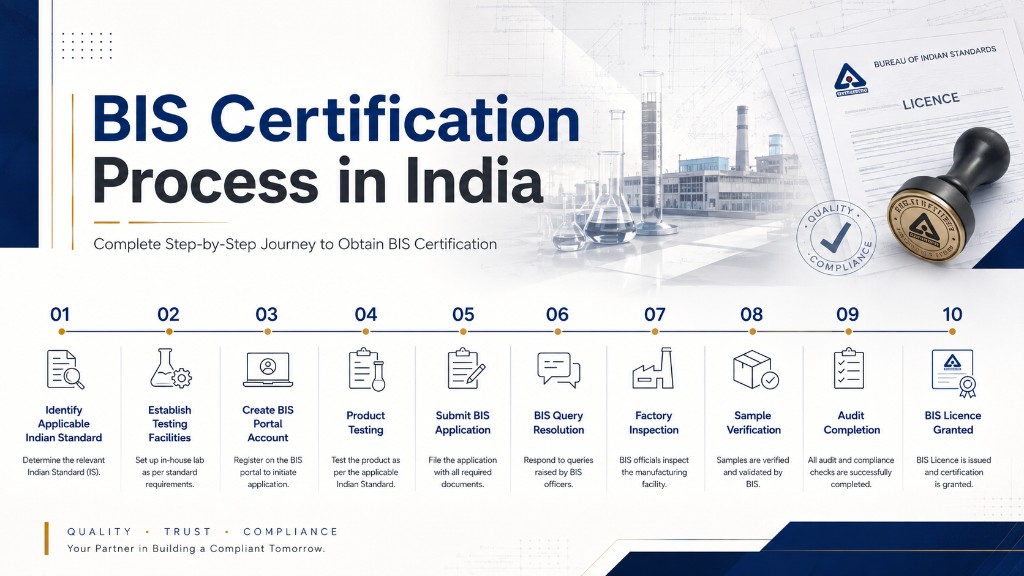
Identify the Applicable Standard: Determine the relevant Indian Standard (IS) that applies to the product.
Establish Testing Facilities: Set up an in-house laboratory that meets the requirements of the applicable standard.
Create a BIS Portal Account: Indian manufacturers must register on the BIS online portal to initiate the application.
Product Testing: Get the product tested according to the applicable Indian Standard Specifications (ISS).
Application Submission: File the BIS application along with the test report and required documents.
Query Resolution: Respond to any clarification or queries raised by BIS officials.
Factory Inspection: A BIS officer visits the manufacturing facility to verify compliance and inspect the production process.
Sample Verification: During the inspection, samples are tested in the in-house lab and sealed for re-verification by the BIS officer.
Audit Completion: Once the inspection and verification activities are completed, the audit is finalized.
Grant of Licence: If all requirements are met, BIS grants the certification licence to the manufacturer.
Sample copy of BIS Certificate Indian
Sample copy of BIS FMCS certificate
Sample copy of CRS Certificate
Documents Required for BIS Certification
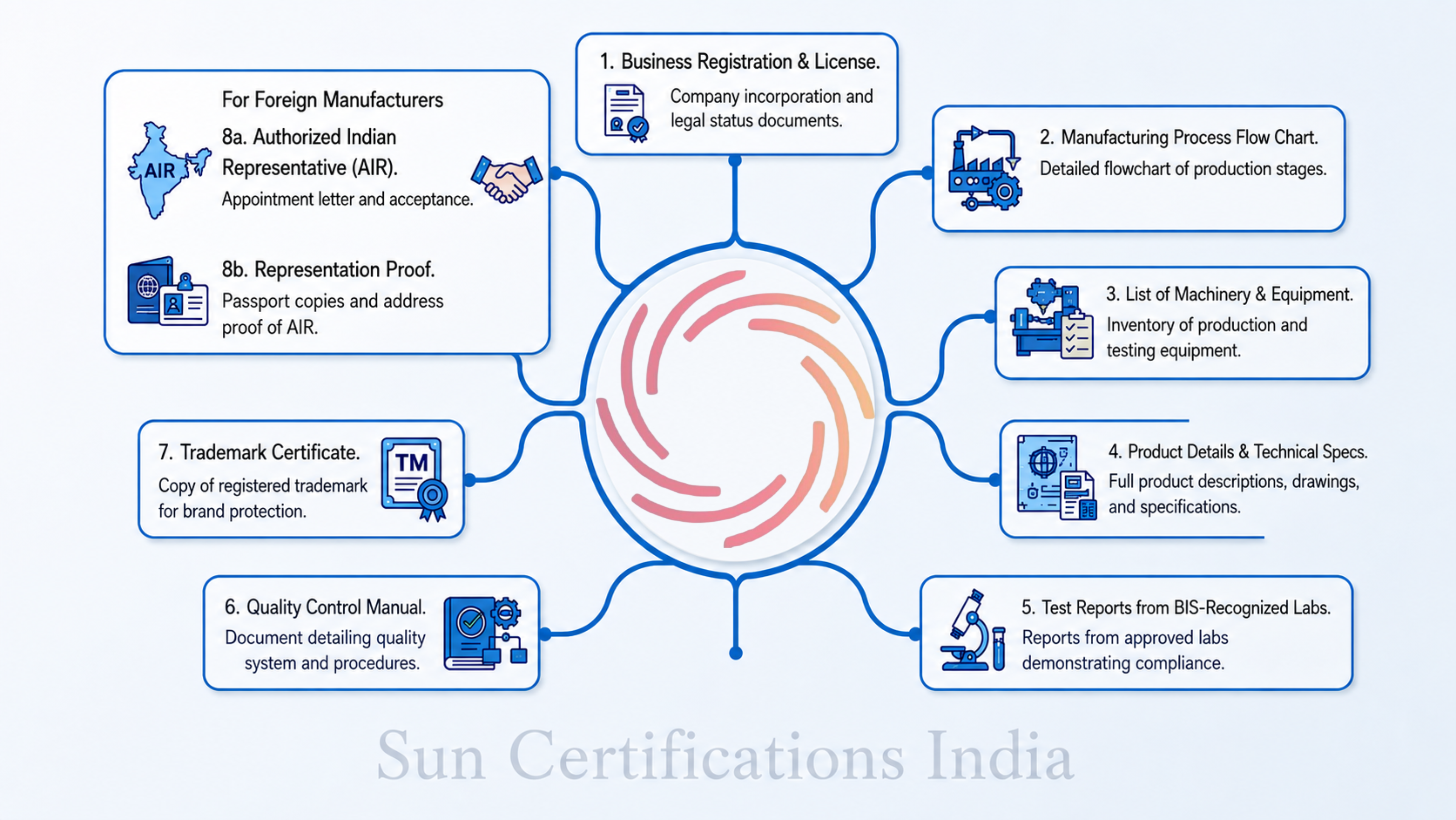
A strong documentation package ensures smooth processing. Key requirements include:
Business license or company registration documents.
Manufacturing process flow chart.
List of machinery and equipment.
Product details and technical specifications.
Test reports from BIS-recognized labs.
Quality control manual.
Trademark certificate.
For foreign manufacturers:
Appointment of an Authorized Indian Representative (AIR).
Proof of representation and identity documents.
BIS Certification Cost
BIS Certification Cost and Licence Fees
The cost of obtaining BIS certification varies depending on several factors, including the product category, the applicable Indian Standard (IS), and whether the manufacturer is based in India or overseas.
Fee Structure for BIS Registration (CRS)
Government Fee: ₹53,000 + 18% GST per test report. An additional ₹20,000 is charged for each extra test report submitted within the same application.
Testing Charges: Applicable as per laboratory rates, which vary depending on the product and testing facility.
Note: Companies registered under the MSME Act may be eligible for certain concessions on government fees.
Fee Structure for BIS Licence (ISI Certification)
Application Fee: ₹1,000
Licence Fee: ₹1,000
Audit Charges: ₹7,000 per man-day for factory inspection
Testing Charges: Based on the product and testing laboratory
Minimum Marking Fee: Varies according to the product category.
For foreign manufacturers, additional charges apply under the Foreign Manufacturers Certification Scheme (FMCS). The exact cost structure depends on the specific case and applicable requirements. See the full BIS certification cost breakdown by scheme.
Role of Authorized Indian Representative (AIR)
For foreign manufacturers, the Authorized Indian Representative (AIR) is critical.
Handles all communication with BIS.
Gathers and submits documents, then facilitates the inspection process.
Ensures compliance regarding certification, before, and after.
Must be an Indian citizen or an organization with a registered local address.
In the absence of an AIR, obtaining BIS certification for foreign companies is impossible.
A History of BIS in India
The Bureau of Indian Standards (BIS) is the National Standards Body of India. The institutional history of the Bureau may be traced to the Indian Standards Institution (ISI) which was set up in 1947 for the development and promotion of standards for products and industrial operations in India. India’s standards and conformity-assessment regime has evolved over the years from the initial ISI system to the statutory BIS regime in use today.
In 1947 the ISI was founded to support quality control systems after the country gained independence.
In 1955 the ISI mark was awarded, becoming one of the most famous quality symbols in India.
In 1986, the BIS Act was passed, replacing ISI with the Bureau of Indian Standards.
In 2016 and 2018, further amendments enriched the BIS's responsibilities, making hallmarking and product certification more thorough.
Today, BIS creates Indian Standards and does conformity assessment, product certification, hallmarking and other associated operations in a wide spectrum of sectors. Hence the present BIS framework covers much more than the classic ISI Mark and incorporates alternative certification, registration and conformity-assessment methods depending on the product and applicable regulatory requirements.
Having a BIS certification is a necessity for doing business in India. It is no longer an optional certification in business. It is crucial for business success and building trust. BIS is essential for safety and success in India. For manufacturers and importers, it offers an easy and safe business setup environment. Legal issues and fines are no longer a concern. With a BIS mark, consumer trust is guaranteed.
India is one of the biggest growing economies in the world and gaining access to sell there can help an exporter grow. No matter if you are a manufacturer in India or abroad, the BIS license is needed to manufacture or sell products in the Indian market. It's required, and it unlocks business prospects with India's growing population. It's an investment in safety, consumer trust, brand reputation, credibility, and long-term growth.
Dhruv Aggarwal
Head of Operations at Sun Certifications India
Experience: 10+ years & Handled 1000+ projects
Awarded by many Indian and International organisations











PT Quty Karunia, BIS Licensee in Vietnam
“Sun Certifications India provided excellent BIS Certification services. Their unparalleled service and sincerity gained our trust. One of the best BIS consultants in India!”

Thantawan Industries Ltd, BIS Licensee in Thailand
“Sun Certifications India supported us throughout the BIS certification process. Their responsive customer service and punctuality are exceptional. Highly recommend for hassle-free BIS certification.”

Leaderart Industries, BIS Licensee in Malaysia
“Sun Certifications India helped us acquire BIS Certification, doubling our engagement in India. Their services are fast, genuine, and up-to-date with latest BIS norms.”

Aluminium Bahrain (ALBA), BIS Licensee in Bahrain
“Excellent BIS certification support, highly reliable consultants.”

Bahrain Aluminium Manufacturing Company, BIS Licensee in Bahrain
“Smooth BIS registration process with expert consultants.”

Daiki Aluminium Japan, BIS Licensee in Japan
“Efficient BIS license assistance, great consultants.”

Trimble Navigation, BIS Licensee in USA
“Seamless BIS certification and registration support.”

Remsa Italia, BIS Licensee in Italy
“Helpful BIS consultants, simplified license process.”

Aquazzura, BIS Licensee in Italy
“We got our BIS certificate well within the timelines and at affordable prices, great work team Sun!”

PT Quty, BIS Licensee in Indonesia
“Excellent BIS registration service, highly recommended.”

Danu Vina, BIS Licensee in Vietnam
“Reliable BIS license consultants, fast process.”

Hanh My Production Company, BIS Licensee in Vietnam
“Expert BIS consultants, certification made easy.”

Sedo Vina, BIS Licensee in Vietnam
“Smooth BIS certificate registration, great support.”

Misumi Japan, BIS Licensee in Japan
“Trusted BIS consultants, quick certification process.”

Thantawan Public Industry Company, BIS Licensee in Thailand
“Professional BIS certification service, very efficient.”

Cortizo Aluminios, BIS Licensee in Spain
“Excellent BIS registration and license guidance.”

Midal Cables, BIS Licensee in Bahrain
“Expert BIS consultants, smooth certification process.”
Years Exp.
Our Clients
Success Rate
Countries Served
Our team brings 10e4+ years of experience in CDSCO and BIS compliance.
We reduce approval time by up to 40% with streamlined processes.
100% success rate with 1500+ successful registrations.
Dedicated account manager ensuring personalized service.
Leave your details below and our experts will call you back within 24 hours to discuss your regulatory compliance needs.
By submitting this form, you agree to our Privacy Policy and consent to being contacted.
Products Under BIS Certification as per Indian Standards
View This Page in Your Language