BIS Certification for Bayonet Lamp Holders – IS 1258: 2005
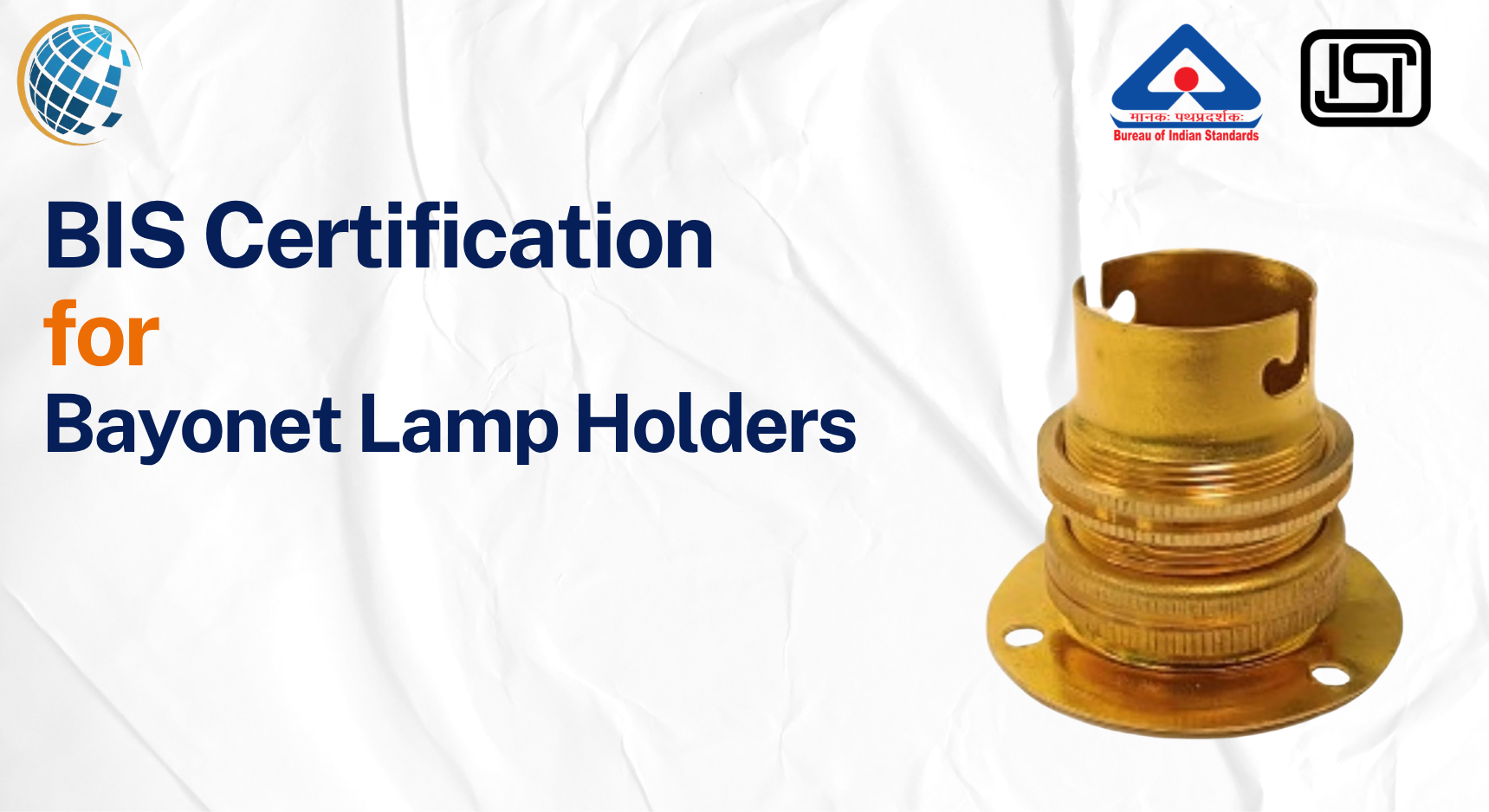
BIS Certification for Bayonet Lamp Holders ensures that these electrical fittings comply with IS 1258: 2005, focusing on safe current flow, heat resistance, and mechanical durability. Certification is required in India to prevent electrical hazards such as shocks, overheating, and fire risks in residential, commercial, and industrial lighting systems.
Bayonet lamp holders are among the most widely used electrical accessories in Indian lighting systems. Found in homes, offices, factories, and public infrastructure, these components act as the connection point between a light source and the electrical supply. While they may appear simple, their role is critical—any defect can directly expose users to electrical danger.
The Indian market for lighting accessories is vast and highly competitive, with both organized manufacturers and small-scale producers supplying products. In such an environment, maintaining consistent product reliability becomes essential. A poorly manufactured lamp holder can lead to loose connections, sparking, overheating, or even electrical fires, especially in high-load environments.
This is where BIS Certification for Bayonet Lamp Holders becomes crucial. The certification framework ensures that every unit placed in the market adheres to a defined benchmark of safety and performance. For manufacturers, importers, and distributors, obtaining a BIS License for Bayonet Lamp Holders is not just about compliance—it is about delivering dependable electrical components that perform safely over time.
Understanding BIS Certificate for Bayonet Lamp Holders - IS 1258: 2005
BIS Certification for Bayonet Lamp Holders is designed to evaluate how safely and effectively these components perform in real-world electrical conditions. Unlike passive products, lamp holders are constantly exposed to current flow, heat generation, and repeated mechanical usage. This makes them highly sensitive to design flaws and material inconsistencies.
For example, when a bulb is inserted into a bayonet holder, it requires precise alignment and secure contact points. If the internal springs or terminals are not properly engineered, the connection may become unstable, leading to intermittent current flow or sparking. Over time, this can damage both the holder and the connected appliance.
The certification process examines multiple aspects such as:
- Electrical insulation between live parts and accessible surfaces
- Heat resistance under continuous load conditions
- Mechanical durability during repeated insertion and removal cycles
- Contact reliability to prevent arcing or loose connections
The BIS Certification for Bayonet Lamp Holders acts as a structured quality checkpoint, ensuring that manufacturers follow consistent production practices. It also ensures that materials used—such as brass contacts or insulating housings—meet specific performance expectations. When you plan the licence route itself, it helps to align product-specific work with how Indian BIS operates overall — Check complete details about documentation, cost, and process etc.
Applicable BIS Standard for Bayonet Lamp Holders - IS 1258: 2005
The relevant standard governing these products is IS 1258: 2005, which outlines detailed technical requirements for bayonet-type lamp holders used in lighting installations.
Scope of IS 1258: 2005
This standard applies to:
- B22d bayonet cap lamp holders commonly used in India
- Ceiling-mounted, wall-mounted, and batten-type holders
- Lamp holders designed for domestic and commercial applications
Product Categories Covered
The standard includes variations such as:
- Pendant holders
- Angle holders
- Batten holders
- Weatherproof lamp holders
Each category must meet specific dimensional and performance criteria to ensure compatibility and safe operation.
Safety and Performance Objectives
IS 1258: 2005 focuses on:
- Preventing accidental contact with live parts
- Ensuring stable electrical connections
- Maintaining structural integrity under heat exposure
- Avoiding deformation or cracking of insulating materials
Design and Testing Principles
The standard incorporates:
- Dimensional accuracy for proper bulb fitting
- Heat resistance evaluation to simulate long usage hours
- Mechanical endurance testing for repeated operations
- Electrical safety tests to confirm insulation reliability
The BIS License for Bayonet Lamp Holders is granted only when the product consistently meets all these requirements.
Testing Requirements as per IS 1258: 2005
Testing plays a crucial role in evaluating product performance.
Safety Tests
- Insulation resistance
- Electric strength test
Performance Tests
- Contact reliability
- Current carrying capacity
Durability Tests
- Endurance under repeated use
- Heat resistance testing
Quality Verification Tests
- Dimensional accuracy
- Material consistency
All tests must be conducted in BIS-recognized laboratories to ensure validity.
Conclusion
BIS Certification for Bayonet Lamp Holders under IS 1258: 2005 plays a vital role in ensuring that these everyday electrical components perform safely and reliably. From preventing overheating to ensuring secure electrical connections, certification addresses critical risks associated with lighting accessories.
For manufacturers, obtaining a BIS License for Bayonet Lamp Holders is not just a regulatory step but a commitment to quality and safety. Whether you are a domestic producer or an importer, securing a BIS Certificate for Bayonet Lamp Holders strengthens your market position, builds trust, and ensures compliance with Indian standards.
FAQs – BIS Certification for Bayonet Lamp Holders - IS 1258: 2005
1. How does contact design affect BIS certification approval for Bayonet Lamp Holders?
The internal contact design plays a major role in BIS Certification for Bayonet Lamp Holders because it directly affects electrical continuity and safety. If the contact springs or terminals are not properly aligned or lack sufficient pressure, the connection between the bulb and holder may become loose. This can lead to sparking or intermittent current flow. During testing, such defects are easily identified, which is why manufacturers must ensure precise engineering and consistent assembly quality.
2. Can changes in raw materials impact an existing BIS License for Bayonet Lamp Holders?
Yes, any significant change in raw materials—such as switching insulating compounds or metal contact materials—can affect compliance. The BIS License for Bayonet Lamp Holders is granted based on approved material specifications. If a manufacturer changes materials without proper evaluation, the product may no longer meet required performance standards. In such cases, re-testing or prior approval is necessary to maintain compliance and avoid penalties.
3. Why is dimensional accuracy important in BIS certification for Bayonet Lamp Holders?
Dimensional accuracy ensures that the lamp holder fits perfectly with standard bayonet cap bulbs. If the dimensions are slightly off, the bulb may not lock properly, leading to loose connections or difficulty in installation. BIS testing checks these tolerances carefully. Improper fitting can also cause uneven electrical contact, increasing the risk of overheating or failure during usage.
4. What role does packaging and labelling play in BIS compliance?
Packaging and labeling are not just marketing elements—they are part of compliance requirements. Each certified product must display the ISI mark along with the license number and relevant details. Incorrect or missing labeling can result in non-compliance, even if the product itself meets technical standards. Proper packaging also ensures that the product reaches the end user without damage, maintaining its tested quality.
5. How does BIS certification help in large-scale electrical projects?
In large-scale projects such as residential complexes, commercial buildings, or infrastructure developments, certified components are often mandatory. Contractors and project consultants prefer products with BIS Certification for Bayonet Lamp Holders because they reduce the risk of electrical failures. Using certified products ensures uniform quality across installations, which is essential for long-term safety and maintenance efficiency.
6. What is the importance of endurance testing in the certification process?
Endurance testing evaluates how well the lamp holder performs under repeated usage. Since bulbs are frequently inserted and removed, the holder must withstand multiple cycles without losing functionality. This test ensures that the contact mechanism remains stable and does not degrade quickly. A product that fails endurance testing may not be suitable for real-world conditions where frequent handling is common.
7. Can a BIS-certified Bayonet Lamp Holder be exported to other countries?
While BIS Certification for Bayonet Lamp Holders is specifically designed for the Indian market, it can enhance acceptance in other regions as well. Many international buyers view BIS certification as an indicator of structured manufacturing and quality control. However, exporters must still comply with the destination country's standards, which may require additional certifications or testing.
8. How do environmental factors influence product testing for lamp holders?
Environmental factors such as humidity, temperature variation, and dust exposure can affect the performance of lamp holders. During testing, products may be subjected to conditions that simulate real-world environments. This ensures that the holder maintains insulation integrity and mechanical strength even in challenging conditions. Manufacturers must consider these factors during product design to meet certification requirements.
9. What is the significance of in-house quality control for maintaining certification?
In-house quality control systems are essential for maintaining consistency in production. Once the BIS License for Bayonet Lamp Holders is granted, manufacturers are expected to regularly monitor product quality through internal testing. This helps identify defects early and prevents non-compliant products from reaching the market. Strong quality control also ensures smooth audits and continued certification validity.
10. How can manufacturers reduce rejection rates during BIS certification?
Manufacturers can reduce rejection rates by conducting pre-certification testing, maintaining strict raw material checks, and ensuring proper staff training. Understanding the technical requirements of IS 1258: 2005 in detail helps avoid common mistakes. Additionally, maintaining clear documentation and following standardized production processes significantly improves the chances of successful certification on the first attempt.
Many of our users also read
This compliance advisory was vetted by our Senior Consultant (Enforcement & Vigilance), a former BIS Director (Enforcement). He specializes in post-certification compliance, helping companies navigate surveillance audits and legal adherence to BIS mandates.
Dhruv Aggarwal
Head of Operations at Sun Certifications India
Experience: 10+ years & Handled 1000+ projects
Awarded by many Indian and International organisations








PT Quty Karunia, BIS Licensee in Vietnam
“Sun Certifications India provided excellent BIS Certification services. Their unparalleled service and sincerity gained our trust. One of the best BIS consultants in India!”

Thantawan Industries Ltd, BIS Licensee in Thailand
“Sun Certifications India supported us throughout the BIS certification process. Their responsive customer service and punctuality are exceptional. Highly recommend for hassle-free BIS certification.”

Leaderart Industries, BIS Licensee in Malaysia
“Sun Certifications India helped us acquire BIS Certification, doubling our engagement in India. Their services are fast, genuine, and up-to-date with latest BIS norms.”

Aluminium Bahrain (ALBA), BIS Licensee in Bahrain
“Excellent BIS certification support, highly reliable consultants.”

Bahrain Aluminium Manufacturing Company, BIS Licensee in Bahrain
“Smooth BIS registration process with expert consultants.”

Daiki Aluminium Japan, BIS Licensee in Japan
“Efficient BIS license assistance, great consultants.”

Trimble Navigation, BIS Licensee in USA
“Seamless BIS certification and registration support.”

Remsa Italia, BIS Licensee in Italy
“Helpful BIS consultants, simplified license process.”

Aquazzura, BIS Licensee in Italy
“We got our BIS certificate well within the timelines and at affordable prices, great work team Sun!”

PT Quty, BIS Licensee in Indonesia
“Excellent BIS registration service, highly recommended.”

Danu Vina, BIS Licensee in Vietnam
“Reliable BIS license consultants, fast process.”

Hanh My Production Company, BIS Licensee in Vietnam
“Expert BIS consultants, certification made easy.”

Sedo Vina, BIS Licensee in Vietnam
“Smooth BIS certificate registration, great support.”

Misumi Japan, BIS Licensee in Japan
“Trusted BIS consultants, quick certification process.”

Thantawan Public Industry Company, BIS Licensee in Thailand
“Professional BIS certification service, very efficient.”

Cortizo Aluminios, BIS Licensee in Spain
“Excellent BIS registration and license guidance.”

Midal Cables, BIS Licensee in Bahrain
“Expert BIS consultants, smooth certification process.”
Years Exp.
Our Clients
Success Rate
Countries Served
Our team brings 10e4+ years of experience in CDSCO and BIS compliance.
We reduce approval time by up to 40% with streamlined processes.
100% success rate with 1500+ successful registrations.
Dedicated account manager ensuring personalized service.
Leave your details below and our experts will call you back within 24 hours to discuss your regulatory compliance needs.
By submitting this form, you agree to our Privacy Policy and consent to being contacted.