BIS Certification for Toys in India – Complete Guide to IS 9873 & IS 15644
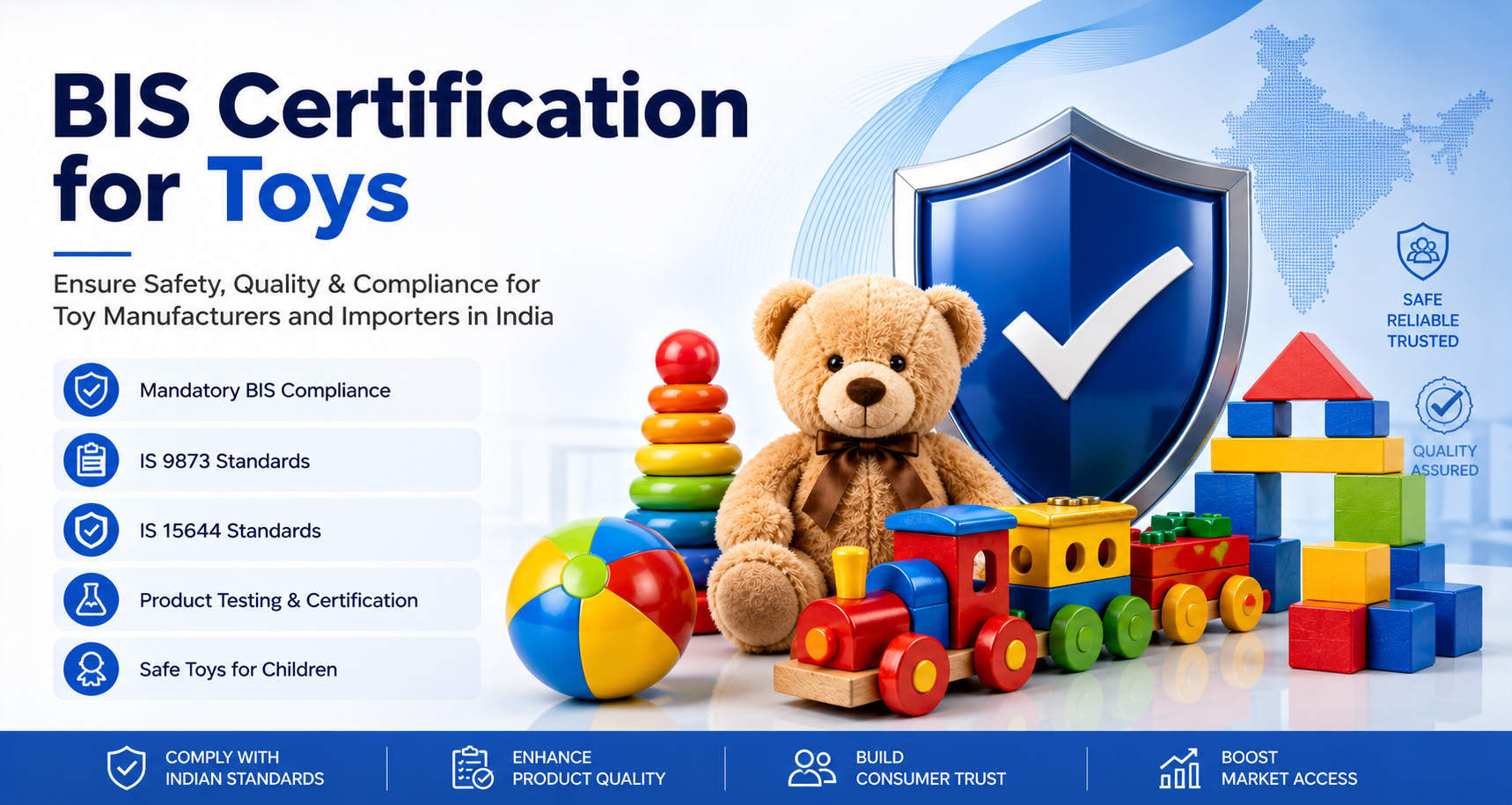
Toy safety in India is regulated through the IS 9873 series for non-electric toys and IS 15644:2006 for electric toys. These standards establish requirements related to mechanical safety, flammability, toxic substances, electrical protection, chemical migration, and structural durability to ensure toys sold for children are safe during normal and foreseeable use.
Toys are designed to entertain, educate, and support child development, but they also represent one of the most safety-sensitive product categories in the consumer market. Unlike household products used under supervision by adults, toys are handled directly by children who may pull, twist, bite, throw, or misuse products during play. Because of this, toy safety regulations must evaluate risks far beyond normal product performance.
India's toy market has grown rapidly in recent years with the rise of educational products, STEM learning kits, remote-controlled vehicles, battery-operated toys, sensory toys, activity structures, slime kits, plush products, and digitally interactive learning systems. This growth has increased the need for stronger safety controls covering physical hazards, toxic materials, overheating, sharp edges, and unsafe chemicals.
To regulate this sector, India introduced mandatory quality requirements under the Toys (Quality Control) framework, requiring toys for children below 14 years of age to comply with specified Indian Standards and carry the ISI mark under BIS Certification.
The BIS Certification for Toys applies to both:
- Non-electric toys under the IS 9873 series
- Electric toys under IS 15644:2006
These standards collectively evaluate:
- Mechanical and physical safety
- Flammability resistance
- Chemical migration limits
- Electrical safety
- Structural strength
- Battery safety
- Toxic substance restrictions
- Activity toy stability
The BIS Certificate for Toys is therefore not only a compliance requirement but also a critical safety assurance mechanism for manufacturers, importers, distributors, e-commerce sellers, and toy brands operating in India.
Understanding BIS Certification for Toys - IS 9873 & IS 15644
Children interact with toys differently depending on age, developmental stage, and play behaviour. An infant may chew or swallow parts of a toy, while older children may apply force, climb on structures, or repeatedly impact products during play.
Because of these varied interactions, toy safety standards in India are divided into multiple technical parts, each addressing a specific category of risk.
The BIS Certificate for Toys evaluates whether toys remain safe during:
- Normal play
- Rough handling
- Accidental misuse
- Environmental exposure
- Long-duration usage
For non-electric toys, the primary focus is on:
- Choking prevention
- Structural durability
- Sharp edge elimination
- Material safety
- Flammability control
- Chemical migration limits
For electric toys, additional evaluation includes:
- Electrical insulation
- Temperature rise control
- Leakage current safety
- Battery protection
- Fire hazard reduction
The BIS License for Toys ensures that products are designed and manufactured in a way that minimizes foreseeable risks to children.
For example:
- A painted toy may contain excessive lead content in coatings.
- A battery-operated toy may overheat during charging.
- A plush toy may ignite rapidly if exposed to flame.
- A climbing structure may collapse under load.
- A toy vehicle wheel may detach and create a choking hazard.
The BIS certification framework addresses each of these risks through separate standards and laboratory testing procedures.
Applicable BIS Standards for Toys
To ensure the safety, quality, and reliability of toys available in the Indian market, the Bureau of Indian Standards (BIS) has established a comprehensive framework of Indian Standards for toy safety. Currently, BIS has published 10 Indian Standards covering various aspects of toy design, manufacturing, performance, and safety.
The mandatory BIS standards for toys include:
IS 9873 (Part 1):2019 / ISO 8124-1:2018
This standard specifies the mechanical and physical safety requirements for toys, ensuring that products are designed and manufactured to minimize risks such as choking, sharp edges, entrapment, and other physical hazards.
IS 9873 (Part 2):2017 / ISO 8124-2
This standard lays down flammability requirements for toys, helping to reduce fire-related risks and ensuring safer use by children.
IS 9873 (Part 3):2020 / ISO 8124-3
This standard regulates the migration of certain toxic elements from toy materials and coatings, protecting children from exposure to harmful substances.
IS 9873 (Part 4):2017 / ISO 8124-4
This standard covers safety requirements for activity toys such as swings, slides, and similar equipment intended for domestic use by children.
IS 9873 (Part 7):2017 / ISO 8124-7
This standard specifies safety requirements and test methods for finger paints used by children, ensuring that the products are safe and non-toxic.
IS 9873 (Part 9):2017
This standard addresses the permissible limits of phthalates in toys and children's products, helping to safeguard children from potentially harmful chemicals.
IS 15644:2006 / IEC 62115
This standard specifies safety requirements for electric toys, including electrical, thermal, and mechanical aspects, ensuring safe operation during intended use.
Compliance with these BIS standards is essential for obtaining BIS Certification for Toys and demonstrating conformity with India's toy safety regulations. Manufacturers and importers must ensure that their products meet the applicable requirements before entering the Indian market.
Testing Requirements for BIS Certification of Toys - IS 9873 Series & IS 15644
Testing for toys must be conducted in BIS recognized laboratories according to applicable Indian Standards.
Mechanical Safety Tests
These tests evaluate whether toys can withstand physical handling without becoming hazardous.
Important Tests
- Drop testing
- Compression testing
- Torque testing
- Tension testing
- Flexure testing
- Bite testing
Purpose
These tests help identify:
- Small detachable parts
- Sharp edges
- Weak structural areas
- Breakage risks
Flammability Tests
Flammability testing evaluates how quickly toy materials ignite and spread flames.
Important Tests
- Flame spread analysis
- Surface ignition testing
- Burn rate testing
Purpose
These tests help reduce fire-related injuries in fabric and plush toys.
Chemical Safety Tests
Chemical testing evaluates toxic substance migration from toy materials.
Important Tests
- Heavy metal migration analysis
- Lead content testing
- Cadmium testing
- Phthalate testing
Purpose
These tests help prevent harmful chemical exposure during mouthing or prolonged contact.
Electrical Safety Tests
Electric toys undergo additional testing for electrical hazards.
Important Tests
- Leakage current testing
- Insulation resistance testing
- Heating tests
- Battery safety analysis
- Abnormal operation testing
Purpose
These tests help prevent:
- Electric shock
- Burns
- Overheating
- Fire hazards
Structural and Stability Tests
Activity toys and ride-on toys require stability evaluation.
Important Tests
- Static load testing
- Dynamic load testing
- Anchorage strength testing
- Stability analysis
Purpose
These tests help prevent falls and structural collapse during use.
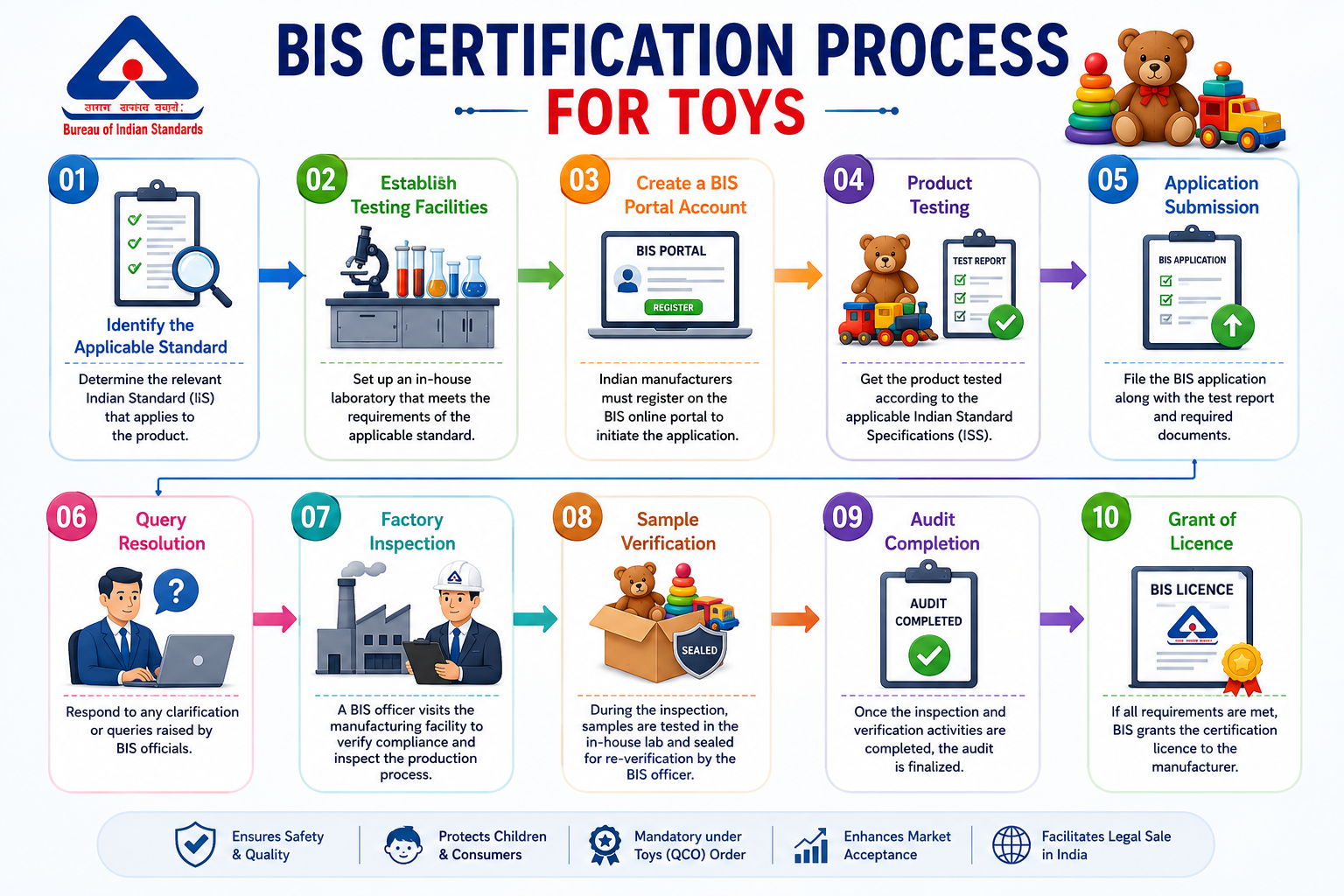
BIS Certification Process for Toys
Conclusion
The BIS Certification for Toys plays a critical role in improving child safety across the Indian toy market. Toys today involve a combination of mechanical structures, electrical systems, coatings, plastics, textiles, and interactive components, making safety evaluation far more complex than simple visual inspection.
The IS 9873 series and IS 15644:2006 collectively establish a comprehensive compliance framework covering physical safety, flammability, toxic substances, electrical protection, structural durability, and chemical restrictions. These standards help ensure that toys remain safe during real-world child interaction and foreseeable misuse conditions.
Manufacturers, importers, distributors, and private label brands dealing in toys must carefully evaluate all applicable standards depending on toy design, materials, and functionality. A valid BIS Certificate for Toys not only fulfils Indian regulatory requirements but also strengthens consumer confidence, product reliability, retail acceptance, and long-term brand credibility.
FAQs – BIS License for Toys in India - IS 9873 & IS 15644
1. Why is BIS certification important for toys sold in India?
BIS certification is important because toys are directly used by children, who are more vulnerable to injuries and health risks caused by unsafe products. The certification framework helps evaluate mechanical safety, chemical safety, electrical protection, flammability resistance, and structural durability before toys enter the market. It also helps manufacturers and importers demonstrate compliance with Indian toy safety regulations.
2. Which toys require BIS certification under Indian regulations?
Almost all toys intended for children below 14 years of age require BIS certification before being sold in India. This includes both electric and non-electric toys such as dolls, puzzles, ride-on toys, educational toys, remote-controlled toys, battery-operated toys, construction kits, activity toys, and plush toys. Different toy categories may require compliance with different BIS standards.
3. What is the difference between IS 9873 and IS 15644 standards?
The IS 9873 series mainly applies to non-electric toys and covers areas such as mechanical safety, flammability, toxic elements, activity toys, finger paints, and phthalate restrictions. IS 15644:2006 specifically applies to electric toys and focuses on electrical safety aspects including insulation, overheating protection, leakage current, battery safety, and protection against electric shock during toy usage.
4. Can one toy require compliance with multiple BIS standards?
Yes, many toys require compliance with multiple BIS standards depending on their materials, design, and functionality. For example, a battery-operated plush toy may require IS 9873 Part 1 for mechanical safety, Part 2 for flammability, Part 3 for chemical migration, and IS 15644 for electrical safety. BIS compliance is therefore often multi-layered for complex toy products.
5. What are the major safety risks evaluated during toy testing?
Toy testing evaluates various hazards that may arise during real-world child interaction. These include choking risks from detachable parts, sharp edges, toxic chemical migration, overheating, fire hazards, battery leakage, electrical shock, weak structural components, and instability in activity toys. Testing helps identify these risks before products are released into the consumer market.
6. Why is heavy metal testing important for children's toys?
Children frequently place toys in their mouths, especially infants and toddlers. If toy paints, coatings, plastics, or decorative finishes contain excessive levels of lead, cadmium, mercury, or other toxic elements, harmful chemicals may enter the child's body. Heavy metal testing under IS 9873 Part 3 helps ensure toy materials remain within safe permissible limits.
7. Are imported toys also required to obtain BIS certification?
Yes, imported toys must also comply with Indian BIS regulations before they can be sold in the Indian market. Customs authorities may stop shipments of non-compliant toys at ports if proper certification and labeling requirements are not fulfilled. Importers are responsible for ensuring foreign-manufactured toys meet all applicable Indian safety standards.
8. What happens if a toy product fails BIS laboratory testing?
If a toy fails laboratory testing, the manufacturer must identify the reason for non-compliance and implement corrective modifications. Common failures may involve weak structural parts, excessive heavy metal content, overheating, sharp edges, or unsafe battery compartments. Revised product samples must then undergo re-testing before BIS certification approval can be considered.
9. Why are factory inspections conducted during BIS certification?
Factory inspections help verify whether manufacturers can consistently produce toys that meet applicable safety standards. BIS officials review production systems, quality control procedures, testing facilities, calibration records, raw material management, and traceability systems. The inspection process ensures that certified toys maintain consistent quality across commercial production batches and not just in sample testing.
10. How does BIS certification help toy manufacturers and brands?
BIS certification helps toy businesses improve regulatory compliance, consumer confidence, retail acceptance, and long-term brand credibility. Certified products are generally viewed as safer and more reliable by parents, retailers, distributors, and e-commerce platforms. The certification also reduces the risk of product recalls, legal complications, customs delays, and market restrictions arising from non-compliance.
Related Resources
Many of our users also read
Our Principal Regulatory Consultant, a former BIS Deputy Director General (Standardization). With over 30 years of service, he specializes in interpreting the Bureau of Indian Standards Act and simplifying complex certification workflows for Indian manufacturers.
Dhruv Aggarwal
Head of Operations at Sun Certifications India
Experience: 10+ years & Handled 1000+ projects
Awarded by many Indian and International organisations








PT Quty Karunia, BIS Licensee in Vietnam
“Sun Certifications India provided excellent BIS Certification services. Their unparalleled service and sincerity gained our trust. One of the best BIS consultants in India!”

Thantawan Industries Ltd, BIS Licensee in Thailand
“Sun Certifications India supported us throughout the BIS certification process. Their responsive customer service and punctuality are exceptional. Highly recommend for hassle-free BIS certification.”

Leaderart Industries, BIS Licensee in Malaysia
“Sun Certifications India helped us acquire BIS Certification, doubling our engagement in India. Their services are fast, genuine, and up-to-date with latest BIS norms.”

Aluminium Bahrain (ALBA), BIS Licensee in Bahrain
“Excellent BIS certification support, highly reliable consultants.”

Bahrain Aluminium Manufacturing Company, BIS Licensee in Bahrain
“Smooth BIS registration process with expert consultants.”

Daiki Aluminium Japan, BIS Licensee in Japan
“Efficient BIS license assistance, great consultants.”

Trimble Navigation, BIS Licensee in USA
“Seamless BIS certification and registration support.”

Remsa Italia, BIS Licensee in Italy
“Helpful BIS consultants, simplified license process.”

Aquazzura, BIS Licensee in Italy
“We got our BIS certificate well within the timelines and at affordable prices, great work team Sun!”

PT Quty, BIS Licensee in Indonesia
“Excellent BIS registration service, highly recommended.”

Danu Vina, BIS Licensee in Vietnam
“Reliable BIS license consultants, fast process.”

Hanh My Production Company, BIS Licensee in Vietnam
“Expert BIS consultants, certification made easy.”

Sedo Vina, BIS Licensee in Vietnam
“Smooth BIS certificate registration, great support.”

Misumi Japan, BIS Licensee in Japan
“Trusted BIS consultants, quick certification process.”

Thantawan Public Industry Company, BIS Licensee in Thailand
“Professional BIS certification service, very efficient.”

Cortizo Aluminios, BIS Licensee in Spain
“Excellent BIS registration and license guidance.”

Midal Cables, BIS Licensee in Bahrain
“Expert BIS consultants, smooth certification process.”
Years Exp.
Our Clients
Success Rate
Countries Served
Our team brings 10e4+ years of experience in CDSCO and BIS compliance.
We reduce approval time by up to 40% with streamlined processes.
100% success rate with 1500+ successful registrations.
Dedicated account manager ensuring personalized service.
Leave your details below and our experts will call you back within 24 hours to discuss your regulatory compliance needs.
By submitting this form, you agree to our Privacy Policy and consent to being contacted.