BIS Certification for Braided Nylon Ropes for Mountaineering Purposes – IS 6590:1972
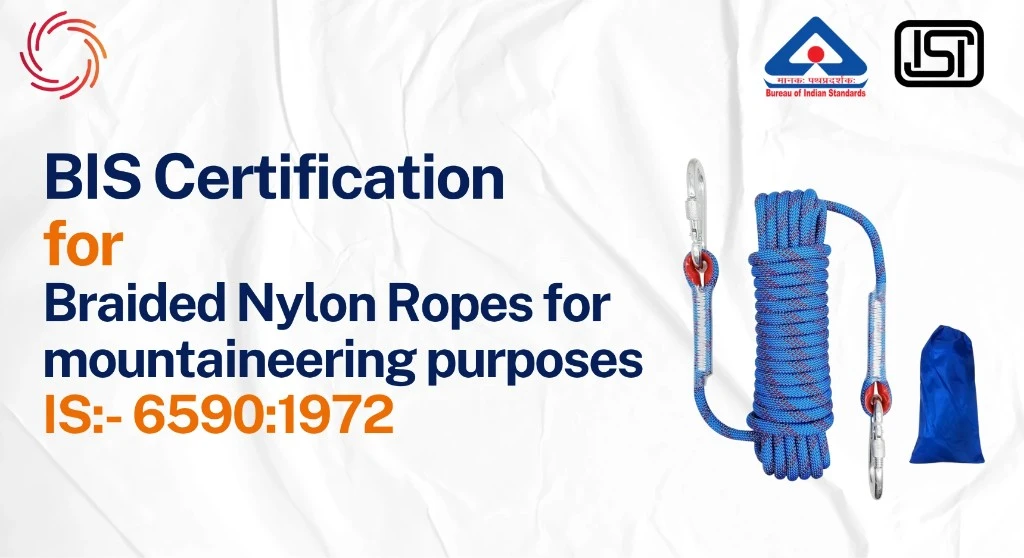
Braided nylon ropes used for mountaineering activities in India are evaluated under IS 6590:1972 to verify their strength, shock absorption capability, construction quality, and safety performance during climbing operations. A BIS Certificate for Braided Nylon Ropes for Mountaineering Purposes confirms that the rope is capable of handling high-load outdoor conditions while reducing risks associated with rope failure during climbing, rescue, trekking, and adventure activities.
Mountaineering equipment is directly connected to human safety, and among all climbing accessories, ropes are considered one of the most critical life-support components. Whether used for high-altitude climbing, rock climbing, glacier travel, rescue operations, trekking expeditions, military exercises, or industrial rope access systems, braided nylon ropes are expected to perform reliably under extreme physical stress.
Unlike ordinary utility ropes, mountaineering ropes are exposed to dynamic loading conditions. A climber's weight, sudden falls, friction against rock surfaces, moisture exposure, temperature variation, and repeated bending all place continuous pressure on the rope structure. If the rope lacks proper tensile strength or energy absorption capability, even a minor defect can lead to severe accidents.
The Indian adventure tourism sector has expanded significantly over the years. Trekking clubs, climbing institutions, military training centres, disaster response teams, and outdoor sports organizations increasingly rely on high-performance climbing ropes. This growing demand has also increased the importance of standardized quality control systems.
The BIS Certification for Braided Nylon Ropes for Mountaineering Purposes plays a major role in ensuring that ropes supplied in the Indian market meet recognized safety and performance benchmarks. IS 6590 : 1972 establishes technical requirements for rope construction, load-bearing capacity, elongation characteristics, braid quality, dimensional consistency, and durability. These parameters are essential because the rope must function safely under unpredictable outdoor conditions.
Manufacturing defects such as weak braiding, uneven yarn tension, poor fibre quality, inconsistent diameter, or inadequate shock absorption can significantly reduce rope reliability. In climbing operations, such failures may lead to serious injury or fatal incidents. The BIS License for Braided Nylon Ropes for Mountaineering Purposes therefore acts as an important quality assurance mechanism for manufacturers, importers, and suppliers.
For institutional buyers such as mountaineering institutes, government rescue agencies, defence organizations, and industrial safety contractors, certified products provide greater confidence in operational safety. Certification also improves product credibility in competitive markets where users prioritize equipment reliability over price alone.
The BIS Licence for Braided Nylon Ropes for Mountaineering Purposes is therefore not merely a regulatory formality. It represents technical compliance, manufacturing consistency, and safety accountability for products used in high-risk environments.
Understanding BIS Certification for Braided Nylon Ropes for Mountaineering Purposes - IS 6590:1972
Braided nylon ropes used in climbing applications must withstand conditions that ordinary textile products never encounter. During mountaineering, ropes experience dynamic loads caused by sudden falls, body movement, anchor tension, and environmental stress. Even slight weaknesses in construction may compromise climber safety.
The BIS Certification for Braided Nylon Ropes for Mountaineering Purposes focuses on ensuring that the rope performs reliably under these demanding conditions.
Why Standardization is Important for Climbing Ropes
A climbing rope functions as a protective system rather than a simple load-bearing product. It must:
- Absorb impact energy
- Maintain flexibility
- Resist sudden tension
- Minimize breakage risk
- Withstand abrasion
- Retain structural integrity after repeated use
Without proper manufacturing controls, ropes may develop hidden weaknesses that are difficult to identify visually. A rope may appear normal externally while containing internal fibre damage or uneven braid construction.
The BIS Certificate for Braided Nylon Ropes for Mountaineering Purposes helps establish consistency in:
- Fibre quality
- Rope construction
- Diameter accuracy
- Breaking strength
- Shock absorption capability
- Surface finish
- Load performance
Product-Specific Safety Concerns
Mountaineering ropes operate in environments where equipment failure can directly affect human life. Important risks include:
Sudden Fall Impact
- During climbing falls, ropes experience sharp dynamic forces. Poor-quality ropes may fail to absorb impact properly.
Abrasion Against Rocks
- Continuous rubbing against rough surfaces may damage weak rope structures.
Moisture Exposure
- Rain, snow, glacier environments, and humidity can affect rope flexibility and performance.
UV and Environmental Degradation
- Outdoor exposure can weaken fibres over time if material quality is inadequate.
Repeated Flexing
- Frequent coiling, knotting, and bending place long-term stress on the rope braid.
The BIS Certification for Braided Nylon Ropes for Mountaineering Purposes helps reduce these risks through structured quality evaluation.
Role of BIS Standards in Rope Manufacturing
IS 6590 : 1972 provides technical guidance for manufacturers regarding:
- Rope design parameters
- Material specifications
- Mechanical performance
- Dimensional tolerances
- Safety verification methods
This helps maintain uniform quality across different production batches and suppliers.
Consumer and Institutional Protection
Adventure sports participants, rescue personnel, industrial workers, and military users often rely entirely on climbing ropes during operations. Certified ropes reduce uncertainty regarding product reliability.
The BIS License for Braided Nylon Ropes for Mountaineering Purposes helps buyers identify products manufactured under controlled quality systems with verified performance characteristics.
Applicable BIS Standard for Braided Nylon Ropes for Mountaineering Purposes - IS 6590:1972
IS 6590:1972 – Scope and Technical Framework
IS 6590:1972 specifies technical requirements for braided nylon ropes designed specifically for mountaineering and climbing-related applications.
The standard focuses on ensuring that ropes maintain sufficient strength, flexibility, energy absorption capability, and durability for safe use in outdoor and high-risk environments.
Products Covered Under IS 6590:1972
The standard generally applies to:
- Braided nylon climbing ropes
- Mountaineering ropes
- Safety climbing ropes
- Expedition ropes
- Rescue ropes
- Trekking support ropes
- Adventure sports ropes
These ropes are commonly used by:
- Mountaineering institutes
- Trekking organizations
- Adventure sports operators
- Defence training centres
- Industrial safety teams
- Search and rescue units
Major Technical Objectives of IS 6590:1972
- Strength Verification – The rope must tolerate heavy tensile loads without structural failure.
- Controlled Elongation – Proper stretch characteristics are important for absorbing fall energy while maintaining user control.
- Uniform Braiding Construction – The braid pattern should remain consistent throughout the rope length to prevent weak points.
- Durability under Outdoor Conditions – The rope must remain functional despite environmental exposure and repeated use.
- Dimensional Stability – Consistent diameter and construction improve compatibility with climbing equipment and knots.
Construction and Design Principles
IS 6590:1972 also considers important construction-related parameters such as:
- Nylon yarn quality
- Braid tightness
- Rope flexibility
- Core and sheath consistency
- Surface smoothness
- Knot handling capability
Proper construction improves both operational safety and rope lifespan.
Testing Requirements as per IS 6590:1972
Testing is one of the most important parts of the BIS Certification for Braided Nylon Ropes for Mountaineering Purposes because climbing ropes must perform under physically demanding conditions.
Testing must be conducted in laboratories recognized by the Bureau of Indian Standards to verify compliance with IS 6590 : 1972.
Tensile Strength Test
This test measures the maximum force the rope can withstand before breaking.
The test evaluates:
- Load-bearing capability
- Structural reliability
- Safety margin during climbing operations
A rope with inadequate tensile strength may fail during falls or rescue operations.
Elongation Test
Mountaineering ropes must stretch within controlled limits to absorb shock loads effectively.
This test verifies:
- Extension characteristics
- Shock absorption performance
- Dynamic load response
Excessive elongation may reduce control, while insufficient elongation may increase impact force on climbers.
Knot Performance Test
Knots create concentrated stress areas within ropes. Testing evaluates whether the rope maintains sufficient strength after knot formation.
This is important because ropes are frequently tied during climbing and rescue activities.
Abrasion Resistance Test
The rope surface is evaluated for resistance against friction and wear caused by:
- Rock surfaces
- Climbing equipment
- Repeated movement
- Outdoor terrain
Strong abrasion resistance improves operational life.
Diameter and Construction Verification
Laboratories inspect:
- Rope diameter
- Braiding consistency
- Surface finish
- Structural uniformity
Inconsistent construction may create weak sections within the rope.
Moisture and Environmental Resistance Evaluation
Outdoor ropes are exposed to rain, snow, humidity, and varying temperatures. Environmental testing helps determine whether rope performance remains stable under such conditions.
Quality Verification Procedures
Manufacturers holding a BIS Licence for Braided Nylon Ropes for Mountaineering Purposes are expected to maintain regular production quality checks through:
- Batch inspection
- Internal laboratory testing
- Raw material verification
- Process monitoring
- Traceability systems
Conclusion
Braided nylon ropes used for mountaineering purposes are specialized safety products designed to perform under demanding physical and environmental conditions. Because these ropes directly support climber safety, manufacturing quality and performance consistency are extremely important.
The BIS Certification for Braided Nylon Ropes for Mountaineering Purposes under IS 6590 : 1972 helps verify that the rope meets recognized standards for tensile strength, elongation behaviour, braid quality, durability, and operational safety. Through laboratory testing, production inspection, and technical compliance evaluation, manufacturers can demonstrate that their products are suitable for climbing, rescue, trekking, and safety applications.
Obtaining a BIS Certificate for Braided Nylon Ropes for Mountaineering Purposes also strengthens market credibility and supports institutional procurement opportunities. Whether for adventure tourism, defence operations, industrial rescue work, or professional climbing applications, the BIS License for Braided Nylon Ropes for Mountaineering Purposes reflects a strong commitment to product reliability, user safety, and responsible manufacturing practices in India.
FAQs – BIS Certification for Braided Nylon Ropes for Mountaineering Purposes - IS 6590:1972
1. Why are mountaineering ropes treated differently from ordinary utility ropes?
Mountaineering ropes are designed to protect human life during climbing and rescue activities. Unlike normal ropes, they must absorb sudden fall impact, tolerate repeated stress, and remain reliable under harsh outdoor conditions. IS 6590:1972 establishes technical requirements specifically for these demanding applications.
2. How does rope elongation affect climber safety during mountaineering operations?
Controlled elongation helps reduce the force generated during a climber's fall. A rope that stretches properly can absorb impact energy more effectively. However, excessive stretching may reduce stability and control. BIS testing evaluates elongation behaviour to ensure balanced performance during climbing operations.
3. Why is abrasion resistance important for braided nylon climbing ropes?
Climbing ropes frequently rub against rocks, anchors, metal equipment, and rough surfaces. Weak abrasion resistance can damage the rope exterior and reduce overall strength. Abrasion testing under BIS Certification for Braided Nylon Ropes for Mountaineering Purposes helps verify long-term durability during outdoor usage.
4. Can poor-quality rope braiding reduce the overall safety of mountaineering equipment?
Yes. Uneven or loose braiding may create weak points inside the rope structure. Under heavy tension or sudden impact, these weak areas may fail earlier than expected. IS 6590:1972 includes construction-related requirements to improve structural consistency and operational reliability.
5. Why do rescue teams and defence organizations prefer certified climbing ropes?
Professional rescue and defence operations often occur in dangerous environments where equipment reliability is critical. Certified ropes provide greater confidence regarding strength, durability, and safety performance. A BIS License for Braided Nylon Ropes for Mountaineering Purposes demonstrates that the product has undergone standardized technical evaluation.
6. What factors influence the bis certification cost for Braided Nylon Ropes for Mountaineering Purposes?
The bis certification cost for Braided Nylon Ropes for Mountaineering Purposes depends on laboratory testing scope, rope variants, manufacturing size, factory inspection requirements, and compliance readiness. Additional testing for different rope specifications may also increase the overall certification expense.
7. Why is tensile strength testing essential for mountaineering ropes?
Tensile strength testing measures how much load the rope can withstand before failure. Since climbing ropes must support human weight and sudden dynamic forces, this test is critical for evaluating safety performance. Weak ropes may become hazardous during climbing or rescue operations.
8. What are the common bis certification documents for Braided Nylon Ropes for Mountaineering Purposes?
Manufacturers usually need factory registration records, machinery details, manufacturing process information, product specifications, raw material data, internal test reports, and quality management documents. Proper bis certificate documents for Braided Nylon Ropes for Mountaineering Purposes help reduce approval delays.
9. How does BIS certification help buyers identify reliable climbing rope manufacturers?
Certification indicates that the manufacturer follows controlled production systems and complies with IS 6590 : 1972 requirements. This improves buyer confidence regarding rope quality, strength, durability, and safety performance, especially for institutional and professional climbing applications.
10. Can environmental exposure affect the performance of nylon mountaineering ropes?
Yes. Moisture, sunlight, temperature variation, dirt, and repeated outdoor exposure may gradually affect rope condition. BIS testing evaluates environmental resistance and durability so that ropes maintain dependable performance during long-term field usage.
Quality Control Order (QCO) for Braided Nylon Ropes for Mountaineering Purposes
Related Resources
Many of our users also read
This compliance advisory was vetted by our Senior Consultant (Enforcement & Vigilance), a former BIS Director (Enforcement). He specializes in post-certification compliance, helping companies navigate surveillance audits and legal adherence to BIS mandates.
Dhruv Aggarwal
Head of Operations at Sun Certifications India
Experience: 10+ years & Handled 1000+ projects
Awarded by many Indian and International organisations








PT Quty Karunia, BIS Licensee in Vietnam
“Sun Certifications India provided excellent BIS Certification services. Their unparalleled service and sincerity gained our trust. One of the best BIS consultants in India!”

Thantawan Industries Ltd, BIS Licensee in Thailand
“Sun Certifications India supported us throughout the BIS certification process. Their responsive customer service and punctuality are exceptional. Highly recommend for hassle-free BIS certification.”

Leaderart Industries, BIS Licensee in Malaysia
“Sun Certifications India helped us acquire BIS Certification, doubling our engagement in India. Their services are fast, genuine, and up-to-date with latest BIS norms.”

Aluminium Bahrain (ALBA), BIS Licensee in Bahrain
“Excellent BIS certification support, highly reliable consultants.”

Bahrain Aluminium Manufacturing Company, BIS Licensee in Bahrain
“Smooth BIS registration process with expert consultants.”

Daiki Aluminium Japan, BIS Licensee in Japan
“Efficient BIS license assistance, great consultants.”

Trimble Navigation, BIS Licensee in USA
“Seamless BIS certification and registration support.”

Remsa Italia, BIS Licensee in Italy
“Helpful BIS consultants, simplified license process.”

Aquazzura, BIS Licensee in Italy
“We got our BIS certificate well within the timelines and at affordable prices, great work team Sun!”

PT Quty, BIS Licensee in Indonesia
“Excellent BIS registration service, highly recommended.”

Danu Vina, BIS Licensee in Vietnam
“Reliable BIS license consultants, fast process.”

Hanh My Production Company, BIS Licensee in Vietnam
“Expert BIS consultants, certification made easy.”

Sedo Vina, BIS Licensee in Vietnam
“Smooth BIS certificate registration, great support.”

Misumi Japan, BIS Licensee in Japan
“Trusted BIS consultants, quick certification process.”

Thantawan Public Industry Company, BIS Licensee in Thailand
“Professional BIS certification service, very efficient.”

Cortizo Aluminios, BIS Licensee in Spain
“Excellent BIS registration and license guidance.”

Midal Cables, BIS Licensee in Bahrain
“Expert BIS consultants, smooth certification process.”
Years Exp.
Our Clients
Success Rate
Countries Served
Our team brings 10e4+ years of experience in CDSCO and BIS compliance.
We reduce approval time by up to 40% with streamlined processes.
100% success rate with 1500+ successful registrations.
Dedicated account manager ensuring personalized service.
Leave your details below and our experts will call you back within 24 hours to discuss your regulatory compliance needs.
By submitting this form, you agree to our Privacy Policy and consent to being contacted.