BIS Certification Composite Synthetic Fibre Ropes – Complete Guide to IS 14928:2001
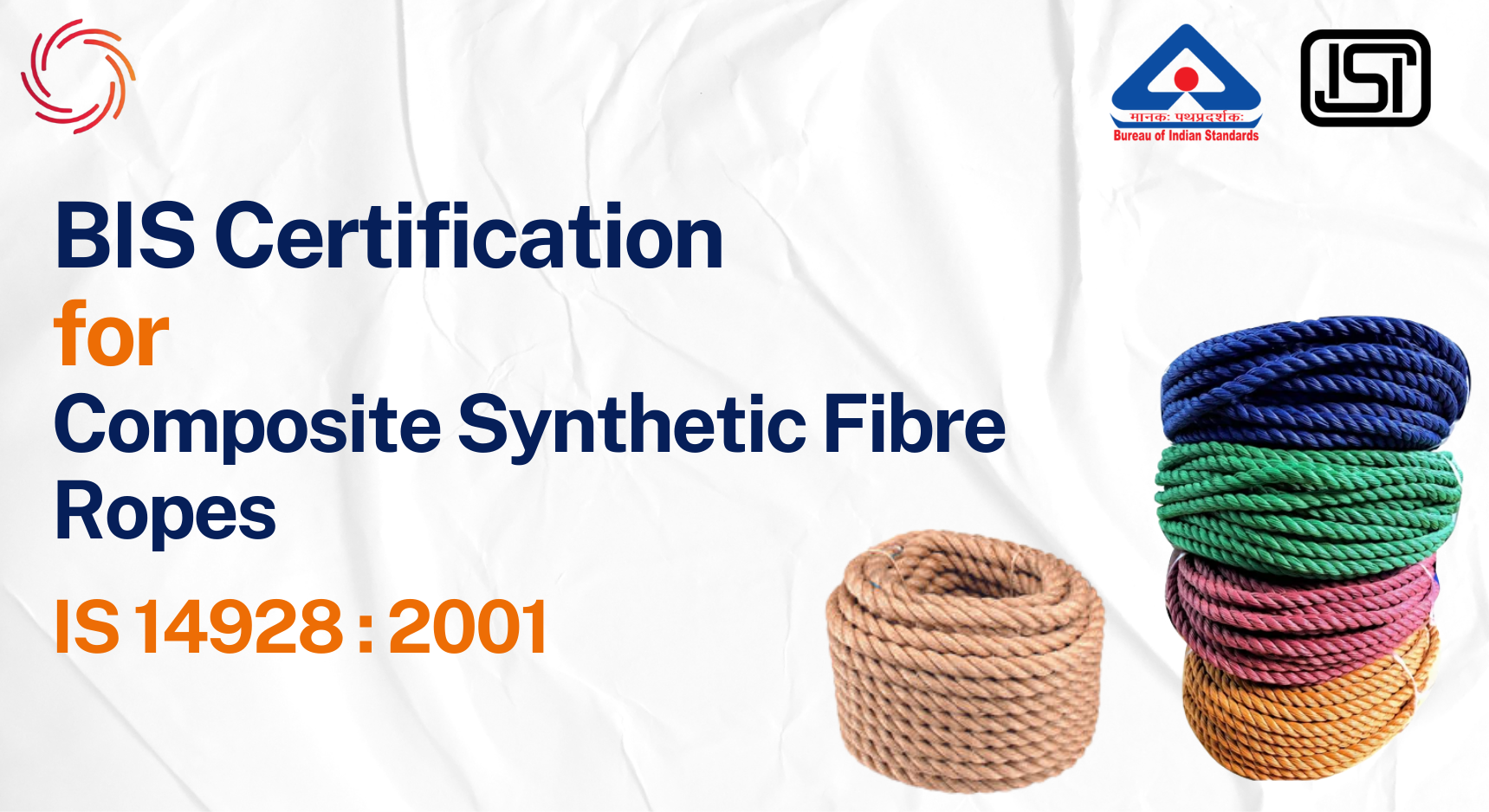
Composite synthetic fibre ropes are widely used across marine operations, ports and harbours, offshore installations, fishing, shipping, construction, agriculture, and heavy material handling. These ropes are engineered by combining two or more synthetic fibres—such as polyester, polypropylene, nylon, or other man-made fibres—to deliver a balanced mix of strength, flexibility, abrasion resistance, buoyancy, and durability. Because composite synthetic fibre ropes are frequently deployed in load-bearing, towing, mooring, lifting, and safety-critical applications, even a minor quality defect can lead to serious accidents, equipment damage, or operational failure.
To control these risks and ensure consistent quality, the Government of India mandates BIS Certification for Composite Synthetic Fibre Ropes under the applicable Indian Standard IS 14928:2001. A valid BIS Certificate for Composite Synthetic Fibre Ropes is a legal requirement for manufacturers and importers before such products can be manufactured, sold, distributed, or imported into the Indian market.
This page serves as a complete, compliance-focused guide explaining the BIS Certification for Composite Synthetic Fibre Ropes, including the scope of IS 14928:2001, safety intent, testing requirements, documentation, cost considerations, and step-by-step certification process. It is designed for manufacturers, importers, foreign manufacturers, traders, and e-commerce sellers who want a clear understanding of how to obtain a BIS License / BIS Licence for Composite Synthetic Fibre Ropes in India.
Also read the QCO Notification for Composite Synthetic Fibre Ropes (IS 14928)
What is BIS Certification?
BIS Certification is a product conformity assessment system operated by the Bureau of Indian Standards (BIS), which functions under the BIS Act, 2016. BIS is responsible for developing Indian Standards, certifying products, and ensuring that goods sold in India meet defined safety, quality, and performance benchmarks.
BIS Certificate Meaning
The BIS Certificate meaning refers to formal approval granted by BIS confirming that a product conforms to the relevant Indian Standard. Once certified, the manufacturer is authorized to use the BIS Certification Mark, commonly known as the ISI Mark, on the product and packaging.
ISI Mark Explanation
The ISI Mark indicates that:
- The product has been tested in a BIS-recognized laboratory
- The manufacturing facility has been assessed by BIS officials
- Ongoing quality control and surveillance mechanisms are in place
Why BIS Exists
BIS exists to:
- Protect consumer and worker safety
- Prevent circulation of substandard products
- Ensure uniformity and reliability of industrial goods
- Strengthen regulatory enforcement and fair trade
For composite synthetic fibre ropes—often used in hazardous and high-load conditions—BIS certification plays a crucial role in accident prevention and quality assurance.
Applicable BIS Standard for Composite Synthetic Fibre Ropes
The applicable Indian Standard for this product is:
🔹 IS 14928:2001 – Composite Synthetic Fibre Ropes
This standard specifies the requirements for materials, construction, dimensions, performance characteristics, marking, sampling, and testing of composite synthetic fibre ropes.
Scope of IS 14928:2001
IS 14928:2001 covers:
- Ropes manufactured using a combination of different synthetic fibres
- Various rope constructions such as laid and braided structures
- Ropes intended for marine, fishing, industrial, and general-purpose applications
Safety, Performance & Testing Intent
The standard aims to ensure:
- Adequate breaking strength and load-bearing capacity
- Consistent diameter and construction quality
- Resistance to abrasion, moisture, and environmental degradation
- Predictable and safe performance throughout service life
Who Must Comply
Compliance with IS 14928:2001 is mandatory for:
- Indian manufacturers of composite synthetic fibre ropes
- Importers supplying these ropes in the Indian market
- Foreign manufacturers selling through Indian representatives
Why BIS Certification is Mandatory for Composite Synthetic Fibre Ropes
1. Consumer and Worker Safety Risks
Composite synthetic fibre ropes are used in:
- Mooring and towing operations
- Lifting and securing heavy loads
- Fishing nets and marine equipment
A rope failure can cause injury, loss of life, vessel damage, and project delays.
2. Government Compliance
As per BIS notifications and quality control requirements, products covered under IS 14928:2001 cannot be legally sold without BIS certification.
3. Legal Implications
Non-compliance may lead to:
- Seizure of non-certified products
- Financial penalties under the BIS Act
- Prosecution and legal action
- Import clearance rejection
4. Market and Brand Benefits
A BIS License for Composite Synthetic Fibre Ropes improves:
- Customer confidence
- Eligibility for government and PSU tenders
- Brand credibility in domestic and export markets
Step-by-Step BIS Certification Process for Composite Synthetic Fibre Ropes
Applicability & Standard Identification
The process begins with confirming that the product falls under IS 14928:2001. This involves identifying:
- Fibre composition and blend
- Rope construction type
- Diameter range and intended application
Accurate identification avoids testing errors and application rejection.
BIS Online Application Process
Manufacturers must BIS apply online through the BIS portal by submitting:
- Product details
- Factory and manufacturing information
- Quality control arrangements
- Test request details
A correctly filled BIS Application is critical for timely processing.
Fees & Cost Structure
The BIS certificate cost includes:
- Application fees
- Testing charges at BIS-recognized labs
- Factory inspection fees
- Annual license and marking fees
The overall BIS certification cost varies depending on rope construction, size range, and testing complexity. Proper planning helps manage the cost of BIS certification and BIS license cost effectively.
Product Sample Testing (as per IS 14928:2001)
Product samples are drawn and tested at BIS-recognized laboratories to verify compliance with all requirements of the standard.
Factory Inspection & Audit
BIS officials conduct a factory audit to verify:
- Manufacturing process control
- Raw material handling
- In-house testing facilities
- Quality assurance systems and records
Grant of BIS License & ISI Mark
Once all requirements are met, BIS grants the Bureau of Indian Standards License, allowing the manufacturer to use the ISI Mark on composite synthetic fibre ropes.
Post-Certification Compliance
After certification, the licensee must:
- Maintain consistent product quality
- Allow periodic surveillance audits
- Inform BIS of any change in material, process, or design
Documents Required for BIS Certification
Manufacturer Documents
- Factory registration certificate
- Manufacturing process flow chart
- List of machinery and testing equipment
Legal Documents
- Company incorporation certificate
- GST registration
- Authorization letter for signatory
Technical Documents
- Product specifications and drawings
- Raw material specifications
- In-house test procedures
BIS Application Documents
- Duly filled BIS application form
- Test request letter
- Marking and labeling details
These collectively form the mandatory BIS CERTIFICATION DOCUMENTS.
Testing Requirements as per IS 14928:2001
Mandatory tests include:
All tests must be conducted only in BIS-recognized laboratories.
Common Challenges & How to Avoid Them
Incorrect Product Classification
Solution: Conduct a pre-certification technical assessment.
Test Failures
Solution: Align raw material quality and process controls with IS 14928:2001.
Incomplete Documentation
Solution: Prepare BIS-specific documents carefully and verify before submission.
Audit Non-Compliance
Solution: Maintain proper records, calibration, and internal quality checks.
Benefits of BIS Certification for Manufacturers & Importers
Legal Benefits
- Compliance with Indian regulations
- Smooth customs clearance
Commercial Benefits
- Eligibility for government and institutional tenders
- Improved buyer acceptance
Branding Benefits
- Authorized use of BIS Mark
- Enhanced trust and market credibility
Market Expansion
- Entry into regulated sectors
- Long-term business growth
Penalties for Non-Compliance
Failure to obtain BIS certification can result in:
- Heavy monetary penalties
- Product seizure or recall
- Import bans
- Legal prosecution
Who Needs BIS Certification for Composite Synthetic Fibre Ropes?
- Indian manufacturers
- Importers
- Foreign manufacturers supplying to India
- Traders and distributors
- E-commerce sellers
Any entity placing composite synthetic fibre ropes in the Indian market must ensure BIS compliance.
Conclusion
Obtaining a BIS Certificate for Composite Synthetic Fibre Ropes under IS 14928:2001 is both a legal obligation and a critical safety requirement. A valid BIS Certification / BIS License for Composite Synthetic Fibre Ropes ensures regulatory compliance, protects end users, and enhances market credibility.
For manufacturers and importers, BIS certification is not just about approval—it is about trust, safety, and sustainable business growth. With proper technical preparation and expert guidance, the BIS certification process in India can be completed smoothly and efficiently.
FAQs – BIS Certification for Composite Synthetic Fibre Ropes
1. What is the BIS Full Form?
Bureau of Indian Standards.
2. Is BIS certification mandatory for composite synthetic fibre ropes?
Yes, as per IS 14928:2001.
3. What is the BIS Certificate full form?
Bureau of Indian Standards Certificate.
4. Can I apply for BIS certificate online?
Yes, BIS apply online through the official portal.
5. How long does BIS certification take?
Typically 1–2 months.
6. What is the BIS certification cost?
It varies based on testing and audit scope.
7. Do importers need BIS certification?
Importers must ensure products are certified.
8. Can foreign manufacturers apply?
Yes, through an Authorized Indian Representative.
9. Is BIS registration the same as BIS license?
No, fibre ropes require a BIS license.
10. What happens if a product fails testing?
Corrective action and retesting are required.
11. Is ISI marking mandatory?
Yes, after certification.
12. How long is the BIS license valid?
Usually 1–2 years, renewable.
13. Are surveillance audits compulsory?
Yes, BIS conducts periodic audits.
14. Can license scope be extended later?
Yes, through scope extension approval.
15. Can uncertified products be sold online?
No, e-commerce sales also require BIS compliance.
Related Resources
Many of our users also read
Our Principal Regulatory Consultant, a former BIS Deputy Director General (Standardization). With over 30 years of service, he specializes in interpreting the Bureau of Indian Standards Act and simplifying complex certification workflows for Indian manufacturers.
Dhruv Aggarwal
Head of Operations at Sun Certifications India
Experience: 10+ years & Handled 1000+ projects
Awarded by many Indian and International organisations








PT Quty Karunia, BIS Licensee in Vietnam
“Sun Certifications India provided excellent BIS Certification services. Their unparalleled service and sincerity gained our trust. One of the best BIS consultants in India!”

Thantawan Industries Ltd, BIS Licensee in Thailand
“Sun Certifications India supported us throughout the BIS certification process. Their responsive customer service and punctuality are exceptional. Highly recommend for hassle-free BIS certification.”

Leaderart Industries, BIS Licensee in Malaysia
“Sun Certifications India helped us acquire BIS Certification, doubling our engagement in India. Their services are fast, genuine, and up-to-date with latest BIS norms.”

Aluminium Bahrain (ALBA), BIS Licensee in Bahrain
“Excellent BIS certification support, highly reliable consultants.”

Bahrain Aluminium Manufacturing Company, BIS Licensee in Bahrain
“Smooth BIS registration process with expert consultants.”

Daiki Aluminium Japan, BIS Licensee in Japan
“Efficient BIS license assistance, great consultants.”

Trimble Navigation, BIS Licensee in USA
“Seamless BIS certification and registration support.”

Remsa Italia, BIS Licensee in Italy
“Helpful BIS consultants, simplified license process.”

Aquazzura, BIS Licensee in Italy
“We got our BIS certificate well within the timelines and at affordable prices, great work team Sun!”

PT Quty, BIS Licensee in Indonesia
“Excellent BIS registration service, highly recommended.”

Danu Vina, BIS Licensee in Vietnam
“Reliable BIS license consultants, fast process.”

Hanh My Production Company, BIS Licensee in Vietnam
“Expert BIS consultants, certification made easy.”

Sedo Vina, BIS Licensee in Vietnam
“Smooth BIS certificate registration, great support.”

Misumi Japan, BIS Licensee in Japan
“Trusted BIS consultants, quick certification process.”

Thantawan Public Industry Company, BIS Licensee in Thailand
“Professional BIS certification service, very efficient.”

Cortizo Aluminios, BIS Licensee in Spain
“Excellent BIS registration and license guidance.”

Midal Cables, BIS Licensee in Bahrain
“Expert BIS consultants, smooth certification process.”
Years Exp.
Our Clients
Success Rate
Countries Served
Our team brings 10e4+ years of experience in CDSCO and BIS compliance.
We reduce approval time by up to 40% with streamlined processes.
100% success rate with 1500+ successful registrations.
Dedicated account manager ensuring personalized service.
Leave your details below and our experts will call you back within 24 hours to discuss your regulatory compliance needs.
By submitting this form, you agree to our Privacy Policy and consent to being contacted.