BIS Certification for Continuous (Piano) Hinges – IS 3818:1992
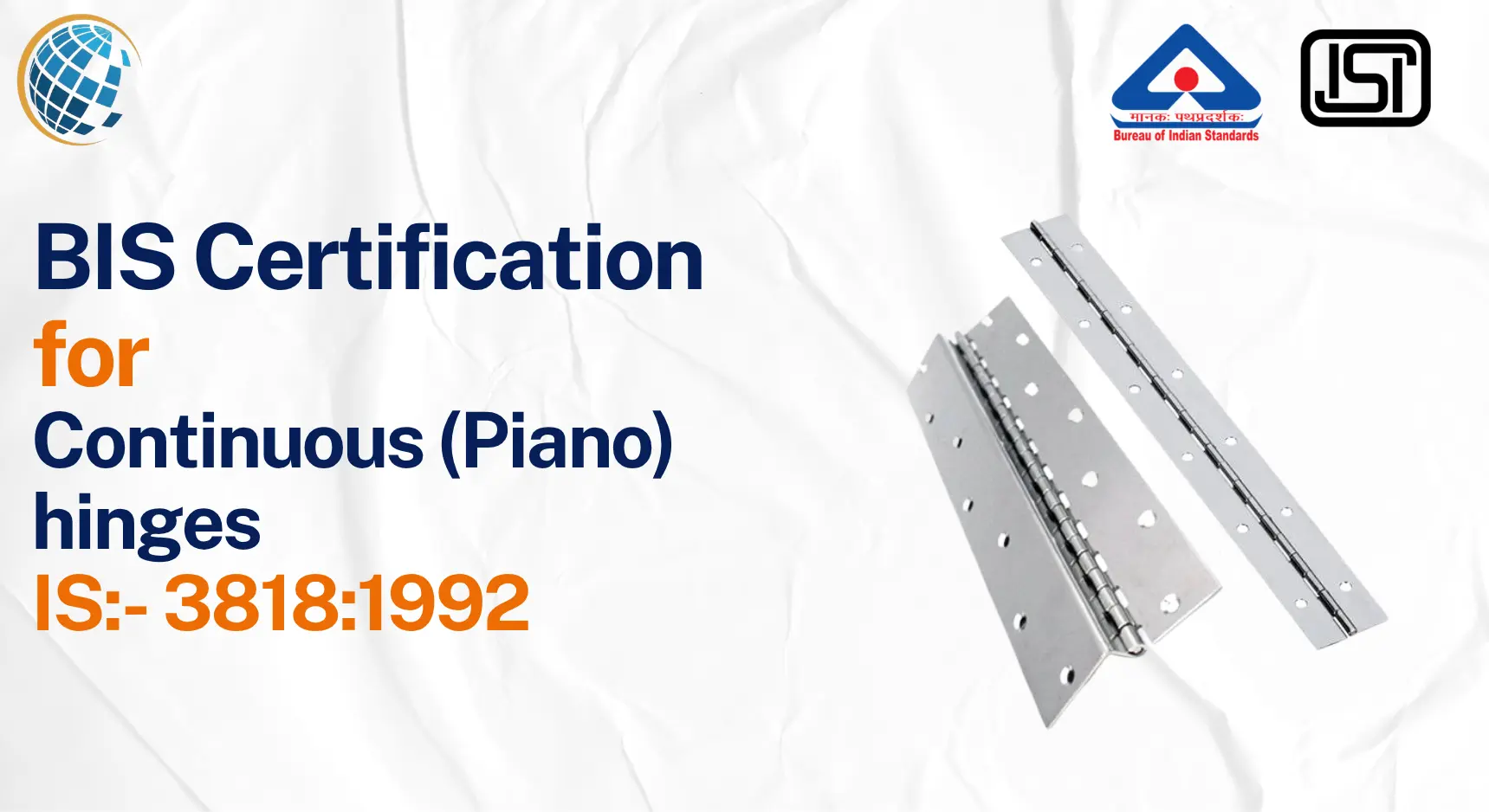
BIS Certification for Continuous (Piano) hinges under IS 3818:1992 confirms that these long, load-bearing hinges meet strict Indian requirements for durability, alignment accuracy, and corrosion resistance. Certification is essential to ensure smooth door movement, structural reliability, and safe usage across furniture, cabinets, and industrial installations in India.
Continuous hinges, often called piano hinges, are widely used in applications where uniform support along the entire length of a door or panel is required. Unlike conventional hinges that support weight at discrete points, continuous hinges distribute load evenly, making them essential in cabinetry, industrial enclosures, storage systems, and even specialized equipment like electrical panels.
Because these hinges operate across their full length, even minor defects in alignment, material strength, or finish can lead to operational failure. A misaligned hinge can cause doors to jam, sag, or create uneven pressure on mounting surfaces. In industrial environments, such failures may compromise safety, especially when heavy panels or machinery access doors are involved.
In the Indian market, where both residential furniture and industrial infrastructure demand long-lasting hardware, regulatory oversight ensures that such components meet minimum performance expectations. BIS Certification for Continuous (Piano) hinges plays a crucial role in verifying that these hinges are not just visually consistent but mechanically dependable.
For manufacturers, importers, and suppliers, obtaining a BIS Certificate for Continuous (Piano) hinges is not merely a compliance formality—it is a signal of engineering precision and long-term performance assurance. It enables seamless market entry while reducing risks associated with product failure, customer dissatisfaction, and liability.
Understanding BIS Certificate for Continuous (Piano) Hinges - IS 3818:1992
Continuous hinges operate under constant mechanical stress. Every opening and closing cycle applies friction, load transfer, and torque along the hinge axis. This makes them highly sensitive to issues such as:
- Uneven pin alignment
- Material fatigue
- Poor surface finishing
- Inconsistent thickness
BIS Certification for Continuous (Piano) hinges evaluates these aspects from a performance perspective rather than just a dimensional one. The certification ensures that hinges maintain structural integrity even after repeated usage cycles.
From a regulatory standpoint, the objective is to standardize hinge performance across various manufacturers so that end-users—whether carpenters, industrial fabricators, or OEMs—can rely on consistent functionality.
The BIS License for Continuous (Piano) hinges is granted only after verifying that the manufacturing process is capable of producing hinges with uniform:
- Load-bearing capacity
- Smooth rotational movement
- Resistance to environmental factors like humidity and corrosion
This certification acts as a technical checkpoint, ensuring that the hinge performs reliably throughout its lifecycle rather than just passing initial inspection.
Applicable BIS Standard for Continuous (Piano) Hinges - IS 3818:1992
The relevant standard for this product category is IS 3818:1992, which defines requirements specifically tailored for continuous hinges used in furniture and industrial applications.
Scope of IS 3818:1992
This standard covers:
- Continuous (piano-type) hinges made from steel, brass, or other approved materials
- Hinges designed for full-length support of doors, panels, and lids
- Various sizes and thicknesses used in residential, commercial, and industrial applications
Product Categories Covered
IS 3818:1992 includes hinges used in:
- Wooden and metal cabinets
- Electrical control panels
- Storage boxes and trunks
- Industrial enclosures
Safety and Performance Objectives
The standard focuses on ensuring:
- Uniform load distribution along the hinge length
- Smooth and consistent rotation without binding
- Resistance to wear under repetitive usage
- Structural stability under static and dynamic loads
Design and Testing Principles
IS 3818:1992 incorporates design checks such as:
- Accurate knuckle formation and spacing
- Proper pin fitting to prevent wobbling
- Surface finishing to prevent corrosion
- Dimensional tolerances to ensure interchangeability
These principles ensure that hinges are not only functional but also compatible with various installation environments.
Testing Requirements as per IS 3818:1992
Testing plays a critical role in verifying the quality of continuous hinges because their performance cannot be judged by appearance alone. All tests must be conducted in BIS recognized laboratories to ensure reliability and standardization.
1. Safety Tests
Safety testing evaluates whether the hinge can withstand operational stress without failure. This includes:
- Checking for sharp edges or burrs that may cause injury
- Ensuring proper fastening strength to avoid detachment
- Verifying that the hinge does not deform under load
For example, a hinge installed on a heavy cabinet door must not bend or crack during repeated opening cycles.
2. Performance Tests
Performance tests focus on operational efficiency and usability:
- Smooth opening and closing action
- Absence of noise or friction irregularities
- Consistent movement across the entire hinge length
Since continuous hinges run along the full door edge, even minor irregularities can lead to uneven motion. These tests ensure uniform performance.
3. Durability Tests
Durability is critical because hinges are subjected to repeated use over time. These tests include:
- Cycle testing to simulate thousands of opening and closing operations
- Load endurance testing to check long-term strength
- Wear resistance evaluation for moving parts
A hinge that performs well initially but fails after a few months is considered non-compliant.
4. Corrosion Resistance Tests
Continuous hinges are often used in environments exposed to moisture or chemicals. Testing ensures:
- Resistance to rust formation
- Stability of protective coatings such as plating or painting
- Long-term surface durability
This is particularly important for hinges used in kitchens, outdoor installations, or industrial environments.
5. Dimensional Accuracy Tests
Dimensional precision ensures compatibility with installation systems. Tests include:
- Measurement of hinge length, width, and thickness
- Uniformity of knuckles and pin alignment
- Tolerance verification
Accurate dimensions prevent installation issues and ensure proper alignment.
6. Material Quality Verification
Material testing checks whether the hinge is made from suitable raw materials:
- Tensile strength testing
- Hardness testing
- Chemical composition analysis
This ensures that the hinge can withstand mechanical stress without premature failure.
Conclusion
Continuous (piano) hinges are more than just connecting components—they are load-bearing elements that ensure smooth, stable, and long-lasting operation of doors and panels. Any compromise in their quality can lead to functional issues, safety risks, and increased maintenance costs.
Obtaining a BIS Certificate for Continuous (Piano) hinges under IS 3818:1992 ensures that these products meet well-defined performance benchmarks tailored to real-world usage conditions. From durability and corrosion resistance to dimensional precision, certification evaluates every critical aspect that influences hinge reliability.
For manufacturers and suppliers, BIS Certification for Continuous (Piano) hinges is not just about regulatory compliance; it is a strategic advantage. It enhances product credibility, simplifies market access, and assures customers of consistent quality. Whether you are applying for a BIS License for Continuous (Piano) hinges or evaluating the cost of BIS certification for Continuous (Piano) hinges, aligning with these standards is a vital step toward long-term business success and product excellence.
FAQs – BIS License for Continuous (Piano) Hinges - IS 3818:1992
1. How does hinge length affect BIS testing and certification for continuous hinges?
Hinge length plays a significant role in certification because continuous hinges are designed to support weight evenly across their entire span. Longer hinges are more prone to alignment issues and bending if not manufactured correctly. During BIS testing, longer variants may undergo stricter dimensional and load distribution checks to ensure uniform performance. Manufacturers must ensure that even extended-length hinges maintain consistent thickness, straightness, and pin alignment to comply with certification requirements.
2. Is surface finishing important for BIS Certification of Continuous (Piano) hinges?
Yes, surface finishing is a critical aspect of certification. Continuous hinges are often exposed to environmental factors such as humidity, dust, and chemicals, especially in industrial or kitchen settings. BIS testing evaluates coatings like galvanization, powder coating, or polishing to ensure corrosion resistance. Poor finishing can lead to rust formation, which affects both aesthetics and functionality. Therefore, manufacturers must adopt proper finishing techniques to meet BIS quality benchmarks.
3. Can BIS Certification cover both metal and alloy-based continuous hinges?
Yes, BIS Certification can apply to different material compositions, including steel, stainless steel, brass, or certain alloys, as long as they fall within the scope of IS 3818:1992. However, each material type may require separate evaluation because performance characteristics such as strength, corrosion resistance, and wear behaviour differ. Manufacturers must clearly specify material details during application to ensure appropriate testing and certification coverage.
4. What role does pin quality play in BIS Certification for Continuous (Piano) hinges?
The hinge pin is the central component that enables rotational movement. Its quality directly affects hinge performance. BIS testing ensures that the pin is properly fitted, resistant to bending, and capable of smooth rotation without excessive friction. Poor pin quality can cause wobbling, uneven movement, or even hinge failure. Therefore, manufacturers must focus on precision machining and material selection for pins to meet certification standards.
5. How do environmental conditions influence BIS testing for continuous hinges?
Environmental factors such as moisture, temperature fluctuations, and exposure to chemicals can significantly impact hinge performance. BIS testing includes corrosion resistance and durability checks to simulate these conditions. For example, hinges used in coastal areas or industrial environments must withstand higher corrosion risks. Certification ensures that the hinge can perform reliably under such conditions without degradation.
6. Are customized continuous hinges eligible for BIS Certification?
Customized hinges can be certified, provided they meet the technical requirements outlined in IS 3818:1992. However, customization in terms of size, thickness, or material may require additional testing and evaluation. Manufacturers must ensure that even customized designs maintain compliance with dimensional tolerances, load-bearing capacity, and performance criteria specified in the standard.
7. What quality control measures are expected during manufacturing for BIS compliance?
Manufacturers are expected to implement strict quality control systems, including raw material inspection, in-process checks, and final product testing. This ensures consistency across production batches. For continuous hinges, quality control may include monitoring knuckle formation, pin fitting, and surface finishing. A well-documented quality control process is essential for obtaining and maintaining BIS Certification.
8. How does BIS Certification impact bulk buyers and OEMs of continuous hinges?
Bulk buyers and OEMs prefer certified products because they reduce the risk of failure and ensure consistent performance. BIS Certification for Continuous (Piano) hinges provides assurance that the product meets standardized requirements. This is especially important for industries such as furniture manufacturing, construction, and equipment production, where hinge reliability directly affects product quality and customer satisfaction.
9. Can BIS Certification be revoked for continuous hinges after approval?
Yes, certification can be revoked if the manufacturer fails to maintain compliance with the standard. This may occur due to changes in manufacturing processes, use of inferior materials, or failure in periodic inspections. Regular surveillance by authorities ensures that certified products continue to meet required standards. Maintaining consistent quality is essential to retain certification.
10. How does BIS Certification support long-term durability of continuous hinges?
BIS Certification ensures that hinges undergo rigorous testing for durability, including repeated usage cycles and load-bearing capacity. This helps identify potential weaknesses before the product reaches the market. As a result, certified hinges are more likely to perform reliably over time, reducing maintenance costs and improving user satisfaction. This long-term reliability is a key advantage of certification.
Many of our users also read
This compliance advisory was vetted by our Senior Consultant (Enforcement & Vigilance), a former BIS Director (Enforcement). He specializes in post-certification compliance, helping companies navigate surveillance audits and legal adherence to BIS mandates.
Dhruv Aggarwal
Head of Operations at Sun Certifications India
Experience: 10+ years & Handled 1000+ projects
Awarded by many Indian and International organisations








PT Quty Karunia, BIS Licensee in Vietnam
“Sun Certifications India provided excellent BIS Certification services. Their unparalleled service and sincerity gained our trust. One of the best BIS consultants in India!”

Thantawan Industries Ltd, BIS Licensee in Thailand
“Sun Certifications India supported us throughout the BIS certification process. Their responsive customer service and punctuality are exceptional. Highly recommend for hassle-free BIS certification.”

Leaderart Industries, BIS Licensee in Malaysia
“Sun Certifications India helped us acquire BIS Certification, doubling our engagement in India. Their services are fast, genuine, and up-to-date with latest BIS norms.”

Aluminium Bahrain (ALBA), BIS Licensee in Bahrain
“Excellent BIS certification support, highly reliable consultants.”

Bahrain Aluminium Manufacturing Company, BIS Licensee in Bahrain
“Smooth BIS registration process with expert consultants.”

Daiki Aluminium Japan, BIS Licensee in Japan
“Efficient BIS license assistance, great consultants.”

Trimble Navigation, BIS Licensee in USA
“Seamless BIS certification and registration support.”

Remsa Italia, BIS Licensee in Italy
“Helpful BIS consultants, simplified license process.”

Aquazzura, BIS Licensee in Italy
“We got our BIS certificate well within the timelines and at affordable prices, great work team Sun!”

PT Quty, BIS Licensee in Indonesia
“Excellent BIS registration service, highly recommended.”

Danu Vina, BIS Licensee in Vietnam
“Reliable BIS license consultants, fast process.”

Hanh My Production Company, BIS Licensee in Vietnam
“Expert BIS consultants, certification made easy.”

Sedo Vina, BIS Licensee in Vietnam
“Smooth BIS certificate registration, great support.”

Misumi Japan, BIS Licensee in Japan
“Trusted BIS consultants, quick certification process.”

Thantawan Public Industry Company, BIS Licensee in Thailand
“Professional BIS certification service, very efficient.”

Cortizo Aluminios, BIS Licensee in Spain
“Excellent BIS registration and license guidance.”

Midal Cables, BIS Licensee in Bahrain
“Expert BIS consultants, smooth certification process.”
Years Exp.
Our Clients
Success Rate
Countries Served
Our team brings 10e4+ years of experience in CDSCO and BIS compliance.
We reduce approval time by up to 40% with streamlined processes.
100% success rate with 1500+ successful registrations.
Dedicated account manager ensuring personalized service.
Leave your details below and our experts will call you back within 24 hours to discuss your regulatory compliance needs.
By submitting this form, you agree to our Privacy Policy and consent to being contacted.