BIS Certification for Countersunk Flat Head Screws with type H or Type Z Cross Recess – Product Grade A part 2 Steel Screws of Property Class 8.8, Stainless Steel Screws and Non – Ferrous Metal Screws – IS 7485 (Part 2):2018
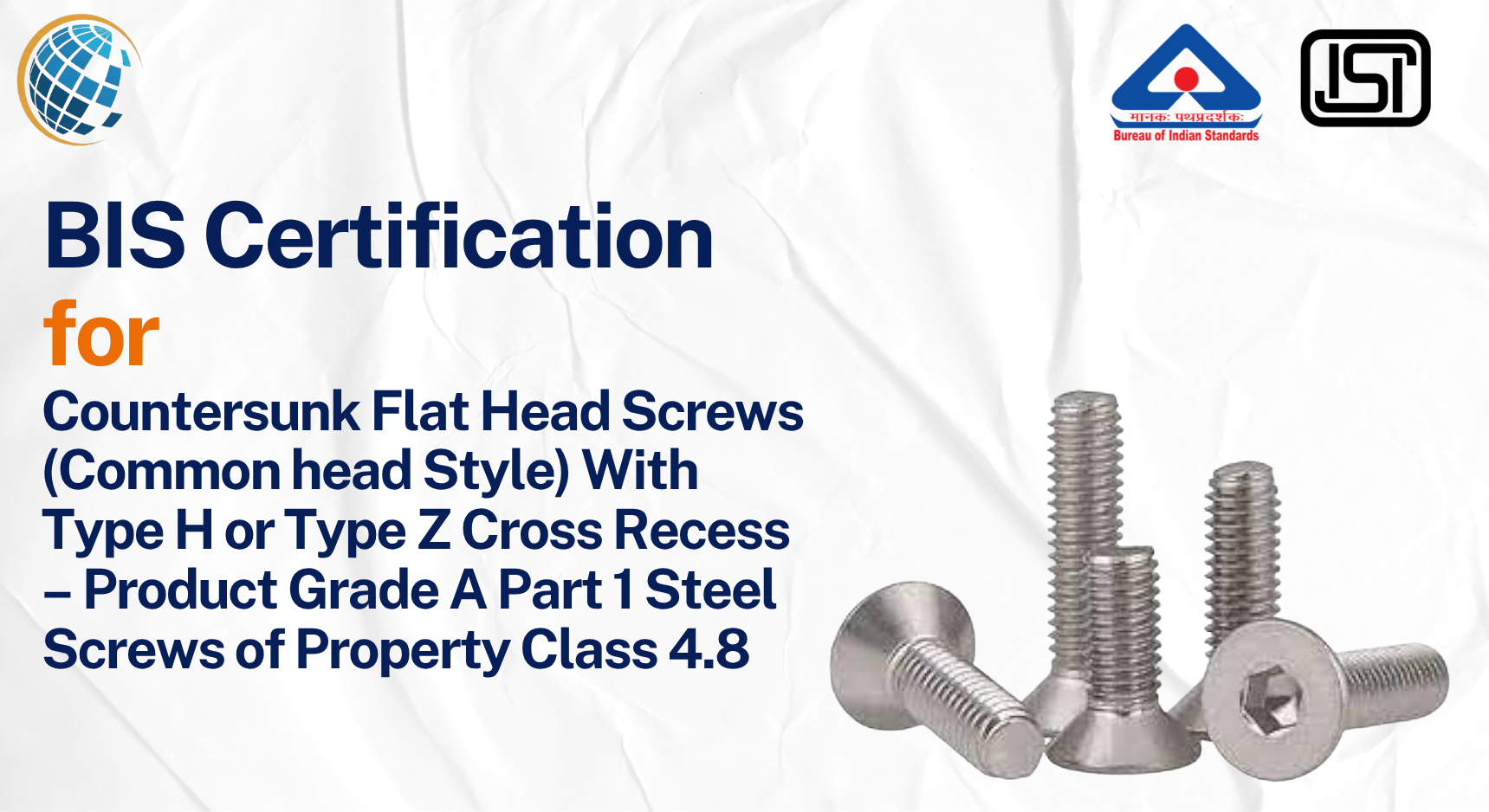
BIS certification for Countersunk Flat Head Screws with type H or Type Z Cross Recess – Product Grade A part 2 Steel Screws of Property Class 8.8, Stainless Steel Screws and Non – Ferrous Metal Screws under IS 7485 (Part 2):2018 verifies that these fasteners meet strict dimensional precision, strength, and surface finish requirements. It is required in India to ensure proper flush fitting, secure fastening, and long-term reliability in applications where alignment and structural integrity are critical.
Countersunk flat head screws are widely used in applications where a completely flush surface is required after fastening. Unlike raised head variants, these screws sit perfectly level with the surface once installed, making them ideal for precision assemblies such as machinery panels, automotive bodywork, electrical enclosures, and high-finish furniture.
Their importance becomes evident in environments where even a slight projection could interfere with movement, aerodynamics, or aesthetics. For example, in sliding mechanisms or rotating components, a protruding fastener head could cause friction, wear, or operational failure. Similarly, in consumer-facing products like modular furniture, improper seating of screws affects both appearance and durability.
Because these screws directly influence structural alignment and load distribution, manufacturing inconsistencies can lead to issues such as stripping, misalignment, or loosening under vibration. This makes regulatory oversight essential in maintaining uniformity across the market.
The BIS Certification for Countersunk Flat Head Screws with type H or Type Z Cross Recess – Product Grade A part 2 Steel Screws of Property Class 8.8, Stainless Steel Screws and Non – Ferrous Metal Screws ensures that these fasteners are manufactured according to defined engineering benchmarks. For manufacturers, it establishes production discipline. For importers and sellers, it enables smoother market access. And for end-users, it ensures reliability in everyday applications where fastening integrity cannot be compromised.
Understanding BIS Certification for Countersunk Flat Head Screws
Countersunk flat head screws are not just simple fasteners—they are precision components designed to integrate seamlessly into surfaces. Their functionality depends heavily on accurate head angle, thread uniformity, and material strength. Even a slight deviation in these parameters can lead to improper seating or reduced holding capacity.
The BIS Certification for Countersunk Flat Head Screws evaluates these aspects in a structured manner. Instead of treating screws as generic hardware, the certification process examines how they perform in real-world conditions. For instance, a screw used in a steel panel must maintain its thread integrity even after repeated tightening, while one used in wood must resist splitting and maintain grip.
From a regulatory standpoint, the goal is to ensure consistency across manufacturers. Without such oversight, variations in dimensions or material quality could lead to compatibility issues, especially in large-scale industrial applications where components are sourced from multiple suppliers.
Another important dimension is consumer safety. While users may not directly inspect individual screws, they rely on the overall stability of the products assembled using them. A poorly manufactured screw can compromise the integrity of an entire structure, whether it's a machine, a cabinet, or an electrical enclosure.
The BIS Licence for Countersunk Flat Head Screws therefore acts as a technical assurance that the product meets predefined criteria for performance, durability, and compatibility.
Applicable BIS Standard for Countersunk Flat Head Screws
The applicable specification for this category is IS 7485 (Part 2):2018, which defines the requirements for countersunk flat head screws used in various industrial and commercial applications.
Scope of the Standard
IS 7485 (Part 2):2018 covers screws designed with a flat countersunk head, intended to sit flush with the surface after installation. The standard applies to screws made from different materials, including carbon steel and alloy steel, depending on their intended use.
Product Categories Covered
The standard includes screws of varying sizes, thread types, and mechanical properties. It accommodates applications ranging from light-duty furniture assembly to heavy-duty industrial fastening.
Safety and Performance Objectives
The primary objectives include:
- Ensuring precise head angle for proper seating
- Maintaining thread accuracy for secure fastening
- Achieving required tensile and shear strength
- Preventing material defects such as cracks or corrosion
Design and Testing Principles
The design principles focus on ensuring that the screw head aligns perfectly with countersunk holes, distributing load evenly across the surface. Testing principles include dimensional verification, mechanical strength evaluation, and surface finish assessment to ensure durability under operational conditions.
Why BIS Certification is Mandatory for Countersunk Flat Head Screws
Safety Risks Related to the Product
Countersunk flat head screws are often used in applications where structural alignment is critical. If the head angle is incorrect or the material is weak, the screw may fail under load, leading to component misalignment or detachment.
Consumer Protection
End-users depend on the reliability of assembled products. Certified screws ensure that these products maintain their structural integrity over time, reducing the risk of failure.
Regulatory Enforcement in India
Indian regulations require compliance with specific standards for certain categories of fasteners. Non-certified products may face restrictions or removal from the market.
Market Access Requirements
A valid BIS Certificate for Countersunk Flat Head Screws is often necessary for participation in large-scale projects, including government tenders and industrial contracts.
Brand Credibility
Manufacturers with a BIS License for Countersunk Flat Head Screws demonstrate a commitment to quality and consistency, which enhances their reputation in the market.
Testing Requirements as per IS 7485 (Part 2):2018
Testing plays a critical role in verifying compliance. Key tests include:
- Mechanical strength tests to evaluate load-bearing capacity
- Dimensional checks for head angle and thread accuracy
- Surface finish tests to ensure corrosion resistance
- Thread verification tests for compatibility
All testing must be conducted in BIS-recognized laboratories to ensure reliability and consistency.
Conclusion
The BIS Certification for Countersunk Flat Head Screws under IS 7485 (Part 2):2018 plays a vital role in ensuring that these precision fasteners meet the demands of modern engineering and manufacturing. From achieving perfect flush fitting to maintaining structural integrity under stress, every aspect of the screw's performance is governed by strict compliance requirements.
Obtaining a BIS License for Countersunk Flat Head Screws not only enables legal market entry but also strengthens trust among buyers, distributors, and end-users. For manufacturers and importers, investing in certification is a strategic step toward delivering consistent quality and building long-term credibility in the Indian market.
FAQs – BIS Certification for Countersunk Flat Head Screws
1. Why is head angle accuracy critical in BIS Certification for countersunk flat head screws?
The head angle in countersunk flat head screws determines how perfectly the screw sits flush within a countersunk hole. If the angle deviates even slightly, the screw may either protrude or sink too deep, weakening the joint. BIS certification ensures strict control over head geometry so that the screw distributes load evenly and maintains structural alignment in assemblies.
2. How does BIS certification ensure flush fitting performance in real applications?
Flush fitting is essential in applications like metal panels, sliding components, and decorative surfaces. BIS testing checks dimensional tolerances, including head diameter, thickness, and angle, to ensure the screw sits perfectly level with the surface. This prevents interference with moving parts and avoids stress concentration points that can lead to material damage or loosening.
3. What types of thread-related issues are identified during BIS testing?
During BIS testing, issues such as uneven thread pitch, incomplete threading, or improper thread depth are commonly detected. These defects can cause poor engagement with mating components, leading to weak fastening or stripping during installation. Certification ensures that threads are manufactured with precision, allowing consistent torque application and secure fastening.
4. How does BIS certification address the risk of screw loosening under vibration?
Countersunk flat head screws are often used in machinery and automotive applications where vibration is constant. If the screw lacks proper tensile strength or thread accuracy, it may loosen over time. BIS certification verifies mechanical strength and thread performance, ensuring that the screw maintains its hold even under dynamic loads and repeated stress conditions.
5. Are surface finish and coating quality evaluated in BIS Certification?
Yes, surface finish plays a critical role, especially for screws exposed to environmental conditions. BIS certification evaluates whether coatings such as zinc plating are uniformly applied and resistant to corrosion. Poor surface treatment can lead to rust formation, which weakens the screw and affects both performance and appearance in visible applications.
6. How does BIS certification help in large-scale industrial assembly operations?
In industrial settings, thousands of screws are used in assembly lines where consistency is essential. BIS certification ensures uniform dimensions and performance across batches, reducing the risk of mismatched components. This consistency minimizes production delays, tool wear, and assembly errors, making operations more efficient and reliable.
7. What role does material selection play in BIS compliance for countersunk flat head screws?
Material selection directly affects the strength, durability, and corrosion resistance of the screw. BIS certification ensures that the chosen material meets specific mechanical and chemical requirements. Whether using carbon steel or alloy steel, the material must be capable of withstanding operational loads without deformation or failure.
8. Can countersunk flat head screws used in electrical equipment require stricter compliance?
Yes, when used in electrical enclosures or panels, these screws must not only provide mechanical fastening but also maintain insulation safety and prevent loosening. BIS certification ensures that such screws meet precise dimensional and strength requirements, reducing the risk of loose connections that could lead to electrical faults or hazards.
9. How does BIS certification ensure repeatability in screw manufacturing?
Repeatability means producing identical screws across multiple production cycles. BIS certification requires manufacturers to implement controlled processes, including calibrated machinery and quality checks. This ensures that every screw produced matches the approved specifications, which is critical for maintaining compatibility in standardized assemblies.
10. Why is dimensional tolerance control important in BIS Certification for countersunk flat head screws?
Dimensional tolerances define how much variation is allowed in the screw's size and shape. Tight control is necessary because even small deviations can affect fit, load distribution, and tool compatibility. BIS certification ensures that tolerances are maintained within specified limits, enabling reliable performance in precision assemblies where exact fitting is required.
Check complete details about documentation, cost, and process for foreign manufacturers
Check complete details about documentation, cost, and process for Indian manufacturers
Many of our users also read
This documentation guide was reviewed by our Lead Application Specialist, a former BIS Section Head (Licensing & Scrutiny). With experience processing over 5,000 application files, he ensures that client submissions meet the strict administrative criteria to prevent rejection during the initial scrutiny stage.
Dhruv Aggarwal
Head of Operations at Sun Certifications India
Experience: 10+ years & Handled 1000+ projects
Awarded by many Indian and International organisations








PT Quty Karunia, BIS Licensee in Vietnam
“Sun Certifications India provided excellent BIS Certification services. Their unparalleled service and sincerity gained our trust. One of the best BIS consultants in India!”

Thantawan Industries Ltd, BIS Licensee in Thailand
“Sun Certifications India supported us throughout the BIS certification process. Their responsive customer service and punctuality are exceptional. Highly recommend for hassle-free BIS certification.”

Leaderart Industries, BIS Licensee in Malaysia
“Sun Certifications India helped us acquire BIS Certification, doubling our engagement in India. Their services are fast, genuine, and up-to-date with latest BIS norms.”

Aluminium Bahrain (ALBA), BIS Licensee in Bahrain
“Excellent BIS certification support, highly reliable consultants.”

Bahrain Aluminium Manufacturing Company, BIS Licensee in Bahrain
“Smooth BIS registration process with expert consultants.”

Daiki Aluminium Japan, BIS Licensee in Japan
“Efficient BIS license assistance, great consultants.”

Trimble Navigation, BIS Licensee in USA
“Seamless BIS certification and registration support.”

Remsa Italia, BIS Licensee in Italy
“Helpful BIS consultants, simplified license process.”

Aquazzura, BIS Licensee in Italy
“We got our BIS certificate well within the timelines and at affordable prices, great work team Sun!”

PT Quty, BIS Licensee in Indonesia
“Excellent BIS registration service, highly recommended.”

Danu Vina, BIS Licensee in Vietnam
“Reliable BIS license consultants, fast process.”

Hanh My Production Company, BIS Licensee in Vietnam
“Expert BIS consultants, certification made easy.”

Sedo Vina, BIS Licensee in Vietnam
“Smooth BIS certificate registration, great support.”

Misumi Japan, BIS Licensee in Japan
“Trusted BIS consultants, quick certification process.”

Thantawan Public Industry Company, BIS Licensee in Thailand
“Professional BIS certification service, very efficient.”

Cortizo Aluminios, BIS Licensee in Spain
“Excellent BIS registration and license guidance.”

Midal Cables, BIS Licensee in Bahrain
“Expert BIS consultants, smooth certification process.”
Years Exp.
Our Clients
Success Rate
Countries Served
Our team brings 10e4+ years of experience in CDSCO and BIS compliance.
We reduce approval time by up to 40% with streamlined processes.
100% success rate with 1500+ successful registrations.
Dedicated account manager ensuring personalized service.
Leave your details below and our experts will call you back within 24 hours to discuss your regulatory compliance needs.
By submitting this form, you agree to our Privacy Policy and consent to being contacted.