BIS Certification for Double-acting Spring Hinges - IS 453:1993
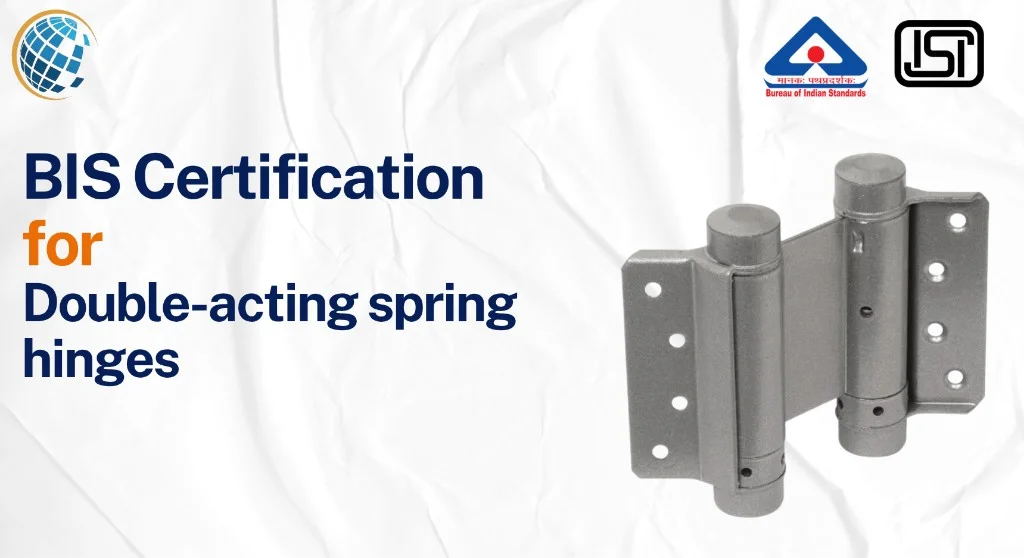
BIS Certification for Double-acting spring hinges as per IS 453:1993 verifies that these hinges meet defined performance, durability, and safety benchmarks for repeated door movement. It is required in India to ensure consistent mechanical strength, controlled closing action, and long-term reliability in residential, commercial, and industrial door applications.
Double-acting spring hinges are a critical yet often overlooked component in modern architecture and interior design. These hinges allow doors to swing in both directions and automatically return to a closed position, making them essential in high-traffic environments such as hospitals, restaurants, offices, and commercial buildings. Their function goes far beyond convenience—they directly influence safety, accessibility, and operational efficiency.
In spaces like kitchens or medical facilities, where hands-free door operation is common, a malfunctioning hinge can disrupt workflow or even lead to accidents. For instance, if the spring mechanism loses tension prematurely, doors may not close properly, compromising hygiene in controlled environments or security in restricted areas.
Given their mechanical complexity and continuous usage, maintaining consistent quality in manufacturing becomes crucial. Variations in material strength, spring calibration, or corrosion resistance can significantly impact performance. This is where regulatory oversight in India becomes essential.
BIS Certification for Double-acting spring hinges ensures that products available in the market are engineered to handle repetitive motion, varying loads, and environmental exposure. For manufacturers and importers, obtaining a BIS License for Double-acting spring hinges is not just a regulatory requirement but a strategic advantage. It builds confidence among buyers, ensures product acceptance across markets, and reduces the risk of failure-related liabilities.
Understanding BIS Certificate for Double-acting Spring Hinges - IS 453:1993
When it comes to mechanical hardware like double-acting spring hinges, certification is not just about verifying dimensions—it is about evaluating how the hinge performs under continuous stress. These hinges are designed to operate hundreds or even thousands of times daily. This repetitive movement puts pressure on internal springs, pivot points, and mounting structures.
BIS Certification for Double-acting spring hinges focuses on ensuring that every hinge produced maintains consistent closing force, smooth motion, and durability over time. For example, in a busy commercial kitchen, doors are constantly pushed open from both sides. A poorly manufactured hinge could fail, leading to abrupt door movement or incomplete closure.
The certification process examines multiple aspects:
- The ability of the hinge to maintain spring tension over repeated cycles
- Resistance to corrosion, especially in humid or chemically exposed environments
- Structural integrity under varying door weights
- Precision in alignment to avoid uneven door movement
From a regulatory perspective, the goal is to prevent substandard products from entering the market. Instead of relying solely on visual inspection, the BIS License for Double-acting spring hinges ensures that performance is validated through testing.
For end users, this translates into reliability. Whether installed in a hospital corridor or a retail outlet, certified hinges provide predictable performance, reducing maintenance issues and enhancing safety.
Applicable BIS Standard for Double-acting Spring Hinges - IS 453:1993
The relevant Indian standard for this product category is IS 453:1993, which lays down detailed requirements for double-acting spring hinges used in doors and similar installations.
Scope of the Standard
IS 453:1993 applies to hinges designed to allow doors to open in both directions and return to a closed position automatically. It covers different sizes, load capacities, and installation types suitable for residential, commercial, and industrial use.
Product Categories Covered
The standard includes:
- Hinges for light-duty doors (interior applications)
- Hinges for medium-duty usage (offices, retail spaces)
- Heavy-duty hinges for industrial or high-traffic areas
Each category has specific requirements based on load-bearing capacity and operational frequency.
Safety and Performance Objectives
The standard aims to ensure that hinges:
- Maintain consistent closing action without sudden jerks
- Withstand repeated cycles without losing functionality
- Do not cause injury due to uncontrolled movement
- Provide stable support for doors of varying weights
For example, a hinge used in a hospital must close doors gently to avoid noise and disturbance, while one in a warehouse must handle heavier doors without failure.
Design and Testing Principles
IS 453:1993 emphasizes:
- Spring calibration accuracy
- Material strength and corrosion resistance
- Dimensional precision for proper installation
- Endurance testing to simulate real-world usage
These principles ensure that the BIS Certificate for Double-acting spring hinges reflects actual performance rather than theoretical specifications.
Testing Requirements as per IS 453:1993
Testing is a critical part of BIS Certification for Double-acting spring hinges because it directly evaluates how the product performs in real-world conditions. All testing must be conducted in BIS recognized laboratories to ensure accuracy and reliability.
Safety Tests
Safety testing focuses on ensuring that the hinge operates smoothly without causing sudden or uncontrolled door movement. Hinges are evaluated for:
- Controlled closing speed
- Stability under load
- Absence of sharp edges or defects that may cause injury
For example, in public spaces, doors must not slam shut abruptly, as this can lead to accidents.
Performance Tests
Performance tests assess the operational efficiency of the hinge. These include:
- Opening and closing cycle tests
- Spring tension consistency
- Alignment accuracy during movement
A hinge that loses tension quickly may fail to close doors properly, making this test essential.
Durability Tests
Durability is tested through repeated cycle simulations. Hinges are subjected to thousands of opening and closing cycles to evaluate:
- Wear and tear on internal components
- Retention of spring strength
- Structural stability over time
This ensures that the hinge performs reliably throughout its expected lifespan.
Quality Verification Tests
Additional tests focus on:
- Material composition
- Corrosion resistance
- Dimensional accuracy
For instance, hinges used in humid environments must resist rust to maintain functionality.
These testing requirements ensure that the BIS Certification for Double-acting spring hinges reflects real-world durability and performance.
Conclusion
Double-acting spring hinges may seem like small components, but their impact on safety, convenience, and operational efficiency is significant. From controlling door movement in busy environments to ensuring durability under constant use, these hinges play a vital role in everyday infrastructure.
Obtaining a BIS Certificate for Double-acting spring hinges under IS 453:1993 ensures that the product meets rigorous performance and safety benchmarks. It validates the hinge's ability to withstand repeated use, maintain consistent closing action, and resist environmental factors such as corrosion.
For manufacturers and importers, BIS Certification for Double-acting spring hinges is more than a regulatory requirement—it is a mark of reliability and quality. It facilitates smoother market entry, builds trust among buyers, and reduces the risk of product failures. Similarly, a BIS License for Double-acting spring hinges strengthens brand reputation and ensures long-term compliance with Indian regulations.
In a competitive market where performance and durability matter, aligning with IS 453:1993 is not just beneficial—it is essential for sustained growth and credibility.
FAQs – BIS License for Double-acting Spring Hinges - IS 453:1993
1. Why is BIS Certification important specifically for double-acting spring hinges used in commercial environments?
Double-acting spring hinges in commercial environments experience significantly higher usage compared to residential settings. Doors in places like restaurants, hospitals, and offices are opened and closed continuously throughout the day. BIS Certification for Double-acting spring hinges ensures that these products can handle such repetitive stress without losing functionality. It verifies that the hinge maintains consistent spring tension, does not fail under load, and provides safe operation. Without certification, there is a higher risk of premature failure, which can disrupt operations and compromise safety.
2. How does IS 453:1993 address the durability of spring mechanisms in hinges?
IS 453:1993 includes specific testing methods to evaluate the durability of the internal spring mechanism. The hinge is subjected to repeated opening and closing cycles to simulate long-term usage. This ensures that the spring retains its tension and does not weaken prematurely. The standard also considers factors like material quality and resistance to fatigue. As a result, the BIS License for Double-acting spring hinges ensures that the product will continue to perform reliably even after extensive use in demanding environments.
3. What factors influence the bis certification cost for Double-acting spring hinges?
The bis certification cost for Double-acting spring hinges depends on several factors, including the number of product variants, testing requirements, and factory audit expenses. For example, hinges of different sizes or load capacities may require separate testing. Additionally, manufacturers must account for application fees, laboratory charges, and compliance costs. While the cost may vary, investing in BIS Certification for Double-acting spring hinges ensures market acceptance and reduces long-term risks associated with product failures or regulatory issues.
4. Can imported double-acting spring hinges be sold in India without BIS certification?
Imported double-acting spring hinges must comply with Indian regulatory requirements before being sold in the market. This includes obtaining a BIS Licence for Double-acting spring hinges under the applicable standard. Importers must ensure that the product meets IS 453:1993 specifications and undergoes testing in recognized laboratories. Without certification, the product may face restrictions at customs or be barred from sale, making compliance essential for smooth market entry.
5. What are the common reasons for failure during the bis certification process for Double-acting spring hinges?
Failures during the bis certification process for Double-acting spring hinges often occur due to issues such as inconsistent spring tension, poor material quality, or dimensional inaccuracies. In some cases, hinges may not withstand durability testing or fail corrosion resistance checks. Inadequate documentation or non-compliance during factory audits can also lead to delays. To avoid these issues, manufacturers should implement strict quality control measures and ensure that production processes align with IS 453:1993 requirements.
6. How long does it typically take to obtain a BIS Certificate for Double-acting spring hinges?
The time required to obtain a BIS Certificate for Double-acting spring hinges depends on factors such as product readiness, testing timelines, and documentation accuracy. Typically, the process includes application submission, sample testing, and factory inspection. If all requirements are met without delays, the certification process may take a few weeks to a few months. Proper preparation and compliance with IS 453:1993 can significantly reduce the overall timeline.
7. What documents are required for the bis certification documents for Double-acting spring hinges?
The bis certification documents for Double-acting spring hinges include manufacturer details, factory registration certificates, technical specifications, and quality control procedures. Additionally, applicants must provide product drawings, test reports, and details of manufacturing processes. Accurate and complete documentation is crucial for smooth processing of the application. Missing or incorrect documents can lead to delays or rejection of the BIS License for Double-acting spring hinges.
8. How does BIS certification improve the marketability of double-acting spring hinges?
BIS Certification for Double-acting spring hinges enhances product credibility by demonstrating compliance with recognized standards. Buyers, especially in commercial and institutional sectors, prefer certified products because they offer reliability and consistent performance. Certification also simplifies procurement processes, as many organizations require compliance with IS standards. As a result, manufacturers with a BIS License for Double-acting spring hinges gain a competitive advantage in the market.
9. Are there specific labelling requirements after obtaining BIS certification for Double-acting spring hinges?
Yes, after obtaining BIS Certification for Double-acting spring hinges, manufacturers must mark their products with the ISI symbol along with relevant details such as license number and standard reference. Proper labelling ensures traceability and helps buyers identify certified products. Incorrect or missing labelling can lead to compliance issues and potential penalties, making it important to follow marking guidelines accurately.
10. What role do BIS recognized laboratories play in the certification process?
BIS recognized laboratories play a crucial role in verifying the performance and quality of double-acting spring hinges. These laboratories conduct tests as per IS 453:1993 to evaluate parameters such as durability, safety, and material strength. The test results form the basis for granting the BIS Certificate for Double-acting spring hinges. Using accredited laboratories ensures that the evaluation process is reliable and meets regulatory expectations.
Quality Control Order (QCO) for Double-acting Spring Hinges
Related Resources
Many of our users also read
This compliance advisory was vetted by our Senior Consultant (Enforcement & Vigilance), a former BIS Director (Enforcement). He specializes in post-certification compliance, helping companies navigate surveillance audits and legal adherence to BIS mandates.
Dhruv Aggarwal
Head of Operations at Sun Certifications India
Experience: 10+ years & Handled 1000+ projects
Awarded by many Indian and International organisations









PT Quty Karunia, BIS Licensee in Vietnam
“Sun Certifications India provided excellent BIS Certification services. Their unparalleled service and sincerity gained our trust. One of the best BIS consultants in India!”

Thantawan Industries Ltd, BIS Licensee in Thailand
“Sun Certifications India supported us throughout the BIS certification process. Their responsive customer service and punctuality are exceptional. Highly recommend for hassle-free BIS certification.”

Leaderart Industries, BIS Licensee in Malaysia
“Sun Certifications India helped us acquire BIS Certification, doubling our engagement in India. Their services are fast, genuine, and up-to-date with latest BIS norms.”

Aluminium Bahrain (ALBA), BIS Licensee in Bahrain
“Excellent BIS certification support, highly reliable consultants.”

Bahrain Aluminium Manufacturing Company, BIS Licensee in Bahrain
“Smooth BIS registration process with expert consultants.”

Daiki Aluminium Japan, BIS Licensee in Japan
“Efficient BIS license assistance, great consultants.”

Trimble Navigation, BIS Licensee in USA
“Seamless BIS certification and registration support.”

Remsa Italia, BIS Licensee in Italy
“Helpful BIS consultants, simplified license process.”

Aquazzura, BIS Licensee in Italy
“We got our BIS certificate well within the timelines and at affordable prices, great work team Sun!”

PT Quty, BIS Licensee in Indonesia
“Excellent BIS registration service, highly recommended.”

Danu Vina, BIS Licensee in Vietnam
“Reliable BIS license consultants, fast process.”

Hanh My Production Company, BIS Licensee in Vietnam
“Expert BIS consultants, certification made easy.”

Sedo Vina, BIS Licensee in Vietnam
“Smooth BIS certificate registration, great support.”

Misumi Japan, BIS Licensee in Japan
“Trusted BIS consultants, quick certification process.”

Thantawan Public Industry Company, BIS Licensee in Thailand
“Professional BIS certification service, very efficient.”

Cortizo Aluminios, BIS Licensee in Spain
“Excellent BIS registration and license guidance.”

Midal Cables, BIS Licensee in Bahrain
“Expert BIS consultants, smooth certification process.”
Years Exp.
Our Clients
Success Rate
Countries Served
Our team brings 10e4+ years of experience in CDSCO and BIS compliance.
We reduce approval time by up to 40% with streamlined processes.
100% success rate with 1500+ successful registrations.
Dedicated account manager ensuring personalized service.
Leave your details below and our experts will call you back within 24 hours to discuss your regulatory compliance needs.
By submitting this form, you agree to our Privacy Policy and consent to being contacted.