BIS Certificate for Electrolysers – Complete Guide
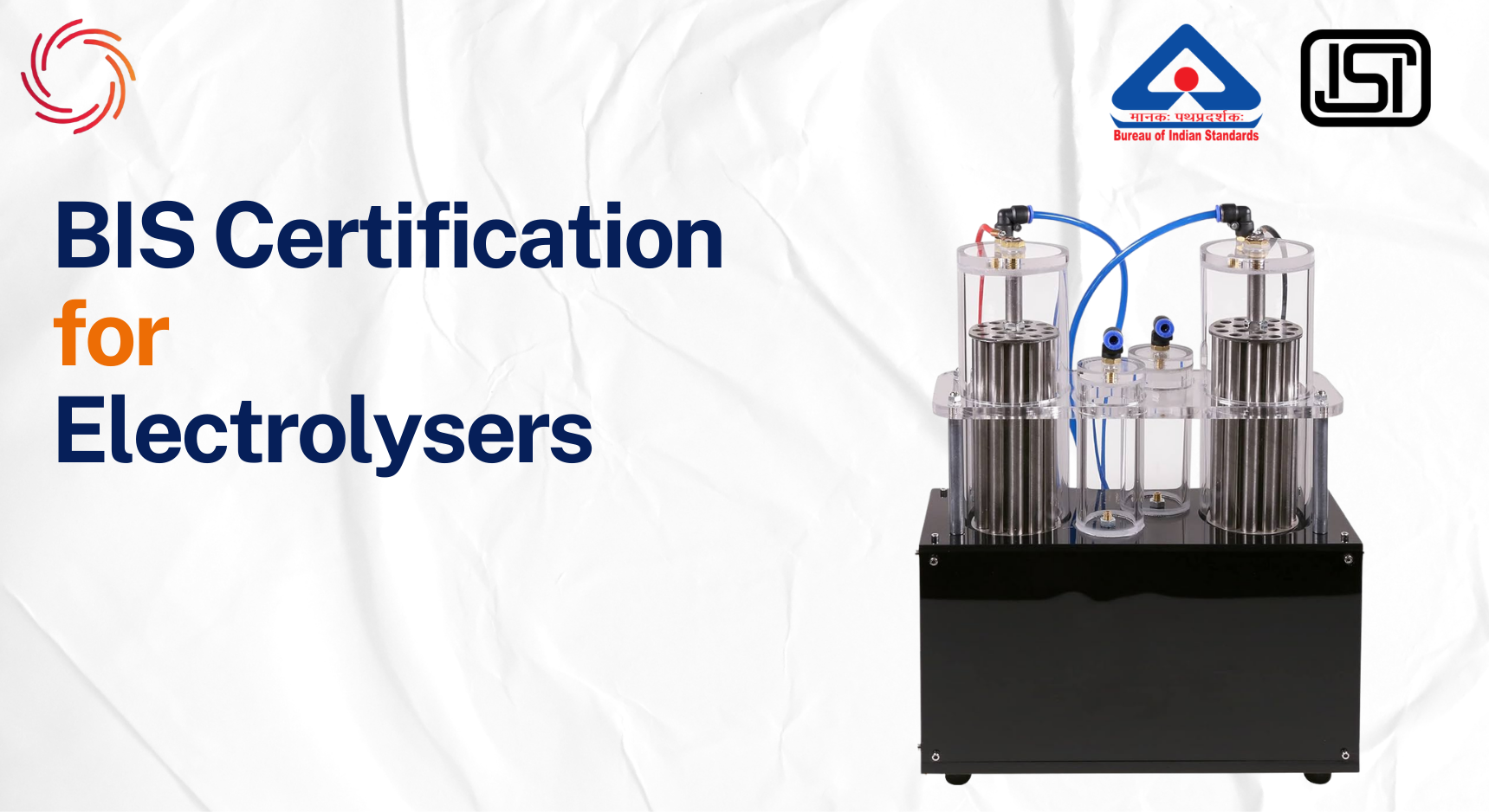
Electrolysers are electrical devices that split water into hydrogen and oxygen using electrolysis. Because they involve high electrical currents, power electronics, and pressurized gases, they must meet strict electrical safety requirements. A valid BIS Licence for Electrolysers under IS 302 (Part 1):2024 confirms compliance with Indian electrical safety standards before these systems can be legally manufactured, imported, or sold in India.
Electrolyser technology is becoming one of the most important components of the global clean energy transition. Electrolysers are systems that use electricity to split water into hydrogen and oxygen through the electrolysis process. Hydrogen produced through electrolysis—often referred to as green hydrogen when renewable energy is used—is increasingly being adopted across industries such as energy, transportation, chemicals, steel production, and power storage.
India has also announced strong policy initiatives for hydrogen production under the National Green Hydrogen Mission, which has significantly increased demand for electrolyser technologies. These systems are used in industrial hydrogen generation plants, laboratory hydrogen generators, energy storage applications, and hydrogen fueling infrastructure.
Because electrolysers operate with high electrical loads, electrolytic cells, conductive electrolytes, control systems, and power electronics, improper design can create serious safety hazards. Electrical faults may cause overheating, insulation failure, electrical shocks, or fire hazards. Therefore, regulatory safety standards are essential to ensure these systems are safe for operation.
To regulate the safety of electrical appliances and equipment, India requires compliance with the national standards established by the Bureau of Indian Standards. Manufacturers and importers must obtain a BIS Certificate for Electrolysers under IS 302 (Part 1):2024, which covers the safety of household and similar electrical appliances.
Obtaining a BIS Certification for Electrolysers confirms that the product has undergone safety testing, electrical evaluation, and factory verification to ensure compliance with Indian standards. A valid BIS License for Electrolysers also allows the manufacturer to use the ISI certification mark, indicating that the product meets recognized safety benchmarks.
This comprehensive guide explains everything manufacturers, importers, technology startups, and industrial equipment suppliers need to know about obtaining a BIS Licence for Electrolysers in India. It covers certification requirements, application procedures, testing standards, compliance obligations, documentation requirements, certification costs, and regulatory penalties.
What is BIS Certification?
BIS Certification is the official product conformity assessment scheme administered by the Bureau of Indian Standards (BIS). The primary objective of this certification system is to ensure that products sold in India meet defined standards for safety, performance, and quality. Electrical equipment, including electrolysers, must comply with applicable Indian standards before entering the market.
Applicable BIS Standard for Electrolysers
IS 302 (Part 1):2024 — Safety of Electrical Appliances
The applicable standard for electrolyser systems is IS 302 (Part 1):2024, which defines electrical safety requirements for appliances operating with electricity. Although electrolysers are industrial equipment, they contain several components covered by electrical appliance safety regulations, including:
- Power supply systems
- Control circuits
- Heating and electrolytic cells
- Electrical insulation and wiring
- Electronic control modules
Who Must Comply
Compliance is mandatory for:
- Electrolyser manufacturers in India
- Importers bringing electrolyser systems into India
- Foreign manufacturers exporting electrolysers to India
- Private-label technology companies
Why BIS Certification is Mandatory for Electrolysers
Electrolysers are complex electrochemical systems that combine electrical engineering, chemical processes, and mechanical components. Because of this complexity, regulatory safety certification is essential.
Consumer and Operator Safety Risks
Potential hazards associated with electrolysers include:
- Electrical shock from high-voltage systems
- Thermal hazards due to overheating
- Leakage currents in conductive electrolytes
- Short circuits in power electronics
- Fire risks due to insulation failure
BIS certification ensures that these risks are minimized through standardized testing.
Step-by-Step BIS Certification Process for Electrolysers
Applicability & Standard Identification
The certification process begins with determining whether the electrolyser system falls within the scope of the relevant BIS standard. Manufacturers must evaluate:
- Electrical ratings
- Power supply specifications
- Control systems
- Heating or electrochemical components
BIS Online Application Process
The BIS application process for Electrolysers involves the following steps:
- Registration on the BIS certification portal
- Submission of product details and technical specifications
- Uploading supporting documentation
- Payment of application fees
Fees & Cost Structure
The bis certificate cost for Electrolysers depends on several factors, including:
- Product complexity
- Number of models
- Laboratory testing requirements
- Factory inspection costs
Typical cost components include:
- BIS application fee
- Product testing charges
- Inspection expenses
- Certification license fee
The bis certification cost for Electrolysers may vary depending on project scale and testing complexity.
Product Sample Testing
Electrolyser systems must undergo testing in BIS-recognized laboratories. Testing evaluates:
- Electrical insulation
- Leakage current
- Temperature rise
- Mechanical stability
- Operational safety
Factory Inspection & Audit
BIS officials conduct a factory audit to verify:
- Manufacturing process controls
- Quality assurance procedures
- Production consistency
- Testing equipment availability
Grant of BIS License & ISI Mark
Once the product successfully completes testing and inspection:
- BIS grants the certification license
- The manufacturer receives authorization to use the ISI mark
Post-Certification Compliance
After obtaining certification, manufacturers must maintain compliance through:
- Periodic surveillance audits
- Random product testing
- License renewal
Scope of BIS License as per IS 302 (Part 1):2024
The BIS license defines the scope of certified products and their technical specifications. For electrolysers, the license may cover:
- Hydrogen generation units
- Industrial electrolytic hydrogen systems
- Water electrolysis equipment
- Compact hydrogen generators
The certification applies to both industrial installations and laboratory hydrogen generation equipment.
Documents Required for BIS Certification
Manufacturers must submit several documents during the certification process.
Manufacturer Documents
- Factory registration certificate
- Manufacturing process flowchart
- Machinery and equipment list
Legal Documents
- Company registration certificate
- GST registration
- Trademark authorization
Technical Documents
- Electrical circuit diagrams
- Product specifications
- Bill of materials
- Product operation manual
BIS Application Documents
- BIS application form
- Compliance declarations
- Test reports
These collectively form the bis certification documents for Electrolysers.
Testing Requirements as per IS 302 (Part 1):2024
Electrolyser systems must pass several safety tests. Key Tests Include:
- Insulation resistance test
- Electric strength test
- Leakage current test
- Temperature rise test
- Abnormal operation test
- Mechanical safety test
Testing must be conducted only in BIS-recognized laboratories.
Who Needs BIS Certification for Electrolysers?
The following entities must obtain certification before selling electrolysers in India:
- Manufacturers — Domestic manufacturers must obtain BIS certification before production.
- Importers — Importers must ensure the product is certified before customs clearance.
- Foreign Manufacturers — Foreign manufacturers must obtain certification through authorized Indian representatives.
- Traders and Distributors — Businesses distributing electrolysers must ensure the product carries a valid BIS mark.
- E-Commerce Sellers — Online platforms must verify certification before listing electrical equipment.
Conclusion
Obtaining a BIS Certificate for Electrolysers under IS 302 (Part 1):2024 is essential for manufacturers and importers planning to introduce electrolyser technology in the Indian market. A valid BIS Certification for Electrolysers confirms that the equipment meets national electrical safety standards, while the BIS License for Electrolysers ensures legal compliance and allows the use of the ISI mark.
As India accelerates its transition toward hydrogen-based energy systems, companies that secure a BIS Licence for Electrolysers will be better positioned to participate in emerging clean energy projects while maintaining the highest standards of safety and reliability.
FAQs – BIS Certification for Electrolysers
1. What is an electrolyser and why does it require BIS certification?
An electrolyser is an electrical device that splits water into hydrogen and oxygen through electrolysis. Because it operates using electricity and involves conductive electrolytes, there are risks related to electrical insulation, leakage current, and overheating. BIS certification ensures the system has been tested according to Indian safety standards and can operate safely in industrial or laboratory environments.
2. Is BIS certification mandatory for electrolysers in India?
Yes, electrical equipment that falls under the scope of applicable BIS standards must obtain certification before being sold in the Indian market. Electrolysers that include electrical power systems, control circuits, or heating components must comply with BIS safety regulations.
3. How long does the BIS certification process take for electrolysers?
The certification process generally takes 4–8 weeks, depending on product complexity and laboratory testing timelines. If the product fails initial testing, modifications may be required, which can extend the approval process.
4. What are the main tests performed during certification?
Testing focuses on electrical safety and operational stability. Common tests include insulation resistance testing, electric strength testing, leakage current measurement, temperature rise evaluation, and abnormal operation testing.
5. What documents are required for BIS certification?
Applicants must provide several documents, including company registration certificates, product technical specifications, electrical circuit diagrams, user manuals, manufacturing process details, and BIS application forms.
6. Can imported electrolysers be sold without BIS certification?
No. Imported electrolysers must comply with Indian BIS standards before they can be sold or distributed. Customs authorities may refuse entry of products that lack valid certification.
7. What happens if the electrolyser fails testing?
If a product fails laboratory testing, the manufacturer receives a report detailing the issues. The product must be modified to meet safety requirements and resubmitted for testing before certification can be granted.
8. Is factory inspection mandatory?
Yes. BIS conducts factory inspections to ensure that the manufacturer has appropriate production controls and testing facilities.
9. How long is a BIS license valid?
The license typically remains valid as long as the manufacturer complies with BIS regulations and successfully completes surveillance inspections.
10. Can multiple electrolyser models be certified together?
Yes, similar product variants with identical design characteristics may be grouped under a single license if they meet BIS grouping guidelines.
11. Does BIS certification improve product credibility?
Yes. Certification enhances trust among customers, industrial buyers, and project developers by demonstrating compliance with recognized safety standards.
12. What is the cost of BIS certification for electrolysers?
The cost of BIS certification for Electrolysers varies depending on testing requirements, number of models, and inspection scope. Manufacturers should consider application fees, laboratory testing charges, and license fees when estimating total costs.
Related Resources
Many of our users also read
Our Principal Regulatory Consultant, a former BIS Deputy Director General (Standardization). With over 30 years of service, he specializes in interpreting the Bureau of Indian Standards Act and simplifying complex certification workflows for Indian manufacturers.
Dhruv Aggarwal
Head of Operations at Sun Certifications India
Experience: 10+ years & Handled 1000+ projects
Awarded by many Indian and International organisations








PT Quty Karunia, BIS Licensee in Vietnam
“Sun Certifications India provided excellent BIS Certification services. Their unparalleled service and sincerity gained our trust. One of the best BIS consultants in India!”

Thantawan Industries Ltd, BIS Licensee in Thailand
“Sun Certifications India supported us throughout the BIS certification process. Their responsive customer service and punctuality are exceptional. Highly recommend for hassle-free BIS certification.”

Leaderart Industries, BIS Licensee in Malaysia
“Sun Certifications India helped us acquire BIS Certification, doubling our engagement in India. Their services are fast, genuine, and up-to-date with latest BIS norms.”

Aluminium Bahrain (ALBA), BIS Licensee in Bahrain
“Excellent BIS certification support, highly reliable consultants.”

Bahrain Aluminium Manufacturing Company, BIS Licensee in Bahrain
“Smooth BIS registration process with expert consultants.”

Daiki Aluminium Japan, BIS Licensee in Japan
“Efficient BIS license assistance, great consultants.”

Trimble Navigation, BIS Licensee in USA
“Seamless BIS certification and registration support.”

Remsa Italia, BIS Licensee in Italy
“Helpful BIS consultants, simplified license process.”

Aquazzura, BIS Licensee in Italy
“We got our BIS certificate well within the timelines and at affordable prices, great work team Sun!”

PT Quty, BIS Licensee in Indonesia
“Excellent BIS registration service, highly recommended.”

Danu Vina, BIS Licensee in Vietnam
“Reliable BIS license consultants, fast process.”

Hanh My Production Company, BIS Licensee in Vietnam
“Expert BIS consultants, certification made easy.”

Sedo Vina, BIS Licensee in Vietnam
“Smooth BIS certificate registration, great support.”

Misumi Japan, BIS Licensee in Japan
“Trusted BIS consultants, quick certification process.”

Thantawan Public Industry Company, BIS Licensee in Thailand
“Professional BIS certification service, very efficient.”

Cortizo Aluminios, BIS Licensee in Spain
“Excellent BIS registration and license guidance.”

Midal Cables, BIS Licensee in Bahrain
“Expert BIS consultants, smooth certification process.”
Years Exp.
Our Clients
Success Rate
Countries Served
Our team brings 10e4+ years of experience in CDSCO and BIS compliance.
We reduce approval time by up to 40% with streamlined processes.
100% success rate with 1500+ successful registrations.
Dedicated account manager ensuring personalized service.
Leave your details below and our experts will call you back within 24 hours to discuss your regulatory compliance needs.
By submitting this form, you agree to our Privacy Policy and consent to being contacted.