BIS Certification Fibre Ropes - Polyethylene - Complete Guide to IS 8674:2013
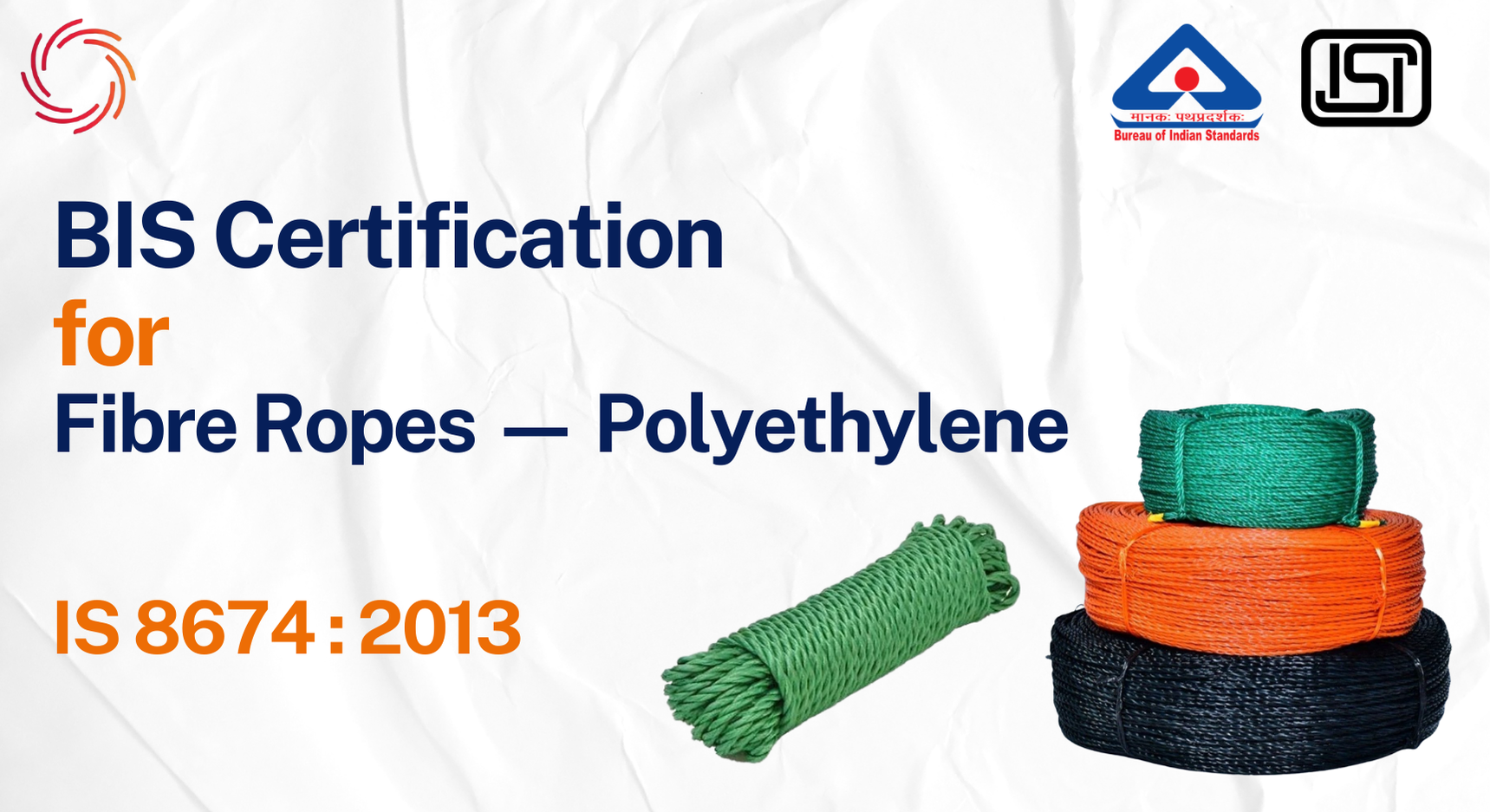
Polyethylene fibre ropes are widely used across India in marine operations, fishing, ports, agriculture, construction, logistics, transportation, and general industrial activities. Their lightweight nature, high strength-to-weight ratio, resistance to moisture, chemicals, and abrasion make them ideal for demanding environments. However, when fibre ropes fail under load due to poor quality or substandard manufacturing, the consequences can be severe-ranging from equipment damage to serious injuries and even loss of life.
To ensure safety, uniform quality, and performance reliability, the Government of India has made BIS Certification for Fibre Ropes - Polyethylene mandatory under IS 8674:2013. Any manufacturer or importer supplying polyethylene fibre ropes in the Indian market must obtain a valid BIS Certificate for Fibre Ropes - Polyethylene. Without this certification, the product is considered non-compliant and may face legal penalties, seizure, or prohibition from sale.
This detailed product page is written for manufacturers, importers, exporters, traders, distributors, marine suppliers, infrastructure contractors, and e-commerce sellers. It explains the complete framework of BIS Certification for Fibre Ropes - Polyethylene, including standard requirements, testing procedures, documentation, costs, timelines, and compliance responsibilities. If you are planning to obtain a BIS License / BIS Licence for Fibre Ropes - Polyethylene, this guide will help you navigate the process with clarity and confidence.
Also read the QCO Notification for Fibre Ropes (Polyethylene) (IS 8674)
What is BIS Certification?
BIS Certification is a product conformity assessment system administered by the Bureau of Indian Standards (BIS), the national standards authority of India. The BIS full form is Bureau of Indian Standards, established under the BIS Act, 2016.
BIS Certificate Meaning
The BIS Certificate meaning refers to official recognition that a product conforms to a specific Indian Standard (IS) and meets prescribed requirements related to safety, strength, durability, and performance. A BIS-certified product undergoes testing in BIS-recognized laboratories and assessment through factory inspection and quality audits.
ISI Mark and BIS Certification Mark
Products certified under BIS carry the BIS certification mark, commonly known as the ISI Mark, along with a unique license number. The BIS Mark assures buyers, inspectors, and regulatory authorities that the product complies with applicable BIS Standards.
Why BIS Exists
BIS exists to:
- Protect users from unsafe and substandard products
- Ensure consistency and reliability in manufacturing
- Enforce government regulations through BIS notifications
- Promote trust, quality, and fair trade in the Indian market
Applicable BIS Standard for Fibre Ropes - Polyethylene
IS 8674:2013 - Indian Standard Explained
The applicable Indian Standard for this product is IS 8674:2013, titled "Fibre Ropes - Polyethylene - Specification". This standard defines requirements for polyethylene fibre ropes intended for general-purpose and industrial applications.
Scope of IS 8674:2013
The standard covers:
- Construction and classification of polyethylene fibre ropes
- Raw material requirements and fibre characteristics
- Rope diameter, linear density, and tolerances
- Minimum breaking load and strength requirements
- Marking, labeling, and packaging provisions
Safety, Performance & Testing Intent
IS 8674:2013 aims to ensure that polyethylene fibre ropes:
- Deliver consistent tensile strength
- Perform reliably under static and dynamic loads
- Resist moisture, rot, and chemical exposure
- Are safe for lifting, hauling, mooring, and tying operations
Who Must Comply
Compliance with IS 8674:2013 is mandatory for:
- Indian manufacturers of polyethylene fibre ropes
- Importers bringing polyethylene ropes into India
- Foreign manufacturers selling through Indian entities
Why BIS Certification is Mandatory for Fibre Ropes - Polyethylene
1. Consumer and Worker Safety Risks
Polyethylene fibre ropes are frequently used in load-bearing and safety-critical operations. Substandard ropes may break suddenly, leading to accidents, injuries, equipment damage, and financial losses.
2. Government Compliance
Under BIS notifications and quality control regulations, fibre ropes covered under IS 8674:2013 must be BIS certified before sale, supply, or distribution in India.
3. Legal Implications
Selling polyethylene fibre ropes without BIS certification can result in:
- Seizure of goods
- Monetary penalties
- Cancellation of contracts and tenders
- Prosecution under the BIS Act, 2016
4. Market and Brand Benefits
A BIS Certificate for Fibre Ropes - Polyethylene improves market acceptance, builds buyer trust, and enables participation in government, PSU, marine, and infrastructure projects.
Step-by-Step BIS Certification Process for Fibre Ropes - Polyethylene
Applicability & Standard Identification
The first step is confirming that the product falls under IS 8674:2013, including rope construction, diameter range, and intended application.
BIS Online Application Process
Manufacturers must submit the BIS application through the BIS apply online portal. The application includes:
- Product and model details
- Manufacturing unit information
- Applicable BIS standard
- Quality control and testing details
This initiates the BIS certificate registration process.
Fees & Cost Structure
The BIS certification cost generally includes:
- Application fee
- Product testing charges
- Factory inspection fee
- License fee
- Annual marking fee
The total cost of BIS certification depends on rope variants, diameter ranges, and testing scope.
Product Sample Testing (Detailed Tests as per Standard)
Samples of polyethylene fibre ropes are tested in BIS-recognized laboratories strictly as per IS 8674:2013.
Factory Inspection & Audit
BIS officials conduct a factory audit to verify:
- Manufacturing process and controls
- Raw material inspection procedures
- In-process quality checks
- Testing and calibration facilities
Grant of BIS License & ISI Mark
After successful testing and inspection, BIS grants the Bureau of Indian Standards License, allowing use of the ISI Mark on certified polyethylene fibre ropes.
Post-Certification Compliance
After certification, license holders must:
- Maintain consistent quality
- Conduct routine testing
- Allow surveillance inspections
- Renew the BIS license periodically
Scope of BIS License as per IS 8674:2013
The BIS license applies to polyethylene fibre ropes intended for:
- Marine and fishing operations
- Ports, shipping, and logistics
- Agriculture and general utility use
- Industrial and commercial applications
The scope is strictly limited to ropes conforming to IS 8674:2013 specifications.
Documents Required for BIS Certification
Manufacturer Documents
- Factory registration certificate
- Manufacturing process flow chart
- List of machinery and testing equipment
- Quality control plan
Legal Documents
- Company incorporation certificate
- GST registration
- Trademark authorization (if applicable)
Technical Documents
- Product specifications and drawings
- Rope construction and material details
- Diameter and breaking load data
- Internal test procedures
BIS Application Documents
- BIS application form
- Test reports from BIS-recognized labs
- Undertakings and declarations
These form the complete set of BIS CERTIFICATION DOCUMENTS.
Testing Requirements as per IS 8674:2013
Mandatory tests include:
- Diameter and linear density measurement
- Breaking load and tensile strength test
- Elongation test
- Construction and lay verification
- Visual inspection and finish quality
- Marking and labeling compliance
All testing must be conducted only in BIS-recognized laboratories.
Common Challenges & How to Avoid Them
Inconsistent Raw Material Quality
Solution: Use controlled-grade polyethylene fibres and approved suppliers.
Test Failures
Solution: Conduct internal pre-testing and improve process consistency.
Documentation Errors
Solution: Prepare accurate and complete documents before BIS submission.
Benefits of BIS Certification for Manufacturers & Importers
Legal Benefits
- Compliance with Indian regulations
- Reduced risk of penalties and seizures
Commercial Benefits
- Eligibility for government, PSU, and marine contracts
- Improved acceptance by industrial buyers
Branding Benefits
- Trust through BIS certification mark
- Enhanced brand credibility
Market Expansion
- Access to regulated domestic and export-oriented markets
Penalties for Non-Compliance
Failure to comply with BIS requirements can lead to:
- Heavy monetary penalties
- Seizure of non-compliant products
- Import and sales restrictions
- Legal prosecution
- Permanent market bans
Who Needs BIS Certification for Fibre Ropes - Polyethylene?
- Indian manufacturers
- Importers
- Foreign manufacturers
- Traders and distributors
- E-commerce sellers
Any entity placing polyethylene fibre ropes on the Indian market must ensure BIS compliance.
Conclusion
Obtaining a BIS Certificate for Fibre Ropes - Polyethylene under IS 8674:2013 is a legal necessity and a strategic advantage for businesses operating in India. BIS Certification for Fibre Ropes - Polyethylene ensures product safety, strength, and reliability while protecting users and strengthening brand credibility.
Manufacturers and importers who secure a valid BIS License / BIS Licence for Fibre Ropes - Polyethylene can confidently access regulated markets, participate in high-value contracts, and avoid legal risks. With proper preparation, accurate documentation, and expert guidance, the BIS certification process becomes smooth, efficient, and highly beneficial for long-term growth.
FAQs - BIS Certification for Fibre Ropes - Polyethylene
Q1. Is BIS certification mandatory for polyethylene fibre ropes in India?
Yes, BIS certification under IS 8674:2013 is mandatory.
Q2. What is the BIS full form?
Bureau of Indian Standards.
Q3. Can polyethylene ropes be sold without BIS certification?
No, uncertified ropes are illegal to sell in India.
Q4. What is the BIS certificate cost?
It depends on product variants and testing scope.
Q5. How long does the BIS certification process take?
Typically 6-10 weeks.
Q6. Is the ISI mark compulsory?
Yes, ISI marking is mandatory after certification.
Q7. Can multiple rope diameters be covered under one license?
Yes, subject to compliance and testing coverage.
Q8. Is factory inspection mandatory?
Yes, BIS conducts factory audits.
Q9. Can startups apply for BIS certification?
Yes, if manufacturing facilities comply.
Q10. Does BIS certification require renewal?
Yes, periodic renewal is mandatory.
Q11. What happens if product testing fails?
Corrective action and retesting are required.
Q12. Are BIS-recognized labs compulsory?
Yes, only BIS-approved labs are accepted.
Q13. Can foreign manufacturers apply directly?
Yes, through an Authorized Indian Representative.
Q14. Are fishing ropes covered under this standard?
Yes, if they conform to IS 8674:2013.
Q15. What does BIS certification mean for buyers?
It assures safety, strength, and consistent quality.
Related Resources
Many of our users also read
This compliance advisory was vetted by our Senior Consultant (Enforcement & Vigilance), a former BIS Director (Enforcement). He specializes in post-certification compliance, helping companies navigate surveillance audits and legal adherence to BIS mandates.
Dhruv Aggarwal
Head of Operations at Sun Certifications India
Experience: 10+ years & Handled 1000+ projects
Awarded by many Indian and International organisations








PT Quty Karunia, BIS Licensee in Vietnam
“Sun Certifications India provided excellent BIS Certification services. Their unparalleled service and sincerity gained our trust. One of the best BIS consultants in India!”

Thantawan Industries Ltd, BIS Licensee in Thailand
“Sun Certifications India supported us throughout the BIS certification process. Their responsive customer service and punctuality are exceptional. Highly recommend for hassle-free BIS certification.”

Leaderart Industries, BIS Licensee in Malaysia
“Sun Certifications India helped us acquire BIS Certification, doubling our engagement in India. Their services are fast, genuine, and up-to-date with latest BIS norms.”

Aluminium Bahrain (ALBA), BIS Licensee in Bahrain
“Excellent BIS certification support, highly reliable consultants.”

Bahrain Aluminium Manufacturing Company, BIS Licensee in Bahrain
“Smooth BIS registration process with expert consultants.”

Daiki Aluminium Japan, BIS Licensee in Japan
“Efficient BIS license assistance, great consultants.”

Trimble Navigation, BIS Licensee in USA
“Seamless BIS certification and registration support.”

Remsa Italia, BIS Licensee in Italy
“Helpful BIS consultants, simplified license process.”

Aquazzura, BIS Licensee in Italy
“We got our BIS certificate well within the timelines and at affordable prices, great work team Sun!”

PT Quty, BIS Licensee in Indonesia
“Excellent BIS registration service, highly recommended.”

Danu Vina, BIS Licensee in Vietnam
“Reliable BIS license consultants, fast process.”

Hanh My Production Company, BIS Licensee in Vietnam
“Expert BIS consultants, certification made easy.”

Sedo Vina, BIS Licensee in Vietnam
“Smooth BIS certificate registration, great support.”

Misumi Japan, BIS Licensee in Japan
“Trusted BIS consultants, quick certification process.”

Thantawan Public Industry Company, BIS Licensee in Thailand
“Professional BIS certification service, very efficient.”

Cortizo Aluminios, BIS Licensee in Spain
“Excellent BIS registration and license guidance.”

Midal Cables, BIS Licensee in Bahrain
“Expert BIS consultants, smooth certification process.”
Years Exp.
Our Clients
Success Rate
Countries Served
Our team brings 10e4+ years of experience in CDSCO and BIS compliance.
We reduce approval time by up to 40% with streamlined processes.
100% success rate with 1500+ successful registrations.
Dedicated account manager ensuring personalized service.
Leave your details below and our experts will call you back within 24 hours to discuss your regulatory compliance needs.
By submitting this form, you agree to our Privacy Policy and consent to being contacted.