BIS Certificate for Flashlight under IS 2083:2024 – Complete Compliance Guide
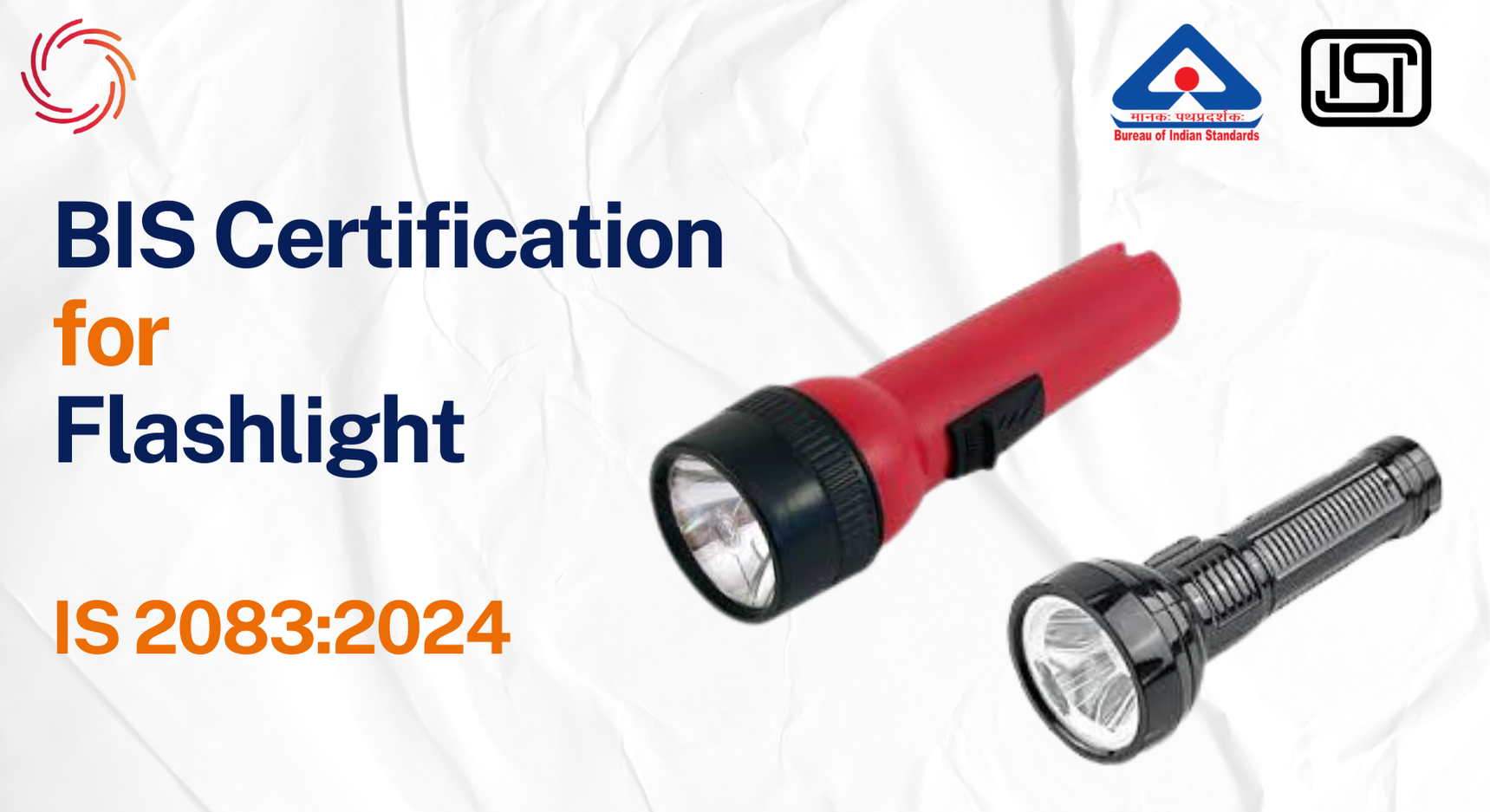
Flashlights (commonly referred to as torches) are essential portable lighting devices used across households, industries, emergency services, security operations, outdoor activities, and disaster management. Because flashlights are electrical products that involve batteries, circuitry, light sources, and enclosures, quality and safety compliance is critical.
To regulate product quality, performance, and consumer safety, the Bureau of Indian Standards (BIS) has notified IS 2083:2024 – Flashlight: Specification, making BIS Certification mandatory for flashlights sold, manufactured, or imported into India.
This page provides a comprehensive and original explanation of BIS Certification for flashlights, covering the applicable standard, certification process, testing requirements, documentation, fees, timelines, penalties, and compliance responsibilities.
What is BIS Certification and Why It Applies to Flashlights
The Bureau of Indian Standards (BIS) is India's national standards authority responsible for ensuring that products sold in the Indian market meet prescribed safety, quality, and performance benchmarks.
Meaning of BIS Certification
A BIS Certificate confirms that a flashlight:
- Conforms to Indian Standard IS 2083:2024
- Has passed all mandatory laboratory tests
- Meets electrical, mechanical, and performance requirements
- Is safe for consumer use
Once approved, the manufacturer is permitted to affix the ISI Mark, which signifies compliance with Indian Standards.
Applicable Indian Standard – IS 2083:2024 (Flashlight: Specification)
🔹 IS 2083:2024 – Flashlight: Specification
IS 2083:2024 defines the construction, performance, safety, and testing requirements for portable flashlights used for general illumination.
Scope of IS 2083:2024
The standard covers:
- Handheld flashlights (torches)
- Battery-operated flashlights
- Rechargeable flashlights
- LED flashlights
- Emergency and utility flashlights
Key Areas Covered by the Standard
- Electrical safety
- Luminous performance
- Mechanical strength
- Battery compatibility
- Switch durability
- Protection against overheating
- Resistance to normal wear and tear
- Marking and labeling requirements
Any flashlight that falls under this scope must obtain a BIS License for Flashlight before entering the Indian market.
Why BIS Certification is Mandatory for Flashlights
Flashlights are widely used by consumers of all age groups and in critical situations such as emergencies, power outages, and industrial operations. Substandard flashlights can cause:
- Electrical short circuits
- Battery leakage or explosion
- Overheating
- Fire hazards
- Poor illumination performance
- Premature failure
BIS Certification Ensures
- Electrical and user safety
- Consistent light output
- Durable construction
- Safe battery operation
- Compliance with Indian regulatory requirements
Selling non-certified flashlights is a legal violation under the BIS Act, 2016.
Scope of BIS License for Flashlight
1.1 This standard specifies the requirements and tests for flashlights powered by replaceable primary batteries and replaceable/built-in secondary batteries with a maximum voltage of 48 V d.c.
1.2 This standard is applicable to pre-focused as well as focusing type of flashlights with incandescent bulb and LED module as light source.
1.3 The following are not covered under the scope of this standard:
- Cord and plug connected handlamps that are within the scope of IS 10322 (Part 5/Sec 6);
- Emergency lighting that is within the scope of IS 10322 (Part 5/Sec 8); and
- Flashlights that are intended for hazardous locations.
BIS Certification Process for Flashlights (IS 2083:2024)
The BIS certification process for flashlights is conducted under the ISI Mark Certification Scheme (Scheme-I) and involves multiple stages.
Step 1 – Product Identification & Standard Mapping
The manufacturer must confirm that the product qualifies as a flashlight under IS 2083:2024 and identify:
- Type of flashlight
- Power source (battery/rechargeable)
- Light source (LED, bulb, etc.)
- Variants and models
Step 2 – Online BIS Application
The application is submitted through the BIS Manak Online Portal, along with:
- Manufacturer details
- Factory address
- Product description
- Brand/trademark details
- Manufacturing process information
Step 3 – Payment of BIS Fees
Applicable fees include:
- Application fee
- Processing charges
- Product testing fees
- Factory inspection charges
- Marking fee
Step 4 – Product Testing as per IS 2083:2024
Samples are tested at a BIS-recognized laboratory.
Mandatory Tests for Flashlights
- Luminous intensity test
- Light output stability test
- Battery endurance test
- Switch operation test
- Mechanical strength (drop test)
- Insulation resistance test
- Temperature rise test
- Electrical safety test
- Marking and labeling verification
Test reports are directly submitted to BIS by the laboratory.
Step 5 – Factory Inspection
A BIS officer conducts an on-site inspection to verify:
- Manufacturing setup
- Quality control system
- Incoming material inspection
- In-process checks
- Finished product testing
- Calibration of test instruments
Compliance with the Scheme of Testing and Inspection (STI) is mandatory.
Step 6 – Grant of BIS License
After successful testing and inspection, BIS issues:
- BIS Certificate
- ISI Mark approval
- CML (Certificate of Manufacturing Licence) number
The manufacturer can now legally manufacture and sell flashlights in India.
Step 7 – Post-Certification Compliance
After certification, manufacturers must:
- Use ISI Mark correctly on product and packaging
- Maintain batch-wise quality records
- Allow BIS surveillance inspections
- Renew the license periodically
Documents Required for BIS Certification of Flashlights
Manufacturing Documents
- Factory registration/license
- Manufacturing process flow chart
- List of machinery
- In-house testing equipment list
- Calibration certificates
- Factory layout
Technical Documents
- Product specification sheet
- Circuit diagrams
- Battery specifications
- Bill of materials
- Internal test reports
Legal Documents
- Identity proof of authorized signatory
- Address proof
- Brand authorization letter
- Trademark certificate (if applicable)
BIS-Specific Documents
- BIS application form
- Undertakings and declarations
- Test request letter
- Label artwork (ISI marking format)
Testing Requirements under IS 2083:2024 (Detailed)
Flashlights must undergo rigorous testing to ensure safety and performance.
Only products passing all mandatory tests qualify for BIS approval.
Common Challenges in BIS Certification for Flashlights
- Failure in temperature rise test
- Inconsistent luminous output
- Poor switch durability
- Battery compatibility issues
- Incorrect ISI label format
- Incomplete documentation
Pre-testing and expert guidance significantly reduce rejection risks.
Benefits of BIS Certification for Flashlight Manufacturers
- Legal permission to sell in India
- Enhanced consumer trust
- Improved product reliability
- Acceptance on e-commerce platforms
- Eligibility for government procurement
- Reduced liability and recalls
- Strong brand credibility
Penalties for Selling Flashlights Without BIS Certification
Non-compliance may result in:
- Product seizure
- Heavy monetary penalties
- Import bans
- Manufacturing shutdowns
- Criminal prosecution under BIS Act
Who Needs BIS Certification for Flashlights?
- Indian manufacturers
- Foreign manufacturers exporting to India
- Importers
- Brand owners
- OEM/ODM suppliers
- Online sellers and distributors
Each manufacturing unit requires a separate BIS license.
Conclusion
The BIS Certificate for Flashlight under IS 2083:2024 is a mandatory regulatory requirement that ensures safety, performance, and reliability of portable lighting products in India. Compliance not only protects consumers but also strengthens brand credibility and market access. With professional guidance, manufacturers and importers can achieve BIS certification smoothly and efficiently.
FAQs – BIS Certificate for Flashlight (IS 2083:2024)
1. Is BIS Certification mandatory for flashlights in India?
Yes. Flashlights covered under IS 2083:2024 must be BIS certified.
2. Which standard applies to flashlights?
IS 2083:2024 – Flashlight: Specification.
3. How long does the BIS process take?
Approximately 30–45 working days for Indian Manufacturers and around 120 days for Foreign Manufacturers.
4. Can foreign manufacturers apply for BIS certification?
Yes, through the FMCS scheme.
5. Is ISI marking mandatory?
Yes, ISI Mark must be displayed on certified flashlights.
6. What happens if a flashlight fails testing?
The product must be corrected and retested.
7. Are rechargeable flashlights also covered?
Yes, if they fall within the scope of IS 2083:2024.
8. How long is the BIS license valid?
1–2 years, renewable.
9. Can multiple models be covered under one license?
Yes, if they meet similarity criteria.
Related Resources
Many of our users also read
This compliance advisory was vetted by our Senior Consultant (Enforcement & Vigilance), a former BIS Director (Enforcement). He specializes in post-certification compliance, helping companies navigate surveillance audits and legal adherence to BIS mandates.
Dhruv Aggarwal
Head of Operations at Sun Certifications India
Experience: 10+ years & Handled 1000+ projects
Awarded by many Indian and International organisations








PT Quty Karunia, BIS Licensee in Vietnam
“Sun Certifications India provided excellent BIS Certification services. Their unparalleled service and sincerity gained our trust. One of the best BIS consultants in India!”

Thantawan Industries Ltd, BIS Licensee in Thailand
“Sun Certifications India supported us throughout the BIS certification process. Their responsive customer service and punctuality are exceptional. Highly recommend for hassle-free BIS certification.”

Leaderart Industries, BIS Licensee in Malaysia
“Sun Certifications India helped us acquire BIS Certification, doubling our engagement in India. Their services are fast, genuine, and up-to-date with latest BIS norms.”

Aluminium Bahrain (ALBA), BIS Licensee in Bahrain
“Excellent BIS certification support, highly reliable consultants.”

Bahrain Aluminium Manufacturing Company, BIS Licensee in Bahrain
“Smooth BIS registration process with expert consultants.”

Daiki Aluminium Japan, BIS Licensee in Japan
“Efficient BIS license assistance, great consultants.”

Trimble Navigation, BIS Licensee in USA
“Seamless BIS certification and registration support.”

Remsa Italia, BIS Licensee in Italy
“Helpful BIS consultants, simplified license process.”

Aquazzura, BIS Licensee in Italy
“We got our BIS certificate well within the timelines and at affordable prices, great work team Sun!”

PT Quty, BIS Licensee in Indonesia
“Excellent BIS registration service, highly recommended.”

Danu Vina, BIS Licensee in Vietnam
“Reliable BIS license consultants, fast process.”

Hanh My Production Company, BIS Licensee in Vietnam
“Expert BIS consultants, certification made easy.”

Sedo Vina, BIS Licensee in Vietnam
“Smooth BIS certificate registration, great support.”

Misumi Japan, BIS Licensee in Japan
“Trusted BIS consultants, quick certification process.”

Thantawan Public Industry Company, BIS Licensee in Thailand
“Professional BIS certification service, very efficient.”

Cortizo Aluminios, BIS Licensee in Spain
“Excellent BIS registration and license guidance.”

Midal Cables, BIS Licensee in Bahrain
“Expert BIS consultants, smooth certification process.”
Years Exp.
Our Clients
Success Rate
Countries Served
Our team brings 10e4+ years of experience in CDSCO and BIS compliance.
We reduce approval time by up to 40% with streamlined processes.
100% success rate with 1500+ successful registrations.
Dedicated account manager ensuring personalized service.
Leave your details below and our experts will call you back within 24 hours to discuss your regulatory compliance needs.
By submitting this form, you agree to our Privacy Policy and consent to being contacted.