BIS Certification for Food Waste Disposers – Complete Guide
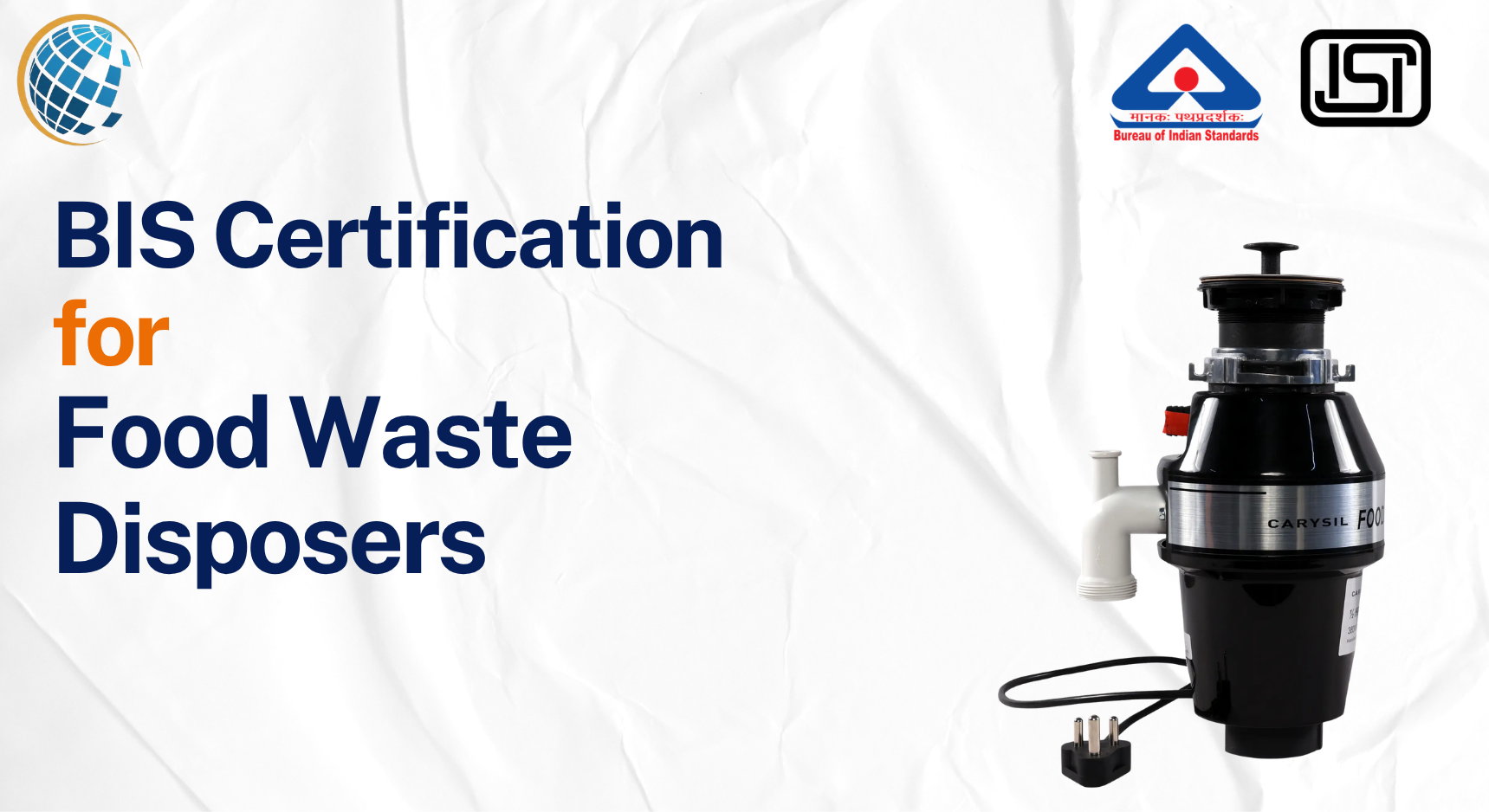
BIS certification for Food Waste Disposers confirms that electrically operated kitchen waste grinding appliances comply with IS 302 (Part 1):2024, ensuring safe operation in wet environments, protection against electrical hazards, and reliable performance under continuous load. This certification is essential for legal sale and safe usage in Indian households and commercial kitchens.
Food waste disposers—also known as kitchen waste grinders—are rapidly gaining popularity in Indian homes, hotels, and commercial kitchens. These devices are installed beneath sinks and are designed to shred food waste into small particles, allowing it to pass through plumbing systems efficiently.
Unlike many household appliances, food waste disposers operate in a unique combination of water, organic waste, and electricity, making them particularly sensitive from a safety standpoint. The presence of moisture, metal blades or grinding components, and continuous motor operation introduces risks that cannot be ignored.
For instance, improper insulation can lead to electric shock hazards, while poorly designed grinding mechanisms may cause mechanical failure or blockages. Additionally, since these devices are connected directly to kitchen drainage systems, leakage and corrosion become critical concerns over time.
To ensure that such appliances are safe for everyday use in Indian conditions, compliance with IS 302 (Part 1):2024 is required. Obtaining a BIS Certificate for Food Waste Disposers validates that the product has undergone rigorous testing and meets the necessary safety benchmarks.
For manufacturers, importers, and distributors, this certification plays a key role in ensuring smooth market entry and long-term product reliability.
Understanding BIS Certification for Food Waste Disposers
Food waste disposers differ significantly from other appliances because they combine mechanical grinding with electrical operation in a wet environment. This creates a distinct set of risks that must be carefully controlled.
A typical disposer consists of:
- A high-speed motor
- Grinding chamber with rotating impellers
- Electrical wiring exposed to moisture conditions
- Drainage integration with plumbing
Because of this setup, several issues can arise if the product is not properly designed:
- Water ingress into electrical components
- Motor overheating due to heavy food load
- Blade or grinding mechanism failure
- Electrical leakage through metal sink connections
The BIS Certification for Food Waste Disposers addresses these risks by ensuring:
- Proper sealing of electrical parts against water exposure
- Safe motor performance under varying load conditions
- Stability of grinding mechanisms
- Protection against accidental contact with moving parts
- Reliable insulation and earthing
Instead of evaluating the product in isolation, the certification process ensures that the disposer functions safely within a real kitchen environment, where water flow, food waste, and continuous usage are common.
Applicable BIS Standard for Food Waste Disposers
IS 302 (Part 1):2024
This standard provides a comprehensive framework for evaluating electrical safety and operational reliability of appliances like food waste disposers.
Scope of the Standard
IS 302 (Part 1):2024 applies to:
- Electrically operated food waste disposers
- Appliances installed in kitchens (domestic and commercial)
- Devices operating under wet conditions
- Products connected to standard power supply systems
Product Categories Covered
Under this standard, food waste disposers are categorized based on:
- Motor capacity
- Installation type (under-sink or integrated systems)
- Intended usage (household vs commercial kitchens)
Why BIS Certification is Mandatory for Food Waste Disposers
1. Electrical Safety in Wet Conditions
Food waste disposers operate in direct contact with water. Without proper insulation, users may face:
- Electric shocks
- Short circuits
2. Mechanical Safety
The grinding mechanism can pose risks if not properly designed:
- Injury during maintenance
- Internal damage due to overload
3. Fire and Overheating Risks
Continuous motor operation can lead to:
- Heat buildup
- Component failure
4. Consumer Protection
Certification ensures that the appliance performs safely even under:
- Heavy food waste loads
- Continuous kitchen usage
5. Regulatory Compliance
Without a BIS License for Food Waste Disposers, products may face:
- Market restrictions
- Legal penalties
6. Brand Credibility
A certified product reflects:
- Compliance with Indian safety norms
- Reliability in real-world usage
Step-by-Step BIS Certification Process for Food Waste Disposers
Applicability & Standard Identification
Manufacturers must first confirm that their product falls under IS 302 (Part 1):2024, based on its design and functionality.
BIS Online Application Submission
The application includes:
- Product specifications
- Manufacturing details
- Technical documentation
BIS Certification Cost Structure
The BIS certification cost for Food Waste Disposers includes:
- Testing fees
- Application charges
- Inspection costs
- Annual license fees
The cost of BIS certification for Food Waste Disposers varies depending on product complexity and testing scope.
Product Sample Testing as per IS 302 (Part 1):2024
Samples are tested in BIS-recognized laboratories for:
- Electrical safety
- Water resistance
- Mechanical durability
Factory Inspection & Quality Audit
BIS officials evaluate:
- Manufacturing processes
- Quality control systems
- Product consistency
Grant of BIS License and ISI Mark
After approval, the manufacturer receives a BIS Licence for Food Waste Disposers, allowing use of the ISI mark.
Post-Certification Compliance
Manufacturers must maintain:
- Product consistency
- Regular quality checks
- Compliance with BIS standards
Check complete details about documentation, cost, and process etc.
Documents Required for BIS Certification
Manufacturer Documents
- Factory registration certificate
- Manufacturing process details
Legal Documents
- Business license
- Authorization documents
Technical Documents
- Product design drawings
- Circuit diagrams
- Component specifications
BIS Application Documents
- Application forms
- Test reports
- Declarations
All BIS certification documents for Food Waste Disposers must be accurate and complete.
Testing Requirements as per IS 302 (Part 1):2024
Safety Tests
- Protection against electric shock
- Insulation resistance
Performance Tests
- Grinding efficiency
- Motor performance
Durability Tests
- Continuous operation cycles
- Load testing
Quality Verification Tests
- Corrosion resistance
- Water ingress protection
All testing must be conducted in BIS-approved laboratories.
Conclusion
Food waste disposers are increasingly becoming a standard kitchen appliance, but their combination of water, electricity, and mechanical operation makes safety compliance essential.
Obtaining a BIS Certification for Food Waste Disposers under IS 302 (Part 1):2024 ensures that products meet strict safety requirements and perform reliably in Indian conditions.
For manufacturers and importers, securing a BIS License for Food Waste Disposers is not only a regulatory necessity but also a strategic step toward building trust and expanding in the Indian market.
FAQs
1. Why is BIS certification important specifically for food waste disposers?
Food waste disposers operate in a unique environment where water, organic waste, and electricity interact continuously, increasing the risk of electrical leakage and corrosion. Unlike dry appliances, these devices must function safely even when exposed to moisture and food acids. The BIS Certification for Food Waste Disposers ensures that the motor housing is sealed, insulation remains intact in wet conditions, and grounding systems work effectively. It also verifies that the grinding chamber does not expose users to moving parts. This makes the certification critical not only for compliance but also for preventing real-world kitchen hazards.
2. How does IS 302 (Part 1):2024 address moisture-related risks in food waste disposers?
IS 302 (Part 1):2024 includes specific testing protocols to ensure that electrical components remain protected in high-moisture environments like kitchen sinks. For food waste disposers, the standard evaluates whether water can seep into motor compartments or electrical wiring. It also checks insulation resistance after exposure to moisture and verifies earthing effectiveness. The product is tested under simulated wet conditions to ensure it does not cause electric shock even when water splashes or leaks occur. This makes the standard highly relevant for disposers, which are constantly exposed to water during operation.
3. What are the common design modifications required to obtain a BIS Certificate for Food Waste Disposers?
Manufacturers often need to redesign certain components to meet compliance requirements. These include improving waterproof sealing around the motor unit, using corrosion-resistant materials inside the grinding chamber, and adding thermal protection devices to prevent overheating. In many cases, insulation thickness must be increased to prevent leakage current. Some designs also require enhanced drainage flow to avoid internal blockages. The BIS Certificate for Food Waste Disposers is only granted after these improvements ensure the appliance performs safely under Indian kitchen conditions, including continuous use and exposure to food waste residue.
4. What types of testing failures are most common during BIS certification for food waste disposers?
The most frequent failures occur due to water ingress, overheating motors, and insufficient insulation. If water enters electrical components during testing, the product is immediately rejected. Another common issue is excessive temperature rise during continuous grinding cycles, which indicates poor thermal management. Some products also fail due to weak earthing or improper wiring. In addition, corrosion resistance tests may reveal material degradation when exposed to food acids. These failures highlight the importance of pre-testing and design validation before applying for BIS Certification for Food Waste Disposers.
5. How does BIS testing simulate real kitchen conditions for food waste disposers?
Testing for food waste disposers is designed to replicate actual kitchen scenarios rather than ideal laboratory conditions. The appliance is tested while processing different types of food waste, including fibrous and hard materials. Water flow is introduced to simulate sink usage, and the motor is run continuously to assess heat buildup. The product may also be tested under blocked drainage conditions to evaluate safety during misuse. These real-world simulations ensure that the BIS License for Food Waste Disposers is granted only to products that can handle everyday kitchen stress without compromising safety.
6. Is BIS certification required for both domestic and commercial food waste disposers?
Yes, the requirement applies to both domestic and commercial units because the core risks remain similar. Whether installed in a household kitchen or a restaurant, food waste disposers operate under wet conditions with continuous load on the motor. Commercial units may require additional evaluation due to higher capacity and longer operating cycles. The BIS Licence for Food Waste Disposers ensures that both types meet safety benchmarks, including electrical protection, mechanical durability, and resistance to corrosion. This ensures safe usage across different environments, from small homes to large-scale food establishments.
7. What role does earthing play in BIS compliance for food waste disposers?
Earthing is a critical safety feature for food waste disposers because the appliance is installed in a metal sink environment with constant water exposure. If a fault occurs, proper earthing ensures that excess current is safely directed away, preventing electric shock. During BIS testing, the effectiveness of the earthing system is carefully evaluated under wet conditions. Any failure in grounding can result in rejection of the product. Therefore, achieving a BIS Certificate for Food Waste Disposers requires a robust and reliable earthing mechanism that performs consistently during real usage.
8. How does BIS certification affect the installation requirements of food waste disposers?
BIS certification indirectly influences installation practices by ensuring that the product is designed for safe integration with kitchen plumbing and electrical systems. Certified disposers are built to handle water pressure, drainage flow, and electrical connections without leakage or short circuits. The design must support proper sealing between the sink and disposer unit. Additionally, wiring must be compatible with standard Indian voltage conditions. The BIS Certification for Food Waste Disposers ensures that installers and users can safely operate the appliance without requiring complex modifications or risking improper setup.
9. What is the typical BIS certification cost for Food Waste Disposers?
The BIS certification cost for Food Waste Disposers depends on several factors, including product complexity, number of models, and testing requirements. Costs generally include application fees, laboratory testing charges, factory inspection expenses, and annual license fees. Products with higher motor capacity or advanced features may require additional testing, increasing the overall cost. The cost of BIS certification for Food Waste Disposers can vary significantly, but investing in compliance helps avoid regulatory penalties and ensures smoother market entry, making it a valuable long-term investment for manufacturers.
10. How long does it take to complete the BIS certification process for food waste disposers?
The BIS certification process for Food Waste Disposers typically takes between 4 to 8 weeks, depending on the readiness of the product and documentation. Testing duration can vary based on lab workload and product complexity. Delays often occur if the product fails initial tests or if documents are incomplete. Factory inspection scheduling may also impact timelines. Manufacturers who prepare technical files and conduct pre-testing can significantly reduce delays. Efficient planning ensures faster approval and allows businesses to launch their products in the Indian market without unnecessary setbacks.
Many of our users also read
This documentation guide was reviewed by our Lead Application Specialist, a former BIS Section Head (Licensing & Scrutiny). With experience processing over 5,000 application files, he ensures that client submissions meet the strict administrative criteria to prevent rejection during the initial scrutiny stage.
Dhruv Aggarwal
Head of Operations at Sun Certifications India
Experience: 10+ years & Handled 1000+ projects
Awarded by many Indian and International organisations








PT Quty Karunia, BIS Licensee in Vietnam
“Sun Certifications India provided excellent BIS Certification services. Their unparalleled service and sincerity gained our trust. One of the best BIS consultants in India!”

Thantawan Industries Ltd, BIS Licensee in Thailand
“Sun Certifications India supported us throughout the BIS certification process. Their responsive customer service and punctuality are exceptional. Highly recommend for hassle-free BIS certification.”

Leaderart Industries, BIS Licensee in Malaysia
“Sun Certifications India helped us acquire BIS Certification, doubling our engagement in India. Their services are fast, genuine, and up-to-date with latest BIS norms.”

Aluminium Bahrain (ALBA), BIS Licensee in Bahrain
“Excellent BIS certification support, highly reliable consultants.”

Bahrain Aluminium Manufacturing Company, BIS Licensee in Bahrain
“Smooth BIS registration process with expert consultants.”

Daiki Aluminium Japan, BIS Licensee in Japan
“Efficient BIS license assistance, great consultants.”

Trimble Navigation, BIS Licensee in USA
“Seamless BIS certification and registration support.”

Remsa Italia, BIS Licensee in Italy
“Helpful BIS consultants, simplified license process.”

Aquazzura, BIS Licensee in Italy
“We got our BIS certificate well within the timelines and at affordable prices, great work team Sun!”

PT Quty, BIS Licensee in Indonesia
“Excellent BIS registration service, highly recommended.”

Danu Vina, BIS Licensee in Vietnam
“Reliable BIS license consultants, fast process.”

Hanh My Production Company, BIS Licensee in Vietnam
“Expert BIS consultants, certification made easy.”

Sedo Vina, BIS Licensee in Vietnam
“Smooth BIS certificate registration, great support.”

Misumi Japan, BIS Licensee in Japan
“Trusted BIS consultants, quick certification process.”

Thantawan Public Industry Company, BIS Licensee in Thailand
“Professional BIS certification service, very efficient.”

Cortizo Aluminios, BIS Licensee in Spain
“Excellent BIS registration and license guidance.”

Midal Cables, BIS Licensee in Bahrain
“Expert BIS consultants, smooth certification process.”
Years Exp.
Our Clients
Success Rate
Countries Served
Our team brings 10e4+ years of experience in CDSCO and BIS compliance.
We reduce approval time by up to 40% with streamlined processes.
100% success rate with 1500+ successful registrations.
Dedicated account manager ensuring personalized service.
Leave your details below and our experts will call you back within 24 hours to discuss your regulatory compliance needs.
By submitting this form, you agree to our Privacy Policy and consent to being contacted.