BIS Certification for Galvanized Steel Barbed Wire for Fencing – IS 278:2009
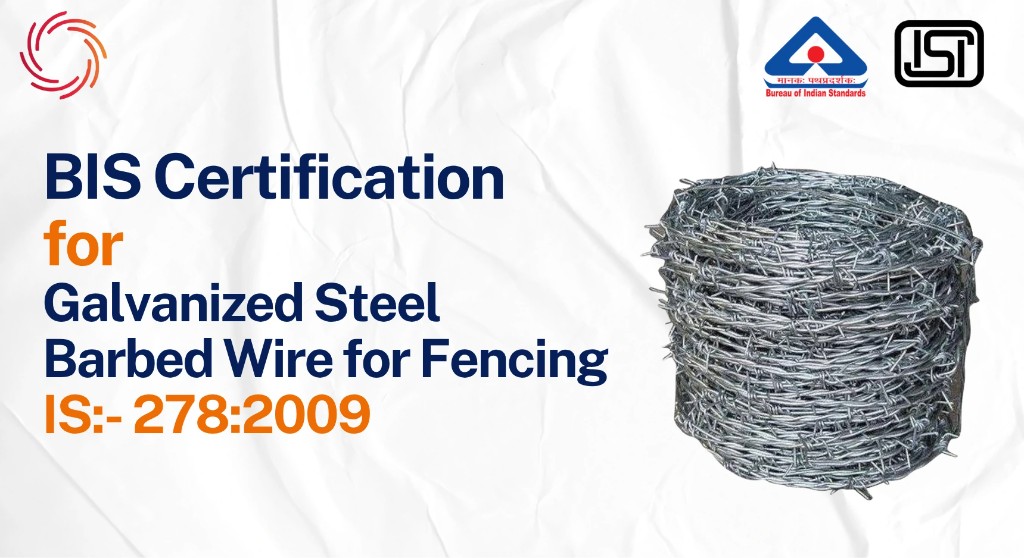
Galvanized steel barbed wire used for fencing in India must comply with IS 278 : 2009 to demonstrate that the wire strength, zinc coating, barb spacing, and durability meet approved quality requirements. A BIS Certificate for Galvanized Steel Barbed Wire for Fencing helps manufacturers and suppliers prove that the fencing material can withstand outdoor exposure, physical tension, and long-term security use across agricultural, industrial, and infrastructure applications.
Galvanized steel barbed wire remains one of the most widely used fencing materials across India due to its affordability, durability, and strong perimeter protection capabilities. From agricultural farms and railway boundaries to military zones, industrial warehouses, highways, airports, and rural land protection systems, this product plays a major role in physical security and land demarcation.
Unlike decorative fencing products, barbed wire is expected to perform under harsh environmental conditions. It must tolerate rain, heat, corrosion, pulling force, and continuous outdoor exposure without snapping, rusting, or losing tensile strength. Poor-quality fencing wire may fail within a short period, leading to property intrusion, livestock escape, or costly replacement work. In many regions with high humidity or coastal exposure, substandard galvanization can quickly damage the fencing structure.
This is where BIS Certification for Galvanized Steel Barbed Wire for Fencing becomes highly important. The certification framework linked with IS 278 : 2009 establishes technical requirements for wire diameter, zinc coating, barb construction, twisting consistency, tensile strength, elongation properties, and corrosion resistance. These parameters are especially critical because fencing materials are usually installed for long-term use and are expected to remain functional for years without structural failure.
The Indian market contains both organized manufacturers and small-scale producers. Without standardized quality verification, buyers may receive fencing products with uneven coating, weak wire, improper barb spacing, or inadequate mechanical performance. Such defects can compromise the entire fencing system. Through the BIS License for Galvanized Steel Barbed Wire for Fencing, manufacturers demonstrate that their production processes, raw materials, and testing methods follow recognized quality benchmarks.
Importers and distributors also benefit from compliance because certified fencing products gain stronger acceptance in government procurement, infrastructure projects, industrial contracts, and institutional purchasing systems. Many contractors prefer certified material because it reduces operational risk and ensures predictable performance in the field.
The BIS Licence for Galvanized Steel Barbed Wire for Fencing therefore acts not only as a regulatory requirement in several procurement environments but also as a technical assurance mechanism that supports safety, durability, and long-term reliability.
Understanding BIS Certification for Galvanized Steel Barbed Wire for Fencing - IS 278 : 2009
Galvanized steel barbed wire appears simple at first glance, but its performance depends heavily on manufacturing precision and material consistency. A fencing system is only as strong as the wire used in it. If the wire loses tensile strength, develops rust quickly, or contains weak barb joints, the entire perimeter protection mechanism becomes unreliable.
The BIS Certification for Galvanized Steel Barbed Wire for Fencing focuses on ensuring that the product performs effectively under real-world conditions. The certification system evaluates whether the wire can maintain structural integrity when stretched across long distances, exposed to seasonal weather changes, and subjected to physical pressure.
Why Quality Control Matters in Barbed Wire Manufacturing
Manufacturing galvanized barbed wire involves multiple technical stages, including:
- Wire drawing
- Surface cleaning
- Galvanization
- Twisting
- Barb formation
- Spacing control
- Coil winding
- Mechanical strength testing
If any of these stages are poorly managed, the final product may become unsafe or ineffective. For example:
- Thin zinc coating can lead to rapid rust formation
- Weak twisting can cause barbs to loosen
- Irregular barb spacing can reduce fencing effectiveness
- Low tensile strength may result in wire breakage during installation
- Inferior steel quality can reduce service life
The BIS Certificate for Galvanized Steel Barbed Wire for Fencing helps prevent these problems by requiring standardized testing and production monitoring.
Role of Certification in Different Industries
Different sectors rely on fencing products for different reasons:
| Sector | Purpose of Fencing |
|---|---|
| Agriculture | Livestock protection and crop security |
| Railways | Restricted area control |
| Highways | Boundary safety |
| Defence | Security perimeter protection |
| Industrial plants | Unauthorized access prevention |
| Warehousing | Property security |
| Forest departments | Wildlife and land protection |
In all these sectors, fencing failure can create financial loss, safety risks, or operational disruption. This is why buyers increasingly prefer suppliers holding a BIS License for Galvanized Steel Barbed Wire for Fencing.
Consumer and Infrastructure Protection
Poor-quality fencing materials can create hidden risks. A rusted wire may snap unexpectedly. Weak barbs may fail to deter intrusion. Uneven galvanization may shorten the life of large-scale fencing projects.
The BIS Licence for Galvanized Steel Barbed Wire for Fencing creates accountability by ensuring that manufacturers maintain:
- Consistent raw material quality
- Controlled production processes
- Reliable coating thickness
- Proper mechanical performance
- Standardized product dimensions
This structured quality system improves buyer confidence and supports safer infrastructure development.
Applicable BIS Standard for Galvanized Steel Barbed Wire for Fencing - IS 278 : 2009
IS 278 : 2009 – Scope and Technical Relevance
IS 278 : 2009 is the Indian Standard applicable to galvanized steel barbed wire used for fencing applications. The standard establishes technical specifications related to material quality, construction design, protective coating, and performance properties of the wire.
The objective of this standard is to ensure that fencing wire remains durable, corrosion-resistant, mechanically strong, and suitable for prolonged outdoor usage.
Products Covered Under IS 278 : 2009
The standard generally applies to:
- Galvanized steel barbed wire
- Double-strand twisted barbed wire
- Line wire fencing systems
- Security fencing wire
- Agricultural boundary fencing wire
- Industrial perimeter fencing products
The standard is relevant for both heavy-duty and general fencing applications.
Key Technical Areas Covered
1. Wire Diameter
The standard specifies acceptable dimensional tolerances for line wires and barb wires. Consistent diameter is essential because uneven thickness affects tension capacity and structural balance.
2. Zinc Coating Requirements
Galvanization is critical for outdoor durability. The standard defines zinc coating requirements to improve resistance against moisture, corrosion, humidity, rain exposure, and industrial atmospheric conditions. A poor coating layer can significantly reduce product lifespan.
3. Barb Construction
The standard addresses number of barbs, barb spacing, twisting method, and uniformity of sharp points. Proper barb construction improves fencing efficiency and physical security.
4. Tensile Strength
Barbed wire must tolerate installation stress and operational tension without deformation or fracture. The standard therefore establishes tensile strength criteria for reliable field performance.
5. Manufacturing Consistency
IS 278 : 2009 also supports manufacturing uniformity across production batches. This helps maintain predictable performance in large infrastructure or agricultural projects.
Testing Requirements as per IS 278 : 2009
Testing plays a central role in the BIS Certification for Galvanized Steel Barbed Wire for Fencing because the product is continuously exposed to environmental stress and mechanical load after installation.
Manufacturers seeking certification must conduct product evaluation through Bureau of Indian Standards recognized laboratories. These laboratories assess whether the fencing wire complies with the requirements of IS 278 : 2009.
Tensile Strength Test
This test determines the maximum pulling force the wire can withstand before breaking. The test helps evaluate structural durability, installation performance, long-span fencing capability, and resistance against deformation. Weak tensile properties may cause wire sagging or breakage during actual use.
Zinc Coating Test
Galvanization quality is one of the most important aspects of fencing durability. The zinc coating test verifies coating thickness, uniform coating distribution, corrosion resistance capability, and surface protection performance. Proper galvanization is especially important in coastal regions and high-humidity environments.
Wrapping Test
This test checks whether the wire coating remains intact during bending or twisting. The wire is wrapped around a mandrel to observe cracking, peeling, surface damage, and coating separation. This test reflects real installation conditions where wires are bent and stretched.
Dimensional Verification
Laboratories verify wire diameter, barb spacing, twist length, and coil dimensions. Dimensional accuracy ensures uniform fencing performance.
Mechanical Construction Inspection
The physical construction of the barbed wire is examined for proper barb formation, tight twisting, structural consistency, and sharpness and alignment. Improper construction can reduce fencing effectiveness.
Corrosion Resistance Evaluation
Outdoor fencing products must survive long-term environmental exposure. Corrosion testing helps estimate the durability of galvanized surfaces under moisture and weather stress.
Quality Verification and Batch Inspection
Manufacturers holding a BIS License for Galvanized Steel Barbed Wire for Fencing are expected to maintain ongoing production quality through regular inspection and testing practices. This includes raw material verification, process monitoring, batch sampling, internal laboratory testing, and traceability systems.
Conclusion
Galvanized steel barbed wire is widely used for perimeter protection, agricultural fencing, infrastructure security, and industrial boundary systems across India. Because these products remain exposed to environmental stress and mechanical tension for extended periods, manufacturing quality becomes critically important.
The BIS Certification for Galvanized Steel Barbed Wire for Fencing under IS 278 : 2009 helps ensure that fencing wire delivers reliable performance, proper galvanization, adequate tensile strength, and consistent construction quality. Through laboratory testing, factory inspection, and technical compliance verification, manufacturers can demonstrate that their products are suitable for demanding outdoor applications.
Obtaining a BIS Certificate for Galvanized Steel Barbed Wire for Fencing also improves market trust, procurement acceptance, and regulatory confidence. Whether for domestic manufacturing, government projects, industrial supply, or infrastructure development, the BIS License for Galvanized Steel Barbed Wire for Fencing supports long-term quality assurance and responsible product manufacturing practices in India.
FAQs – BIS Certification for Galvanized Steel Barbed Wire for Fencing - IS 278:2009
1. Why is galvanization quality extremely important in barbed wire fencing applications?
Galvanization protects steel wire from corrosion caused by rain, moisture, humidity, and environmental exposure. Since barbed fencing is usually installed outdoors for many years, weak zinc coating can lead to rust formation, wire weakening, and fencing failure. IS 278:2009 includes coating-related requirements so that the fencing material remains durable under long-term outdoor conditions.
2. Can low-quality barbed wire create safety or operational problems after installation?
Yes. Poor-quality fencing wire may break under tension, lose sharpness, corrode quickly, or sag over time. In agricultural areas, this may allow livestock movement, while in industrial or security zones it may reduce perimeter protection. BIS Certification for Galvanized Steel Barbed Wire for Fencing helps ensure reliable structural performance and long service life.
3. What types of industries commonly demand certified galvanized steel barbed wire products?
Certified fencing wire is commonly used in agriculture, highways, railways, airports, defence projects, industrial premises, solar farms, warehouses, and infrastructure development projects. Large buyers prefer certified products because fencing replacement and maintenance costs can become very high if inferior wire quality is supplied initially.
4. How does IS 278:2009 help maintain uniformity in fencing products across manufacturers?
The standard establishes measurable technical requirements for wire diameter, zinc coating, barb spacing, tensile strength, and twisting construction. These parameters reduce variation between production batches and ensure that fencing wire supplied by different manufacturers maintains predictable performance characteristics.
5. Why are tensile strength tests important for galvanized steel barbed wire?
Barbed wire is stretched tightly during installation and remains under continuous tension after deployment. If tensile strength is inadequate, the wire may snap or deform during installation or field use. Tensile testing verifies that the product can tolerate mechanical stress without structural failure.
6. Does BIS certification only apply to large fencing manufacturers?
No. Small and medium manufacturers can also apply for a BIS License for Galvanized Steel Barbed Wire for Fencing if their products comply with IS 278:2009. However, they must maintain proper manufacturing controls, testing systems, and quality verification processes to obtain approval.
7. What factors usually affect the bis certification cost for Galvanized Steel Barbed Wire for Fencing?
The bis certification cost for Galvanized Steel Barbed Wire for Fencing depends on testing scope, manufacturing scale, product variants, inspection requirements, and laboratory evaluation charges. Additional costs may also arise if production improvements or quality control upgrades are needed before approval.
8. Why is barb spacing consistency important in fencing wire manufacturing?
Uniform barb spacing improves security effectiveness and ensures balanced fencing performance across the entire installation. Uneven spacing may reduce deterrence capability or create weak sections in the fencing line. IS 278:2009 therefore includes construction-related specifications for barb formation and positioning.
9. What are the major bis certification documents for Galvanized Steel Barbed Wire for Fencing required during application?
Manufacturers generally need factory registration records, product specifications, manufacturing process details, machinery information, raw material data, laboratory test reports, quality control procedures, and authorized signatory documents. Proper documentation helps accelerate the bis certificate process for Galvanized Steel Barbed Wire for Fencing.
10. Why do government and infrastructure buyers prefer certified fencing products?
Large projects require durable materials that can remain operational for years with minimal maintenance. Certified fencing products reduce the risk of corrosion, mechanical failure, and early replacement. A BIS Licence for Galvanized Steel Barbed Wire for Fencing demonstrates that the product has undergone standardized evaluation for quality and performance.
QCO for Galvanized Steel Barbed Wire for Fencing
Related Resources
Many of our users also read
This compliance advisory was vetted by our Senior Consultant (Enforcement & Vigilance), a former BIS Director (Enforcement). He specializes in post-certification compliance, helping companies navigate surveillance audits and legal adherence to BIS mandates.
Dhruv Aggarwal
Head of Operations at Sun Certifications India
Experience: 10+ years & Handled 1000+ projects
Awarded by many Indian and International organisations








PT Quty Karunia, BIS Licensee in Vietnam
“Sun Certifications India provided excellent BIS Certification services. Their unparalleled service and sincerity gained our trust. One of the best BIS consultants in India!”

Thantawan Industries Ltd, BIS Licensee in Thailand
“Sun Certifications India supported us throughout the BIS certification process. Their responsive customer service and punctuality are exceptional. Highly recommend for hassle-free BIS certification.”

Leaderart Industries, BIS Licensee in Malaysia
“Sun Certifications India helped us acquire BIS Certification, doubling our engagement in India. Their services are fast, genuine, and up-to-date with latest BIS norms.”

Aluminium Bahrain (ALBA), BIS Licensee in Bahrain
“Excellent BIS certification support, highly reliable consultants.”

Bahrain Aluminium Manufacturing Company, BIS Licensee in Bahrain
“Smooth BIS registration process with expert consultants.”

Daiki Aluminium Japan, BIS Licensee in Japan
“Efficient BIS license assistance, great consultants.”

Trimble Navigation, BIS Licensee in USA
“Seamless BIS certification and registration support.”

Remsa Italia, BIS Licensee in Italy
“Helpful BIS consultants, simplified license process.”

Aquazzura, BIS Licensee in Italy
“We got our BIS certificate well within the timelines and at affordable prices, great work team Sun!”

PT Quty, BIS Licensee in Indonesia
“Excellent BIS registration service, highly recommended.”

Danu Vina, BIS Licensee in Vietnam
“Reliable BIS license consultants, fast process.”

Hanh My Production Company, BIS Licensee in Vietnam
“Expert BIS consultants, certification made easy.”

Sedo Vina, BIS Licensee in Vietnam
“Smooth BIS certificate registration, great support.”

Misumi Japan, BIS Licensee in Japan
“Trusted BIS consultants, quick certification process.”

Thantawan Public Industry Company, BIS Licensee in Thailand
“Professional BIS certification service, very efficient.”

Cortizo Aluminios, BIS Licensee in Spain
“Excellent BIS registration and license guidance.”

Midal Cables, BIS Licensee in Bahrain
“Expert BIS consultants, smooth certification process.”
Years Exp.
Our Clients
Success Rate
Countries Served
Our team brings 10e4+ years of experience in CDSCO and BIS compliance.
We reduce approval time by up to 40% with streamlined processes.
100% success rate with 1500+ successful registrations.
Dedicated account manager ensuring personalized service.
Leave your details below and our experts will call you back within 24 hours to discuss your regulatory compliance needs.
By submitting this form, you agree to our Privacy Policy and consent to being contacted.