BIS Certification for Glass Beakers – IS 2619: 2018
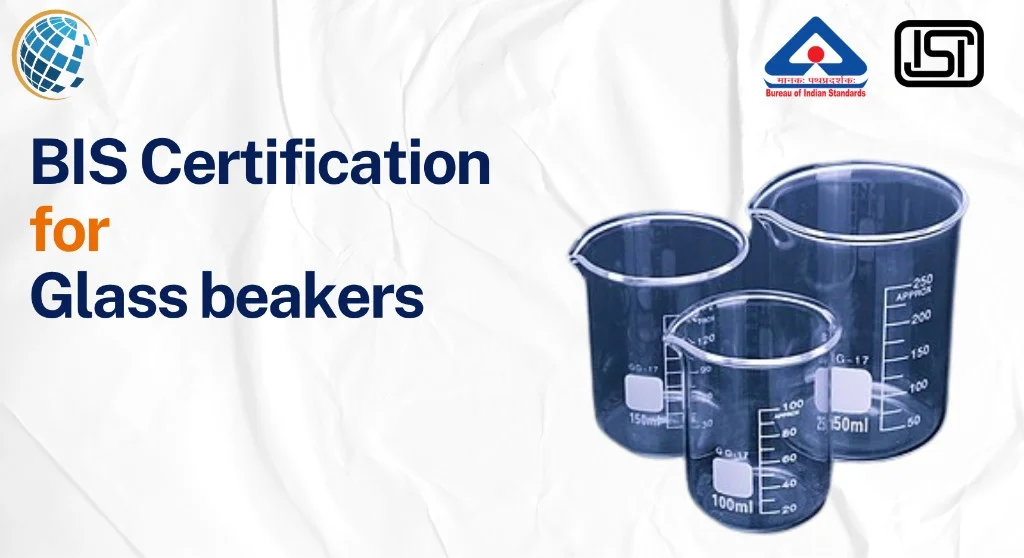
BIS Certification for Glass beakers ensures that laboratory-grade containers meet safety, thermal resistance, and dimensional accuracy requirements under IS 2619: 2018. In India, certification is required to verify durability, chemical resistance, and measurement reliability, helping laboratories, industries, and educational institutions use beakers safely without risk of breakage or contamination.
Glass beakers are among the most fundamental tools used in laboratories, research facilities, pharmaceutical units, chemical industries, and educational institutions. Despite their simple appearance, these containers perform highly sensitive functions such as measuring, mixing, heating, and storing chemical substances. Any defect in a glass beaker—such as uneven thickness, poor heat resistance, or inaccurate graduations—can lead to serious consequences, including chemical spills, inaccurate experiments, or even injury.
In India's expanding scientific and industrial ecosystem, demand for high-quality laboratory equipment is steadily increasing. Laboratories handling corrosive chemicals or high-temperature reactions cannot afford unreliable glassware. For instance, a beaker that cracks during heating can release hazardous substances, posing risks to personnel and equipment.
This is where BIS Certification for Glass beakers becomes essential. The certification framework ensures that manufacturers follow strict guidelines for material quality, dimensional accuracy, and thermal durability. It acts as a checkpoint that verifies whether the beakers can withstand real laboratory conditions.
For manufacturers and importers, obtaining a BIS Certificate for Glass beakers is not merely a compliance requirement—it is a validation of product reliability. For buyers such as laboratories and institutions, it provides assurance that the product will perform consistently and safely.
Understanding BIS Certificate for Glass beakers - IS 2619: 2018
Glass beakers may appear straightforward, but their performance depends on precise engineering and controlled manufacturing. The BIS Certification for Glass beakers evaluates whether the product meets specific criteria that directly impact usability and safety.
Unlike decorative or household glassware, laboratory beakers are exposed to extreme conditions—rapid temperature changes, chemical reactions, and repeated usage cycles. If the glass composition is not properly controlled, it may expand unevenly, crack under stress, or react with chemicals.
The BIS Certification for Glass beakers focuses on ensuring that:
- The glass composition provides resistance to chemical corrosion
- The beaker maintains structural integrity during heating and cooling cycles
- Graduation markings are accurate and permanent
- The product has uniform wall thickness to prevent weak points
For example, a laboratory technician heating a solution relies on the beaker's ability to withstand thermal shock. If the glass fails, it can lead to spillage and contamination of the experiment. Certification ensures such risks are minimized.
From a regulatory perspective, the certification process creates a standardized benchmark that manufacturers must follow. This ensures that products available in the Indian market are consistent in quality and performance.
Applicable BIS Standard for Glass beakers - IS 2619: 2018
The applicable standard is IS 2619: 2018, which specifies the requirements for glass beakers used in laboratory applications.
Scope of the Standard
IS 2619: 2018 covers laboratory glass beakers designed for general use, including measuring, mixing, and heating liquids. It applies to beakers made from borosilicate or similar heat-resistant glass.
Product Categories Covered
The standard includes:
- Low-form (wide) beakers
- Tall-form beakers
- Beakers with spouts for pouring
- Graduated beakers for approximate measurement
Safety and Performance Objectives
The standard ensures that beakers:
- Resist thermal shock during heating and cooling
- Maintain dimensional accuracy for measurement reliability
- Withstand chemical exposure without degradation
- Exhibit sufficient mechanical strength to handle routine use
Design and Testing Principles
Manufacturers must design beakers with uniform thickness and smooth edges to prevent stress concentration. Graduation markings must be clear, durable, and resistant to fading.
For instance, a beaker used in a pharmaceutical lab must maintain precise volume markings even after repeated washing and chemical exposure.
Testing Requirements as per IS 2619: 2018
Safety Tests
- Evaluate resistance to thermal shock and mechanical stress.
Performance Tests
- Check accuracy of graduation markings and dimensional consistency.
Durability Tests
- Assess long-term resistance to chemical exposure and repeated usage.
Quality Verification Tests
- Ensure uniformity in production and material quality.
All tests must be conducted in BIS recognized laboratories.
Conclusion
Glass beakers are essential tools in laboratories, where precision and safety are non-negotiable. The BIS Certification for Glass beakers under IS 2619: 2018 establishes a structured framework to evaluate product performance, durability, and reliability.
For manufacturers and importers, obtaining a BIS Certificate for Glass beakers demonstrates a commitment to quality and compliance. By following the bis certification process for Glass beakers and maintaining consistent standards, businesses can build trust, expand market reach, and ensure long-term success in India's growing scientific and industrial sectors.
FAQs – BIS Certification for Glass beakers - IS 2619: 2018
1. How does annealing quality impact BIS Certification for Glass beakers?
Annealing is a critical step in glass manufacturing where internal stresses are removed through controlled cooling. Poor annealing can leave residual stress inside the beaker, making it prone to sudden cracking during heating or handling. During the BIS certification process for Glass beakers, such defects may lead to failure in thermal or mechanical tests. Manufacturers who maintain precise annealing cycles and temperature control are more likely to achieve consistent compliance and avoid costly rejections.
2. Why is uniform wall thickness important for obtaining a BIS License for Glass beakers?
Uniform wall thickness ensures even heat distribution when the beaker is exposed to temperature changes. If one area is thinner than another, it can expand faster, creating stress points that lead to cracks or breakage. BIS Certification for Glass beakers evaluates this aspect closely because uneven thickness directly impacts durability and safety. Manufacturers must use precise molding techniques and quality inspection tools to maintain uniformity throughout production.
3. How does repeated laboratory use affect compliance with BIS standards for Glass beakers?
Glass beakers are often subjected to repeated heating, cooling, washing, and chemical exposure. Over time, inferior materials may degrade, lose clarity, or develop micro-cracks. BIS Certification for Glass beakers ensures that products are tested for durability under repeated use conditions. This guarantees that the beaker remains safe and functional even after extended use, which is especially important in research and industrial laboratories where reliability is critical.
4. Can customized or branded laboratory beakers still qualify for BIS Certification?
Yes, customized or branded beakers can qualify, but they must meet all requirements specified in IS 2619: 2018. Branding elements such as logos or printed markings should not interfere with graduation accuracy or readability. During the bis certification process for Glass beakers, all design elements are evaluated to ensure they do not compromise performance. Manufacturers offering customized products must ensure that personalization does not affect compliance with safety and measurement standards.
5. What role does surface finish play in BIS Certification for Glass beakers?
Surface finish is important because rough or uneven surfaces can trap chemicals, making cleaning difficult and increasing contamination risks. A smooth finish also reduces the likelihood of micro-cracks forming over time. BIS testing evaluates the internal and external surface quality to ensure it meets hygiene and durability standards. Manufacturers must use proper polishing and finishing techniques to achieve the required level of smoothness and clarity.
6. How do graduation marking techniques affect BIS compliance for Glass beakers?
Graduation markings must remain legible and accurate throughout the product's life. Techniques such as screen printing, etching, or enamel coating are commonly used. However, if the markings fade, peel, or distort after washing or chemical exposure, the product may fail BIS requirements. The BIS Certification for Glass beakers includes testing for marking durability, ensuring that measurement accuracy is maintained under regular laboratory conditions.
7. What challenges arise when scaling production after obtaining BIS Certification?
Once a BIS License for Glass beakers is granted, maintaining consistent quality during large-scale production can be challenging. Variations in raw material batches, furnace temperatures, or molding processes can lead to inconsistencies. Post-certification audits ensure that production quality matches the approved samples. Manufacturers must implement strict quality control systems and regular monitoring to ensure ongoing compliance at higher production volumes.
8. How does packaging influence BIS compliance for Glass beakers?
Although packaging is not directly tested for product performance, it plays a crucial role in maintaining compliance during transportation. Improper packaging can lead to breakage or damage, which may result in non-compliant products reaching the market. BIS Certification for Glass beakers indirectly emphasizes safe handling and packaging practices. Manufacturers should use protective materials and secure packaging methods to preserve product integrity.
9. Are there specific requirements for spout design in BIS-certified Glass beakers?
Yes, the spout design is evaluated for its ability to allow smooth and controlled pouring without spillage. A poorly designed spout can cause liquid to drip or spill, leading to measurement inaccuracies and safety risks. During the bis certification process for Glass beakers, the spout is checked for shape, alignment, and finish. Proper design ensures safe handling, especially when dealing with hot or hazardous liquids.
10. How does BIS Certification improve acceptance of Glass beakers in export-oriented industries?
Export-oriented industries often require compliance with recognized standards to ensure product reliability. Having a BIS Certificate for Glass beakers demonstrates adherence to structured quality benchmarks, which can enhance credibility in both domestic and international markets. Buyers prefer certified products because they reduce the risk of defects and ensure consistent performance. This makes certification a valuable asset for manufacturers looking to expand their market reach.
Related Resources
Many of our users also read
This compliance advisory was vetted by our Senior Consultant (Enforcement & Vigilance), a former BIS Director (Enforcement). He specializes in post-certification compliance, helping companies navigate surveillance audits and legal adherence to BIS mandates.
Dhruv Aggarwal
Head of Operations at Sun Certifications India
Experience: 10+ years & Handled 1000+ projects
Awarded by many Indian and International organisations








PT Quty Karunia, BIS Licensee in Vietnam
“Sun Certifications India provided excellent BIS Certification services. Their unparalleled service and sincerity gained our trust. One of the best BIS consultants in India!”

Thantawan Industries Ltd, BIS Licensee in Thailand
“Sun Certifications India supported us throughout the BIS certification process. Their responsive customer service and punctuality are exceptional. Highly recommend for hassle-free BIS certification.”

Leaderart Industries, BIS Licensee in Malaysia
“Sun Certifications India helped us acquire BIS Certification, doubling our engagement in India. Their services are fast, genuine, and up-to-date with latest BIS norms.”

Aluminium Bahrain (ALBA), BIS Licensee in Bahrain
“Excellent BIS certification support, highly reliable consultants.”

Bahrain Aluminium Manufacturing Company, BIS Licensee in Bahrain
“Smooth BIS registration process with expert consultants.”

Daiki Aluminium Japan, BIS Licensee in Japan
“Efficient BIS license assistance, great consultants.”

Trimble Navigation, BIS Licensee in USA
“Seamless BIS certification and registration support.”

Remsa Italia, BIS Licensee in Italy
“Helpful BIS consultants, simplified license process.”

Aquazzura, BIS Licensee in Italy
“We got our BIS certificate well within the timelines and at affordable prices, great work team Sun!”

PT Quty, BIS Licensee in Indonesia
“Excellent BIS registration service, highly recommended.”

Danu Vina, BIS Licensee in Vietnam
“Reliable BIS license consultants, fast process.”

Hanh My Production Company, BIS Licensee in Vietnam
“Expert BIS consultants, certification made easy.”

Sedo Vina, BIS Licensee in Vietnam
“Smooth BIS certificate registration, great support.”

Misumi Japan, BIS Licensee in Japan
“Trusted BIS consultants, quick certification process.”

Thantawan Public Industry Company, BIS Licensee in Thailand
“Professional BIS certification service, very efficient.”

Cortizo Aluminios, BIS Licensee in Spain
“Excellent BIS registration and license guidance.”

Midal Cables, BIS Licensee in Bahrain
“Expert BIS consultants, smooth certification process.”
Years Exp.
Our Clients
Success Rate
Countries Served
Our team brings 10e4+ years of experience in CDSCO and BIS compliance.
We reduce approval time by up to 40% with streamlined processes.
100% success rate with 1500+ successful registrations.
Dedicated account manager ensuring personalized service.
Leave your details below and our experts will call you back within 24 hours to discuss your regulatory compliance needs.
By submitting this form, you agree to our Privacy Policy and consent to being contacted.