BIS Certification for Insulating Mats for Electrical Purposes – IS 15652: 2006
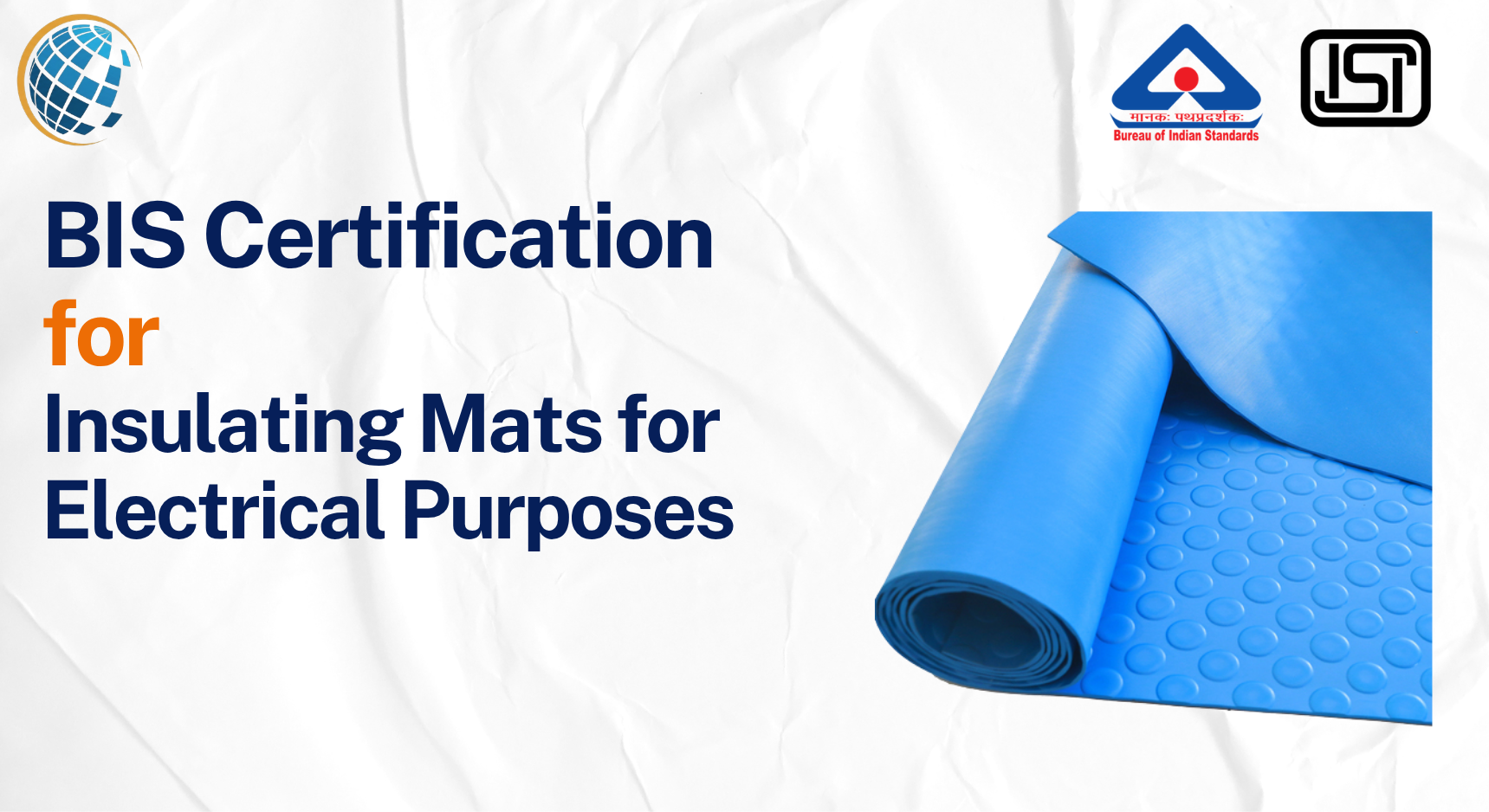
BIS Certification for Insulating Mats for Electrical Purposes under IS 15652: 2006 ensures that these mats provide reliable electrical insulation, withstand voltage exposure, and protect workers from electric shock. Certification is required in India to verify material strength, dielectric properties, and safety performance before the product is used in high-risk electrical environments.
In electrical environments where live circuits, switchboards, and high-voltage panels are routinely accessed, even a minor lapse in insulation can lead to serious injury or fatal accidents. This is where insulating mats for electrical purposes play a critical role. These mats are placed on floors near electrical installations to create a protective barrier between personnel and electrical currents, especially in substations, control rooms, and industrial plants.
Unlike ordinary rubber sheets, insulating mats are engineered to resist electrical conductivity, withstand mechanical stress, and perform reliably in challenging conditions such as moisture, oil exposure, and temperature fluctuations. Their performance directly influences worker safety, making them a high-risk product category from a regulatory standpoint.
In India, the safety expectations for such products are governed through a structured compliance framework. The BIS Certification for Insulating Mats for Electrical Purposes ensures that these mats meet predefined electrical insulation levels, durability standards, and performance benchmarks before entering the market. For manufacturers, importers, and distributors, obtaining a BIS License for Insulating Mats for Electrical Purposes is not just about compliance—it is about demonstrating that the product can reliably protect human lives in hazardous environments.
Understanding BIS Certificate for Insulating Mats for Electrical Purposes - IS 15652: 2006
Electrical insulating mats are not passive products; they function as a frontline defense mechanism in environments where voltage exposure is a daily reality. If the material fails, cracks, or loses its dielectric strength, it can allow current leakage, exposing workers to severe electric shock.
The BIS Certification for Insulating Mats for Electrical Purposes evaluates whether the product can consistently perform under such conditions. Instead of focusing only on physical dimensions, the certification examines:
- Electrical resistance capability under different voltage classes
- Resistance to aging, wear, and environmental stress
- Material composition and uniformity
- Surface characteristics that prevent slipping and ensure stability
For example, a mat used in a high-voltage transformer area must maintain its insulating properties even when exposed to dust, oil, or humidity. Certification ensures that such real-world conditions are considered during testing and evaluation.
The regulatory purpose here is practical: to ensure that every insulating mat placed in an electrical installation behaves predictably under stress. This reduces workplace accidents, improves safety compliance, and ensures that industrial operations are not compromised due to equipment failure. When you plan the licence route itself, it helps to align product-specific work with how Indian BIS operates overall — Check complete details about documentation, cost, and process etc.
Applicable BIS Standard for Insulating Mats for Electrical Purposes - IS 15652: 2006
The applicable standard for this product is IS 15652: 2006, which defines the technical and safety requirements for insulating mats used in electrical installations.
Scope of the Standard
IS 15652: 2006 covers insulating mats made of elastomeric materials designed for use in areas where electrical hazards are present. It applies to mats used in:
- Power generation and distribution units
- Industrial control panels and switchboards
- Commercial electrical installations
- Maintenance zones for electrical equipment
Product Categories Covered
The standard classifies insulating mats based on voltage ratings and thickness. Different classes are designed to handle varying levels of electrical exposure, ensuring suitability for specific applications such as low-voltage panels or high-voltage substations.
Safety and Performance Objectives
The primary objective is to ensure that the mat acts as an effective barrier against electrical current. This includes:
- Maintaining dielectric strength under voltage stress
- Providing mechanical durability to resist wear and tear
- Ensuring surface grip to prevent slipping
- Retaining properties under environmental exposure
Design and Testing Principles
The standard emphasizes performance-based testing rather than just material composition. It evaluates how the mat behaves under simulated electrical conditions, including voltage application, aging cycles, and mechanical stress. This ensures that the product is not only compliant on paper but also reliable in real-world scenarios.
Testing Requirements as per IS 15652: 2006
Testing ensures that insulating mats perform reliably under electrical stress.
Safety Tests
- Evaluate dielectric strength and resistance to electrical current.
Performance Tests
- Assess load-bearing capacity and flexibility.
Durability Tests
- Check resistance to wear, aging, and environmental exposure.
Quality Verification Tests
- Ensure uniform thickness, surface finish, and material consistency.
All tests must be conducted in BIS recognized laboratories.
Conclusion
The BIS Certification for Insulating Mats for Electrical Purposes is a vital requirement for ensuring electrical safety in industrial and commercial environments. By complying with IS 15652: 2006, manufacturers demonstrate that their products can reliably protect users from electrical hazards. Obtaining a BIS License for Insulating Mats for Electrical Purposes not only ensures regulatory compliance but also enhances market credibility, product acceptance, and long-term business growth.
FAQs – BIS License for Insulating Mats for Electrical Purposes - IS 15652: 2006
1. Why are insulating mats tested at different voltage levels during BIS certification?
Insulating mats are used across various electrical environments, from low-voltage panels to high-voltage substations. During the BIS Certification for Insulating Mats for Electrical Purposes, samples are tested at multiple voltage levels to ensure dielectric strength under real operating conditions. This testing verifies that the mat can withstand sudden voltage surges, leakage currents, and insulation breakdown risks. Without such testing, a mat might perform well in normal conditions but fail during electrical faults, leading to serious safety hazards.
2. How does BIS certification address long-term wear and tear in insulating mats?
Electrical insulating mats are exposed to continuous mechanical stress such as foot traffic, equipment movement, and environmental factors. The BIS Certification for Insulating Mats for Electrical Purposes includes abrasion resistance, tensile strength, and elongation tests to evaluate durability over time. These tests simulate real-world conditions to ensure that the mat retains its insulating properties even after prolonged usage. This is crucial because worn-out mats may lose their protective capabilities, increasing the risk of electrical shock.
3. Can imported insulating mats be re-labelled and sold without BIS certificate in India?
No, imported insulating mats cannot be legally sold in India without complying with the BIS License for Insulating Mats for Electrical Purposes. Even if the product meets international standards, it must be evaluated against IS 15652: 2006. Importers must apply for BIS certification, submit samples for testing, and ensure proper labeling with the ISI mark. Re-labeling without certification is considered a violation and may lead to seizure of goods and regulatory penalties.
4. What role does surface texture play in BIS testing of insulating mats?
Surface texture is a critical aspect evaluated during BIS Certification for Insulating Mats for Electrical Purposes. Mats often have ribbed or anti-slip surfaces to prevent accidental slips in electrical environments. BIS testing ensures that the texture does not compromise electrical insulation while still providing adequate grip. This balance is important in workplaces like substations or control rooms where both electrical safety and physical stability are required simultaneously.
5. How do environmental conditions impact BIS compliance for insulating mats?
Insulating mats may be used in environments exposed to moisture, oil, heat, or chemicals. The BIS certification process includes environmental resistance tests such as water absorption and heat aging. These tests ensure that the mat maintains its insulation properties even under adverse conditions. For example, a mat used in an industrial plant must resist oil spills without losing dielectric strength. This ensures consistent safety performance across diverse applications.
6. Is batch-wise testing required after obtaining BIS certification?
Yes, maintaining a BIS License for Insulating Mats for Electrical Purposes requires ongoing quality checks. Manufacturers must conduct routine batch testing as part of their internal quality control system. BIS may also conduct surveillance inspections and sample testing to verify continued compliance. This ensures that every batch of mats produced after certification meets the same safety and performance standards as the originally approved sample.
7. What happens if insulating mats fail during factory inspection?
If insulating mats fail to meet requirements during the factory inspection stage of the BIS certification process, the application may be delayed or rejected. The manufacturer must identify the root cause—such as poor raw material quality or inadequate curing processes—and implement corrective measures. A re-inspection may be required. This step ensures that only manufacturers with consistent production capabilities receive the BIS Certificate for Insulating Mats for Electrical Purposes.
8. How does BIS certification help in government or industrial tenders?
Many government departments and large industrial buyers require BIS-certified insulating mats as part of their procurement criteria. Having a BIS Certification for Insulating Mats for Electrical Purposes demonstrates compliance with Indian safety standards, making it easier for manufacturers and suppliers to participate in tenders. It also reduces the need for additional technical verification, as the certification already validates the product's performance and safety.
9. Are customized insulating mats also covered under BIS certification?
Yes, customized insulating mats can be covered under the BIS Licence for Insulating Mats for Electrical Purposes, provided they fall within the scope of IS 15652: 2006. However, any variation in thickness, voltage rating, or material composition may require separate evaluation or additional testing. Manufacturers must clearly declare specifications during the application process to ensure that all product variants are properly certified.
10. How important is labelling in BIS-certified insulating mats?
Labelling is a mandatory requirement under the BIS certification process. Each insulating mat must display the ISI mark along with details such as manufacturer name, voltage rating, batch number, and standard reference (IS 15652: 2006). Proper labelling ensures traceability and helps users verify authenticity. Incorrect or missing labels can lead to compliance issues, even if the product meets technical requirements.
Many of our users also read
This compliance advisory was vetted by our Senior Consultant (Enforcement & Vigilance), a former BIS Director (Enforcement). He specializes in post-certification compliance, helping companies navigate surveillance audits and legal adherence to BIS mandates.
Dhruv Aggarwal
Head of Operations at Sun Certifications India
Experience: 10+ years & Handled 1000+ projects
Awarded by many Indian and International organisations








PT Quty Karunia, BIS Licensee in Vietnam
“Sun Certifications India provided excellent BIS Certification services. Their unparalleled service and sincerity gained our trust. One of the best BIS consultants in India!”

Thantawan Industries Ltd, BIS Licensee in Thailand
“Sun Certifications India supported us throughout the BIS certification process. Their responsive customer service and punctuality are exceptional. Highly recommend for hassle-free BIS certification.”

Leaderart Industries, BIS Licensee in Malaysia
“Sun Certifications India helped us acquire BIS Certification, doubling our engagement in India. Their services are fast, genuine, and up-to-date with latest BIS norms.”

Aluminium Bahrain (ALBA), BIS Licensee in Bahrain
“Excellent BIS certification support, highly reliable consultants.”

Bahrain Aluminium Manufacturing Company, BIS Licensee in Bahrain
“Smooth BIS registration process with expert consultants.”

Daiki Aluminium Japan, BIS Licensee in Japan
“Efficient BIS license assistance, great consultants.”

Trimble Navigation, BIS Licensee in USA
“Seamless BIS certification and registration support.”

Remsa Italia, BIS Licensee in Italy
“Helpful BIS consultants, simplified license process.”

Aquazzura, BIS Licensee in Italy
“We got our BIS certificate well within the timelines and at affordable prices, great work team Sun!”

PT Quty, BIS Licensee in Indonesia
“Excellent BIS registration service, highly recommended.”

Danu Vina, BIS Licensee in Vietnam
“Reliable BIS license consultants, fast process.”

Hanh My Production Company, BIS Licensee in Vietnam
“Expert BIS consultants, certification made easy.”

Sedo Vina, BIS Licensee in Vietnam
“Smooth BIS certificate registration, great support.”

Misumi Japan, BIS Licensee in Japan
“Trusted BIS consultants, quick certification process.”

Thantawan Public Industry Company, BIS Licensee in Thailand
“Professional BIS certification service, very efficient.”

Cortizo Aluminios, BIS Licensee in Spain
“Excellent BIS registration and license guidance.”

Midal Cables, BIS Licensee in Bahrain
“Expert BIS consultants, smooth certification process.”
Years Exp.
Our Clients
Success Rate
Countries Served
Our team brings 10e4+ years of experience in CDSCO and BIS compliance.
We reduce approval time by up to 40% with streamlined processes.
100% success rate with 1500+ successful registrations.
Dedicated account manager ensuring personalized service.
Leave your details below and our experts will call you back within 24 hours to discuss your regulatory compliance needs.
By submitting this form, you agree to our Privacy Policy and consent to being contacted.