BIS Certification for Key Locks for Security Equipment –IS 17566:2021
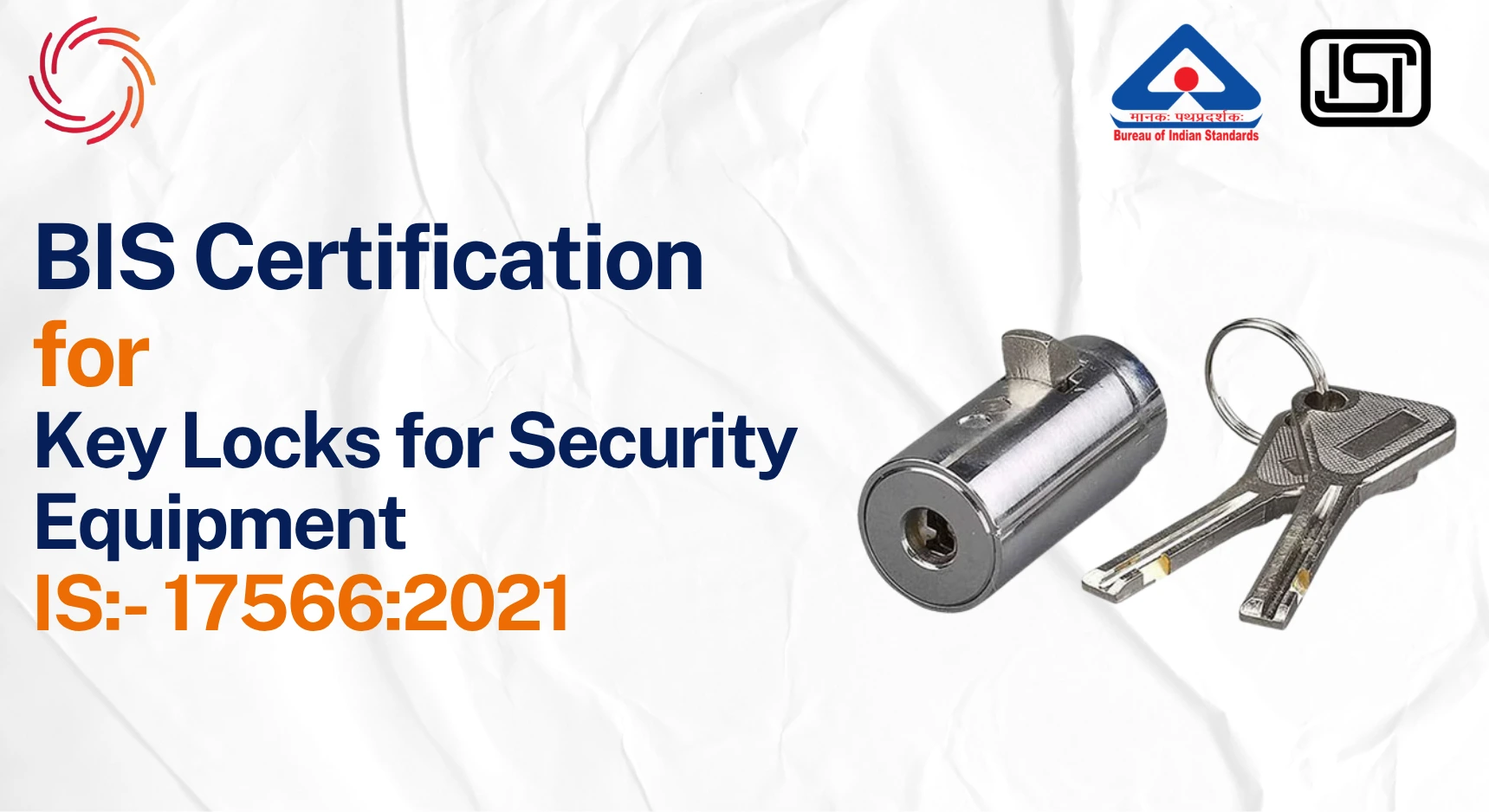
BIS Certification for Key locks for security equipment under IS 17566:2021 ensures that locks meet standardized benchmarks for strength, tamper resistance, and durability. In India, certification is crucial to guarantee reliable protection against unauthorized access and ensure consistent locking performance across manufacturing batches.
Key locks form the first line of defence in safeguarding homes, offices, warehouses, lockers, and high-security installations. Unlike many other hardware components, the performance of a lock is directly linked to personal safety, asset protection, and risk prevention. A compromised lock is not just a functional failure—it can lead to theft, unauthorized entry, and serious security breaches.
In India's rapidly expanding residential and commercial infrastructure, the demand for reliable locking systems has increased significantly. Consumers today expect locks that can resist forced entry, withstand environmental conditions, and function consistently over time. However, the market also contains products of varying quality, making it difficult for end-users to differentiate between reliable and substandard locks.
This is where BIS Certification for Key locks for security equipment becomes essential. Instead of relying solely on brand claims or visual inspection, certification provides a structured method of verifying that locks meet defined performance and safety benchmarks.
For manufacturers and importers, obtaining a BIS Certificate for Key locks for security equipment is not just about compliance—it is about ensuring that their products can be trusted in critical security applications. For distributors and buyers, it serves as a reliable indicator of product integrity and durability.
Understanding BIS Certification for Key Locks for Security Equipment - IS 17566:2021
Key locks are engineered devices that combine mechanical precision, material strength, and design complexity. Even a small flaw—such as weak internal components or poor alignment—can make a lock vulnerable to tampering or failure.
The BIS Certification for Key locks for security equipment evaluates these products beyond surface-level inspection. It focuses on how the lock performs under stress, repeated usage, and potential attack scenarios.
For example:
- A door lock in a residential building must resist forced entry attempts
- A locker lock must maintain precision alignment for repeated use
- A warehouse lock must withstand environmental exposure and heavy-duty usage
Certification ensures that the lock is not only functional but also dependable under these conditions.
The BIS License for Key locks for security equipment confirms that the manufacturing process is controlled, consistent, and capable of producing locks that meet the same tested quality across batches.
This reduces variability in performance and ensures that every unit sold maintains a predictable level of security.
Applicable BIS Standard for Key Locks for Security Equipment - IS 17566:2021
IS 17566:2021 – Overview
The standard IS 17566:2021 defines technical requirements for key-operated locks used in security applications. It establishes guidelines that address both mechanical performance and resistance to unauthorized access.
Scope of the Standard
IS 17566:2021 covers:
- Key-operated locks used in doors, lockers, cabinets, and security enclosures
- Locks designed for residential, commercial, and institutional use
- Different categories based on security levels and application types
Product Categories Covered
The standard classifies locks based on:
- Security grade (basic, medium, high-security)
- Application type (domestic, industrial, institutional)
- Design variations (cylindrical locks, mortise locks, padlocks, etc.)
Safety and Performance Objectives
The standard ensures that locks:
- Resist forced entry attempts such as picking, drilling, or impact
- Maintain locking integrity under repeated usage
- Provide consistent key operation without jamming
- Protect internal mechanisms from environmental damage
Design and Engineering Principles
IS 17566:2021 focuses on:
- Precision in key and cylinder alignment
- Robust internal components to prevent manipulation
- Material strength to resist physical attacks
- Proper assembly to ensure smooth operation
For example, a lock compliant with this standard will not easily open under force or degrade after repeated use.
Testing Requirements as per IS 17566:2021
Testing is the core of the BIS Certification for Key locks for security equipment, ensuring that locks can perform reliably under real-world conditions.
All tests must be conducted in Bureau of Indian Standards recognized laboratories.
1. Safety Tests
These tests evaluate the lock's ability to protect against unauthorized access.
- Resistance to forced opening
- Structural strength of lock body
- Integrity of locking mechanism
Locks must withstand physical stress without breaking or unlocking unintentionally.
2. Performance Tests
Performance testing ensures smooth and consistent operation.
- Key insertion and removal testing
- Locking and unlocking cycle testing
- Alignment and rotation checks
A certified lock should operate without sticking, jamming, or misalignment.
3. Durability Tests
Durability is essential for long-term use.
- Repeated operation cycles
- Wear and tear analysis
- Mechanical fatigue testing
These tests simulate years of usage to ensure consistent performance.
4. Security Resistance Tests
These tests are specific to lock applications.
- Picking resistance
- Drilling resistance
- Impact resistance
Such tests ensure that locks can withstand common intrusion methods.
5. Environmental and Quality Tests
Locks are exposed to different environments.
- Corrosion resistance testing
- Temperature variation testing
- Surface finish inspection
These tests ensure that locks maintain performance under varying conditions.
Conclusion
Key locks are not just hardware components—they are critical security devices that protect property, assets, and people. Their reliability directly impacts safety, making quality assurance a non-negotiable requirement.
The BIS Certification for Key locks for security equipment under IS 17566:2021 provides a structured framework to ensure that locks meet performance, durability, and security expectations. From resisting tampering to maintaining consistent operation, certified locks offer dependable protection.
For manufacturers and importers, obtaining a BIS Certificate for Key locks for security equipment strengthens market acceptance and ensures compliance with Indian regulations. A valid BIS License for Key locks for security equipment not only enables legal sale but also builds trust among customers and institutional buyers.
In a market where security cannot be compromised, certification becomes the foundation of reliability, ensuring that every lock performs exactly as intended when it matters the most.
FAQs – BIS Certification for Key Locks for Security Equipment - IS 17566:2021
1. How does BIS Certification evaluate the internal mechanism complexity of key locks, and why is it important for security applications?
The internal mechanism of a lock—such as pin configurations, tumblers, and cylinder design—plays a major role in preventing unauthorized access. During BIS Certification for Key locks for security equipment, testing authorities assess whether the internal structure resists manipulation techniques like lock picking or bumping. A more complex and precisely engineered mechanism reduces vulnerability. Certification ensures that the lock's internal design is not easily predictable or bypassed, which is especially important for high-security installations such as vaults, lockers, and restricted-access doors.
2. Can a manufacturer upgrade lock designs after obtaining BIS Certification, and how does it affect compliance?
Yes, manufacturers can improve or modify lock designs after obtaining a BIS License for Key locks for security equipment, but any significant change must be evaluated before being introduced into the market. Changes in materials, locking mechanism, or structure may affect performance and security. Therefore, updated designs often require additional testing or approval to ensure they still comply with IS 17566:2021. This process ensures that improvements do not unintentionally compromise safety or reliability.
3. How does BIS Certification address the issue of duplicate keys and key control security?
Key duplication is a major concern in security equipment. While BIS Certification for Key locks for security equipment focuses primarily on mechanical performance, it also considers design aspects that influence key control. Locks with unique key profiles, restricted keyways, or advanced key-cutting patterns are less prone to unauthorized duplication. Certification ensures that the lock design supports controlled access and minimizes the risk of unauthorized key replication, which is crucial for sensitive environments.
4. What role does packaging and labelling play in BIS Certification for key locks?
Packaging and labelling are critical components of BIS compliance. The BIS License for Key locks for security equipment requires that products display correct markings, including the ISI mark, manufacturer details, and standard reference. Proper labelling helps consumers identify certified products and ensures traceability in case of defects or complaints. Incorrect or misleading labelling can lead to non-compliance, even if the product itself meets technical standards.
5. How does BIS Certification ensure consistency in mass production of key locks?
Consistency is essential because even a single defective lock can compromise security. During BIS Certification for Key locks for security equipment, manufacturers must demonstrate that their production processes are controlled and repeatable. Factory inspections evaluate quality control systems, testing procedures, and raw material handling. This ensures that every batch of locks maintains the same quality and performance as the tested sample, reducing variability and risk.
6. Are there different security grades within BIS Certification for key locks, and how do they impact usage?
Yes, IS 17566:2021 categorizes locks based on security levels and intended applications. For example, a basic lock used for household cabinets may have different requirements compared to a high-security lock used in commercial or institutional settings. BIS Certification for Key locks for security equipment ensures that each lock is tested according to its intended use category. This helps buyers select locks that match their specific security needs.
7. How does BIS Certification handle mechanical wear and long-term usage of key locks?
Mechanical wear is inevitable in frequently used locks. BIS Certification for Key locks for security equipment includes endurance testing, where locks undergo repeated locking and unlocking cycles. These tests simulate years of use to ensure that the lock does not lose functionality, alignment, or security over time. This is particularly important for locks used in high-traffic areas such as offices, schools, and public facilities.
8. What precautions should manufacturers take before applying for BIS Certification to avoid rejection?
Manufacturers should conduct internal testing, verify material quality, and ensure proper documentation before applying. Common issues like weak components, poor finishing, or incomplete documentation can lead to rejection. Preparing detailed bis certification documents for Key locks for security equipment and performing pre-compliance checks can significantly improve approval chances. Investing in quality control at the initial stage reduces delays and additional costs.
9. How does BIS Certification contribute to reducing counterfeit lock products in the market?
Counterfeit locks often mimic branded products but lack proper security features. BIS Certification for Key locks for security equipment helps differentiate genuine products by requiring the ISI mark and traceable manufacturing details. This makes it easier for buyers and enforcement authorities to identify authentic products. As a result, certification helps reduce the circulation of low-quality counterfeit locks that may fail in critical situations.
10. Is BIS Certification mandatory for all types of key locks, including decorative or low-security locks?
Not all locks may fall under mandatory certification, but those used in security-sensitive applications typically require compliance with IS 17566:2021. Even for decorative or low-security locks, obtaining a BIS Certificate for Key locks for security equipment enhances credibility and trust. It assures buyers that the product meets minimum performance standards, even if it is not used in high-risk environments.
QCO for Key Locks for Security Equipment
Related Resources
Many of our users also read
This compliance advisory was vetted by our Senior Consultant (Enforcement & Vigilance), a former BIS Director (Enforcement). He specializes in post-certification compliance, helping companies navigate surveillance audits and legal adherence to BIS mandates.
Dhruv Aggarwal
Head of Operations at Sun Certifications India
Experience: 10+ years & Handled 1000+ projects
Awarded by many Indian and International organisations











PT Quty Karunia, BIS Licensee in Vietnam
“Sun Certifications India provided excellent BIS Certification services. Their unparalleled service and sincerity gained our trust. One of the best BIS consultants in India!”

Thantawan Industries Ltd, BIS Licensee in Thailand
“Sun Certifications India supported us throughout the BIS certification process. Their responsive customer service and punctuality are exceptional. Highly recommend for hassle-free BIS certification.”

Leaderart Industries, BIS Licensee in Malaysia
“Sun Certifications India helped us acquire BIS Certification, doubling our engagement in India. Their services are fast, genuine, and up-to-date with latest BIS norms.”

Aluminium Bahrain (ALBA), BIS Licensee in Bahrain
“Excellent BIS certification support, highly reliable consultants.”

Bahrain Aluminium Manufacturing Company, BIS Licensee in Bahrain
“Smooth BIS registration process with expert consultants.”

Daiki Aluminium Japan, BIS Licensee in Japan
“Efficient BIS license assistance, great consultants.”

Trimble Navigation, BIS Licensee in USA
“Seamless BIS certification and registration support.”

Remsa Italia, BIS Licensee in Italy
“Helpful BIS consultants, simplified license process.”

Aquazzura, BIS Licensee in Italy
“We got our BIS certificate well within the timelines and at affordable prices, great work team Sun!”

PT Quty, BIS Licensee in Indonesia
“Excellent BIS registration service, highly recommended.”

Danu Vina, BIS Licensee in Vietnam
“Reliable BIS license consultants, fast process.”

Hanh My Production Company, BIS Licensee in Vietnam
“Expert BIS consultants, certification made easy.”

Sedo Vina, BIS Licensee in Vietnam
“Smooth BIS certificate registration, great support.”

Misumi Japan, BIS Licensee in Japan
“Trusted BIS consultants, quick certification process.”

Thantawan Public Industry Company, BIS Licensee in Thailand
“Professional BIS certification service, very efficient.”

Cortizo Aluminios, BIS Licensee in Spain
“Excellent BIS registration and license guidance.”

Midal Cables, BIS Licensee in Bahrain
“Expert BIS consultants, smooth certification process.”
Years Exp.
Our Clients
Success Rate
Countries Served
Our team brings 10e4+ years of experience in CDSCO and BIS compliance.
We reduce approval time by up to 40% with streamlined processes.
100% success rate with 1500+ successful registrations.
Dedicated account manager ensuring personalized service.
Leave your details below and our experts will call you back within 24 hours to discuss your regulatory compliance needs.
By submitting this form, you agree to our Privacy Policy and consent to being contacted.