BIS Certification for Laboratory Glassware – One–Mark Volumetric Flasks – IS 915:2012
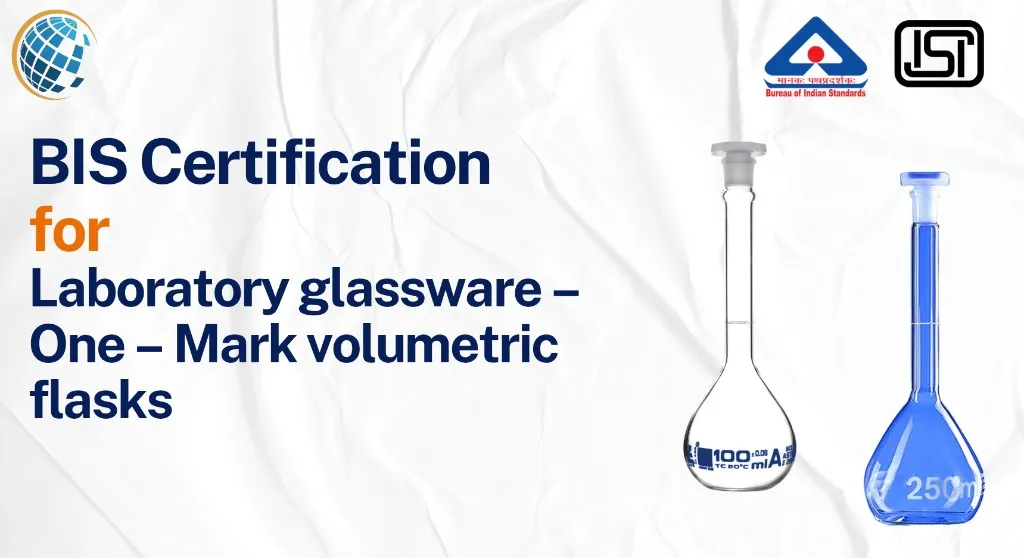
BIS Certification for Laboratory glassware – One–Mark volumetric flasks under IS 915: 2012 confirms that these precision-calibrated flasks deliver exact volume measurement, structural stability, and chemical resistance. In India, certification is essential to ensure laboratory accuracy, prevent measurement errors, and maintain consistency across scientific, pharmaceutical, and industrial applications.
In laboratories where accuracy defines outcomes, volumetric flasks are not just containers—they are measurement tools. One–mark volumetric flasks are specifically designed to hold a precise volume of liquid when filled to a single calibration mark. These flasks are widely used in chemical analysis, pharmaceutical formulation, food testing, and research laboratories where even a slight variation in volume can lead to incorrect results.
Imagine preparing a standard solution where concentration depends entirely on volume precision. If the flask is inaccurately calibrated or distorted due to poor manufacturing, the entire experiment becomes unreliable. This is why precision glassware must go through rigorous evaluation before being used in professional environments.
The need for BIS Certification for Laboratory glassware – One–Mark volumetric flasks arises from this demand for consistency and reliability. Instead of relying on manufacturer claims, the certification process ensures that each flask performs exactly as expected under controlled laboratory conditions.
For manufacturers and importers, obtaining a BIS License for Laboratory glassware – One–Mark volumetric flasks is a strategic requirement. It helps them meet procurement criteria of laboratories, ensures acceptance in regulated industries, and reduces the risk of product rejection due to non-compliance.
Understanding BIS Certificate for One Mark Volumetric Flasks - IS 915:2012
Volumetric flasks are different from general glass containers because their primary function is measurement accuracy. A one–mark volumetric flask is calibrated to contain or deliver a specific volume at a defined temperature, typically 20°C. Any deviation in shape, glass thickness, or calibration marking can directly impact experimental outcomes.
BIS License for One Mark volumetric flasks focuses on ensuring that this level of precision is consistently achieved across every unit produced.
Product-Specific Safety and Accuracy Concerns
- Incorrect calibration leading to measurement errors
- Glass distortion due to thermal stress
- Weak neck structure causing breakage during handling
- Chemical reactions affecting glass integrity
Regulatory Purpose in Context
Instead of broadly assessing quality, the certification examines how accurately the flask holds a specified volume. It ensures that the calibration mark is not just visually placed but scientifically verified through testing.
Role of BIS Standards in This Category
The BIS Certification for One Mark volumetric flasks evaluates:
- Calibration accuracy at defined temperature
- Dimensional uniformity
- Resistance to chemical and thermal stress
- Durability during repeated laboratory use
Protection for End Users
For chemists and analysts, even a 0.1 ml deviation can alter experimental results. Certification ensures:
- Reliable preparation of solutions
- Consistency across experiments
- Reduced risk of analytical errors
Applicable BIS Standard for One Mark Volumetric Flasks - IS 915:2012
The governing standard is IS 915:2012, which specifies requirements for one–mark volumetric flasks used in laboratories.
Scope of the Standard
This standard applies to:
- Glass volumetric flasks with a single calibration mark
- Flasks used for precise measurement and preparation of solutions
- Borosilicate or equivalent glass materials suitable for laboratory use
Product Categories Covered
- Class A volumetric flasks (higher accuracy)
- Class B volumetric flasks (general laboratory use)
- Various capacity ranges (e.g., 50 ml, 100 ml, 500 ml, 1000 ml)
Safety and Performance Objectives
The standard ensures:
- Accurate volume measurement within defined tolerance limits
- Resistance to temperature variations
- Chemical inertness to avoid contamination
- Structural stability during routine handling
Design and Testing Principles
IS 915: 2012 focuses on:
- Precise placement of calibration mark
- Uniform neck diameter for consistent meniscus reading
- Smooth internal surface to prevent liquid retention
- Proper sealing compatibility with stoppers
Testing Requirements as per IS 915:2012
Testing under this standard is highly specialized because it deals with precision rather than just durability. All tests must be conducted in BIS recognized laboratories to ensure accuracy and reliability.
1. Safety Tests
These tests evaluate the physical strength and resilience of the flask:
- Resistance to thermal shock when exposed to temperature variations
- Structural integrity under normal laboratory handling
- Detection of internal stresses that may cause sudden breakage
2. Performance Tests
Performance testing focuses on the primary function—volume accuracy:
- Calibration test to verify exact volume at the marked line
- Meniscus readability check for precise measurement
- Verification of tolerance limits based on flask class (A or B)
For example, a Class A flask must meet stricter tolerance limits compared to Class B, ensuring higher precision.
3. Durability Tests
Repeated use is common in laboratories, so durability is essential:
- Resistance to repeated washing and drying cycles
- Stability of calibration marking over time
- Ability to retain shape under prolonged use
4. Quality Verification Tests
These tests ensure consistency in manufacturing:
- Uniform wall thickness inspection
- Surface finish analysis to detect bubbles or defects
- Dimensional accuracy checks for neck and body
5. Chemical Resistance Testing
Since these flasks are used with acids, solvents, and reagents:
- Glass must not react with chemicals
- No contamination should occur during storage or mixing
- Surface must remain stable under exposure to reagents
Conclusion
BIS Certification for Laboratory glassware – One–Mark volumetric flasks is a critical requirement for ensuring measurement accuracy, safety, and reliability in laboratory environments. By complying with IS 915: 2012, manufacturers demonstrate their commitment to producing precision glassware that meets strict performance standards.
Obtaining a BIS Certificate for Laboratory glassware – One–Mark volumetric flasks not only supports regulatory compliance but also strengthens trust among laboratories and industrial users. Whether you are a manufacturer, importer, or distributor, securing a BIS License for Laboratory glassware – One–Mark volumetric flasks is a vital step toward delivering dependable products in the Indian market.
FAQs – BIS Certification for Laboratory Glassware – One–Mark Volumetric Flasks
1. Why is BIS Certification important for one–mark volumetric flasks when they are primarily used for measurement rather than storage?
BIS Certification for Laboratory glassware – One–Mark volumetric flasks is crucial because these flasks directly influence measurement accuracy in laboratories. Unlike storage containers, their primary function is to ensure precise volume calibration. Even a minor deviation can lead to incorrect chemical concentrations, affecting research results, product formulations, or quality testing. Certification ensures that each flask has been tested for accuracy, consistency, and durability under controlled conditions.
2. How does IS 915: 2012 ensure the accuracy of volumetric flasks used in laboratories?
IS 915: 2012 establishes strict tolerance limits for volume measurement and defines testing methods to verify calibration accuracy. The standard ensures that the marked volume corresponds exactly to the actual capacity at a specific temperature. It also includes guidelines for neck design and marking visibility, which are essential for accurate meniscus reading during liquid measurement.
3. What factors influence the bis certification cost for Laboratory glassware – One–Mark volumetric flasks?
The bis certification cost for Laboratory glassware – One–Mark volumetric flasks depends on factors such as the number of flask sizes being certified, testing complexity, factory inspection requirements, and application fees. Manufacturers offering multiple capacities or both Class A and Class B flasks may incur higher costs due to additional testing and documentation requirements.
4. Can volumetric flasks without BIS Certification be used in professional laboratories in India?
Many professional laboratories, especially in regulated industries like pharmaceuticals and food testing, require certified equipment to maintain compliance and accuracy. Without a BIS Certificate for Laboratory glassware – One–Mark volumetric flasks, such products may not be accepted for official use. Certification ensures that the flasks meet recognized standards for measurement reliability.
5. What are the most common defects found during testing of volumetric flasks?
Common defects include inaccurate calibration marks, uneven glass thickness, internal stress points, and poor surface finish. These issues can affect measurement accuracy and increase the risk of breakage. The BIS certification process helps identify these defects early, allowing manufacturers to correct them before the product reaches the market.
6. How long does it take to obtain a BIS License for Laboratory glassware – One–Mark volumetric flasks?
The time required to obtain a BIS License for Laboratory glassware – One–Mark volumetric flasks depends on factors such as documentation readiness, testing timelines, and factory inspection scheduling. Typically, the process may take several weeks to a few months. Delays often occur due to incomplete documentation or failure to meet testing requirements.
7. What role does calibration testing play in the BIS certification process?
Calibration testing is the most critical aspect of the certification process for volumetric flasks. It verifies that the flask holds the exact volume specified at the calibration mark. This ensures that laboratory measurements are accurate and reproducible. Without proper calibration testing, the flask cannot be considered reliable for scientific use.
8. Are there specific marking requirements for BIS-certified volumetric flasks?
Yes, BIS-certified volumetric flasks must include clear and durable markings such as the calibration mark, capacity, class (A or B), and manufacturer details. These markings ensure traceability and help users identify the flask's specifications. Incorrect or unclear markings can lead to compliance issues even if the flask meets other requirements.
9. What happens if a manufacturer fails to maintain quality after obtaining BIS certification?
If a manufacturer fails to maintain consistent quality, the BIS Licence for Laboratory glassware – One–Mark volumetric flasks can be suspended or canceled. Regular audits and testing are conducted to ensure ongoing compliance. Non-compliance can also lead to penalties and loss of market credibility, affecting business operations.
10. How can manufacturers ensure a smooth BIS certification process for volumetric flasks?
Manufacturers can simplify the bis certification process for Laboratory glassware – One–Mark volumetric flasks by ensuring accurate product design, maintaining detailed documentation, and implementing strong quality control systems. Working with experienced consultants and conducting pre-testing can also help identify potential issues early, reducing delays and improving the chances of successful certification.
Quality Control Order (QCO) for One Mark Volumetric Flasks
Related Resources
Many of our users also read
This compliance advisory was vetted by our Senior Consultant (Enforcement & Vigilance), a former BIS Director (Enforcement). He specializes in post-certification compliance, helping companies navigate surveillance audits and legal adherence to BIS mandates.
Dhruv Aggarwal
Head of Operations at Sun Certifications India
Experience: 10+ years & Handled 1000+ projects
Awarded by many Indian and International organisations











PT Quty Karunia, BIS Licensee in Vietnam
“Sun Certifications India provided excellent BIS Certification services. Their unparalleled service and sincerity gained our trust. One of the best BIS consultants in India!”

Thantawan Industries Ltd, BIS Licensee in Thailand
“Sun Certifications India supported us throughout the BIS certification process. Their responsive customer service and punctuality are exceptional. Highly recommend for hassle-free BIS certification.”

Leaderart Industries, BIS Licensee in Malaysia
“Sun Certifications India helped us acquire BIS Certification, doubling our engagement in India. Their services are fast, genuine, and up-to-date with latest BIS norms.”

Aluminium Bahrain (ALBA), BIS Licensee in Bahrain
“Excellent BIS certification support, highly reliable consultants.”

Bahrain Aluminium Manufacturing Company, BIS Licensee in Bahrain
“Smooth BIS registration process with expert consultants.”

Daiki Aluminium Japan, BIS Licensee in Japan
“Efficient BIS license assistance, great consultants.”

Trimble Navigation, BIS Licensee in USA
“Seamless BIS certification and registration support.”

Remsa Italia, BIS Licensee in Italy
“Helpful BIS consultants, simplified license process.”

Aquazzura, BIS Licensee in Italy
“We got our BIS certificate well within the timelines and at affordable prices, great work team Sun!”

PT Quty, BIS Licensee in Indonesia
“Excellent BIS registration service, highly recommended.”

Danu Vina, BIS Licensee in Vietnam
“Reliable BIS license consultants, fast process.”

Hanh My Production Company, BIS Licensee in Vietnam
“Expert BIS consultants, certification made easy.”

Sedo Vina, BIS Licensee in Vietnam
“Smooth BIS certificate registration, great support.”

Misumi Japan, BIS Licensee in Japan
“Trusted BIS consultants, quick certification process.”

Thantawan Public Industry Company, BIS Licensee in Thailand
“Professional BIS certification service, very efficient.”

Cortizo Aluminios, BIS Licensee in Spain
“Excellent BIS registration and license guidance.”

Midal Cables, BIS Licensee in Bahrain
“Expert BIS consultants, smooth certification process.”
Years Exp.
Our Clients
Success Rate
Countries Served
Our team brings 10e4+ years of experience in CDSCO and BIS compliance.
We reduce approval time by up to 40% with streamlined processes.
100% success rate with 1500+ successful registrations.
Dedicated account manager ensuring personalized service.
Leave your details below and our experts will call you back within 24 hours to discuss your regulatory compliance needs.
By submitting this form, you agree to our Privacy Policy and consent to being contacted.