BIS Certification for Raised Countersunk Head Screws – Complete Guide to IS 7486:2018
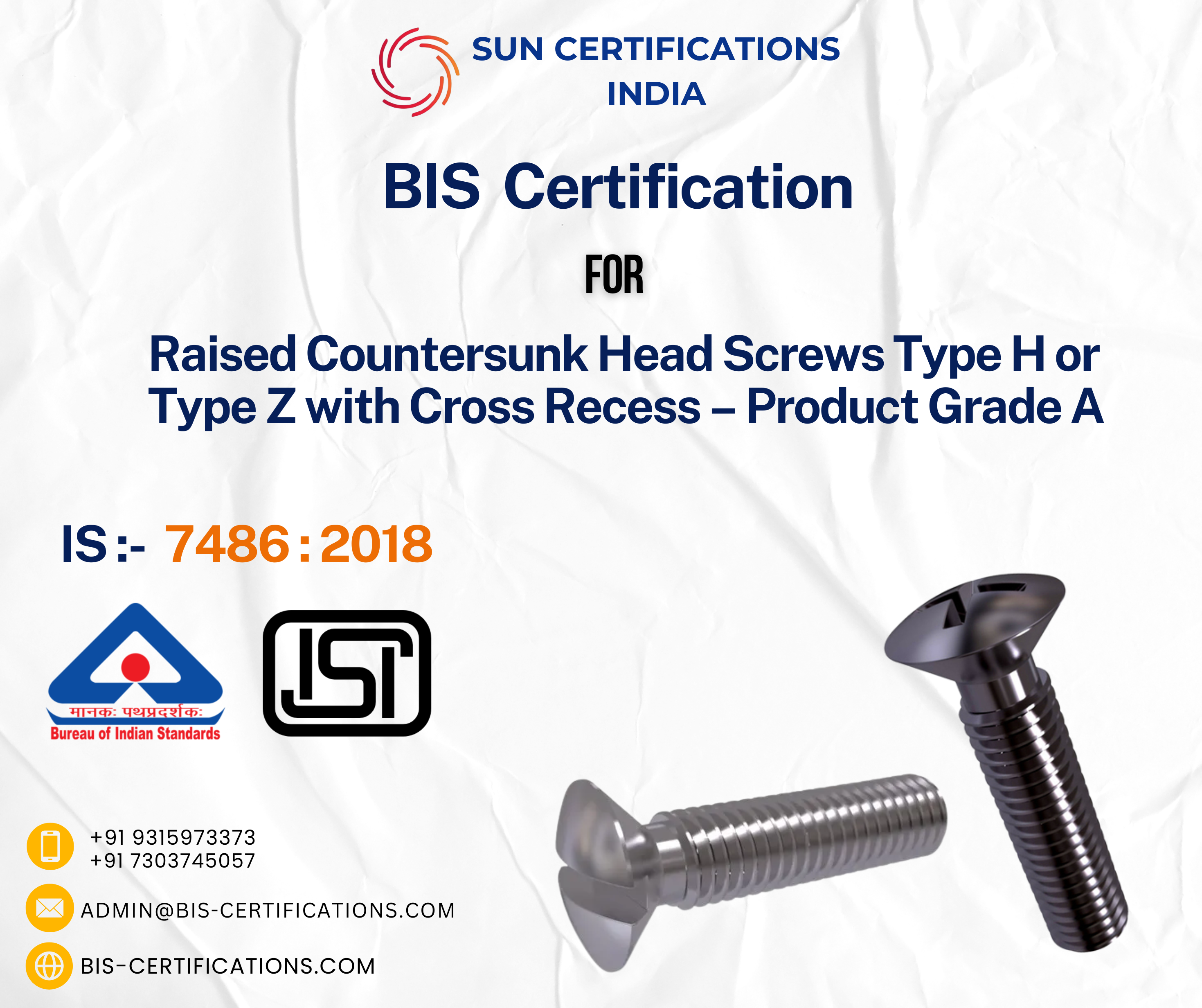
BIS certification for Raised Countersunk Head Screws under IS 7486:2018 ensures that these precision fasteners meet strict dimensional accuracy, strength, and durability requirements. It is required in India to maintain structural reliability in assemblies where flush fitting and load distribution are critical for safety and performance.
Raised countersunk head screws are widely used in industries where both functionality and surface finish matter. From automotive panels and electrical enclosures to furniture fittings and machinery housings, these screws serve a dual purpose—secure fastening and aesthetic alignment. Their unique head design allows them to sit partially flush with the surface while maintaining a slight dome, which enhances both grip and appearance.
Because these screws often hold together components exposed to vibration, load stress, and environmental conditions, even minor manufacturing inconsistencies can lead to serious issues such as loosening, misalignment, or structural failure. For instance, in automotive applications, improper threading or insufficient tensile strength can compromise safety-critical assemblies.
In India, regulatory oversight ensures that such risks are minimized by enforcing standardized manufacturing and testing protocols. This is where the BIS Certification for Raised countersunk head screws becomes essential. It acts as a structured compliance mechanism that aligns manufacturers with nationally accepted engineering benchmarks.
For manufacturers and importers, obtaining a BIS License for Raised countersunk head screws is not just a regulatory checkbox—it is a signal of technical reliability, production discipline, and market readiness. Sellers and distributors also benefit, as certified products are easier to position in quality-conscious markets.
Also read the QCO Notification for Raised countersunk head screws (Common Head Style)
Understanding BIS Certification for Raised countersunk head screws – IS 7486:2018
When it comes to fasteners like raised countersunk head screws, precision is everything. These components are often small, but their role in holding together larger systems makes their reliability non-negotiable. The BIS Certification for Raised countersunk head screws ensures that every unit produced meets defined engineering parameters.
Unlike generic quality checks, this certification evaluates the product in the context of its real-world usage. For example, a screw used in sheet metal assembly must maintain consistent thread pitch and head geometry to avoid stripping or uneven load distribution. BIS certification ensures that such characteristics are not left to chance.
The regulatory purpose here is deeply practical. It is about ensuring that when a screw is tightened into place, it behaves predictably—no unexpected deformation, no premature wear, and no compatibility issues with standard tools or mating components.
Another critical aspect is consumer safety. While end-users may not directly evaluate a screw's compliance, they rely on the integrity of the products assembled using these fasteners. Whether it's a piece of furniture or an electrical panel, certified screws contribute to the overall safety and longevity of the product.
In essence, the BIS Licence for Raised countersunk head screws creates a controlled manufacturing ecosystem where quality is measurable, repeatable, and verifiable.
Check complete details about documentation, cost, and process etc.
Applicable BIS Standard for Raised countersunk head screws
The governing specification for this product category is IS 7486:2018. This standard outlines the technical requirements that raised countersunk head screws must satisfy to be considered compliant in the Indian market.
Scope of IS 7486:2018
This standard applies to screws with a raised countersunk head design, typically used in applications requiring a combination of flush fitting and slight protrusion. It covers screws made from various materials, including carbon steel and alloy steel, depending on the intended application.
Product Categories Covered
IS 7486:2018 includes screws of different sizes, thread types, and mechanical properties. It accommodates variations required for diverse industries such as construction, automotive, and electronics.
Safety and Performance Objectives
The standard focuses on:
- Ensuring dimensional accuracy for proper fitting
- Maintaining thread integrity for secure fastening
- Achieving required tensile and shear strength
- Preventing material defects such as cracks or corrosion
Design and Testing Principles
The design parameters defined in IS 7486:2018 ensure that the screw head aligns correctly with countersunk holes while providing sufficient surface area for load distribution. Testing principles include mechanical strength evaluation, dimensional checks, and surface finish assessment.
By adhering to this standard, manufacturers can produce screws that are not only compatible with industry requirements but also capable of performing reliably under operational stress.
Why BIS Certification is Mandatory for Raised countersunk head screws
Safety Risks Related to the Product
Raised countersunk head screws are often used in load-bearing or vibration-prone environments. A defective screw can lead to loosening, misalignment, or even structural collapse in extreme cases. Certification ensures that such risks are minimized through controlled manufacturing.
Consumer Protection
End-users may never inspect individual screws, but they depend on the safety of assembled products. Certified screws contribute to the overall reliability of these products, indirectly protecting consumers.
Regulatory Enforcement in India
Indian regulations require certain categories of fasteners to comply with BIS standards before being sold. Non-compliant products may be restricted from entering the market.
Market Access Requirements
Without a valid BIS Certificate for Raised countersunk head screws, manufacturers and importers may face barriers in supplying to large-scale projects or government tenders.
Brand Credibility
Certification acts as a quality assurance marker. Businesses that invest in compliance often gain a competitive edge in both domestic and international markets.
Scope of BIS License of countersunk head screws as per IS 7486:2018
The scope includes all raised countersunk head screws manufactured or imported for use in India. It covers:
- Screws used in mechanical assemblies
- Fasteners for electrical and electronic equipment
- Components used in furniture and construction
The license ensures that all such products meet standardized quality benchmarks.
Testing Requirements as per IS 7486:2018
Testing includes:
- Mechanical strength tests to evaluate load-bearing capacity
- Dimensional checks for accuracy
- Surface finish tests to ensure corrosion resistance
- Thread verification tests for compatibility
All tests must be conducted in BIS-recognized laboratories.
Conclusion
The BIS Certification for Raised countersunk head screws under IS 7486:2018 is a critical requirement for ensuring product reliability, safety, and market acceptance in India. From manufacturing precision to regulatory compliance, every aspect of the process contributes to building a trustworthy product.
Obtaining a BIS License for Raised countersunk head screws not only enables legal market entry but also strengthens brand credibility and customer confidence. Whether you are a manufacturer, importer, or distributor, investing in compliance is a strategic move toward long-term success.
FAQs – BIS Certification for Raised countersunk head screws
1. Why is BIS Certification important specifically for raised countersunk head screws used in metal assemblies?
Raised countersunk head screws are frequently used in sheet metal, panels, and machinery where alignment and flush seating are critical. If the head angle or thread geometry is inaccurate, it can lead to improper fitting, surface damage, or loosening under vibration. BIS certification ensures these screws maintain dimensional precision and mechanical strength, reducing risks in assemblies where even minor deviations can cause functional failure.
2. How does IS 7486:2018 address the unique design of raised countersunk head screws?
IS 7486:2018 focuses on the specific geometry of raised countersunk heads, including head angle, diameter, and height proportions. These parameters ensure the screw fits correctly into countersunk holes while maintaining a slight projection for tool engagement. The standard also defines thread consistency and material strength, ensuring that the screw performs reliably in applications requiring both structural integrity and aesthetic finishing.
3. What types of defects are commonly detected during BIS testing of raised countersunk head screws?
During BIS testing, common defects include improper thread pitch, inconsistent head dimensions, surface cracks, and inadequate tensile strength. These issues can arise from poor machining, low-quality raw materials, or improper heat treatment. Such defects directly affect the screw's ability to hold components securely, especially in applications exposed to vibration or load stress.
4. How does BIS certification improve compatibility of raised countersunk head screws with standard tools and components?
BIS certification ensures that screws adhere to standardized dimensions and threading profiles, which allows seamless compatibility with commonly used nuts, tapped holes, and tools. Without this standardization, mismatched threads or incorrect head shapes can lead to stripping, improper torque application, or assembly delays, especially in industrial production lines where precision is essential.
5. Are coating and corrosion resistance covered under BIS Certification for raised countersunk head screws?
Yes, the certification process evaluates surface finish and coating quality where applicable. Raised countersunk head screws are often used in environments exposed to moisture, chemicals, or temperature variations. BIS testing ensures that coatings like zinc plating or other finishes are uniformly applied and effective in preventing corrosion, thereby extending the service life of the fastener.
6. How does BIS certification impact bulk manufacturing of raised countersunk head screws?
For bulk production, maintaining uniformity across thousands or millions of screws is challenging. BIS certification requires manufacturers to implement strict quality control systems, ensuring that each batch meets the same specifications. This reduces variability, minimizes rejection rates, and ensures that large-scale industrial buyers receive consistent and reliable products.
7. What role does heat treatment play in BIS compliance for raised countersunk head screws?
Heat treatment is crucial for achieving the required hardness and tensile strength in screws. If not properly controlled, screws may become too brittle or too soft, leading to breakage or deformation during use. BIS certification verifies that heat treatment processes are correctly implemented, ensuring the screws can withstand operational stresses without failure.
8. Can raised countersunk head screws with different materials (like stainless steel or alloy steel) all be covered under one BIS license?
The BIS license typically specifies the material grade and product variants covered. If a manufacturer produces screws using different materials, each variation may require separate evaluation or inclusion in the license scope. This ensures that the mechanical and chemical properties of each material type meet the required standards under IS 7486:2018.
9. How does BIS certification help in export and domestic supply of raised countersunk head screws?
For domestic supply, BIS certification ensures compliance with Indian regulatory requirements, enabling smooth distribution across markets. For exports, while BIS may not always be mandatory, having certification demonstrates adherence to recognized quality benchmarks, which can improve acceptance in international markets and build trust with global buyers.
10. What happens during factory inspection for BIS Certification of raised countersunk head screws?
During factory inspection, BIS officials evaluate the entire production process, including raw material sourcing, machining, threading, heat treatment, and finishing. They also review quality control systems, testing equipment, and batch traceability. The goal is to ensure that the manufacturer can consistently produce screws that meet IS 7486:2018 requirements, not just in samples but in regular production.
Check complete details about documentation, cost, and process for foreign manufacturers
Check complete details about documentation, cost, and process for Indian manufacturers
Many of our users also read
This documentation guide was reviewed by our Lead Application Specialist, a former BIS Section Head (Licensing & Scrutiny). With experience processing over 5,000 application files, he ensures that client submissions meet the strict administrative criteria to prevent rejection during the initial scrutiny stage.
Dhruv Aggarwal
Head of Operations at Sun Certifications India
Experience: 10+ years & Handled 1000+ projects
Awarded by many Indian and International organisations








PT Quty Karunia, BIS Licensee in Vietnam
“Sun Certifications India provided excellent BIS Certification services. Their unparalleled service and sincerity gained our trust. One of the best BIS consultants in India!”

Thantawan Industries Ltd, BIS Licensee in Thailand
“Sun Certifications India supported us throughout the BIS certification process. Their responsive customer service and punctuality are exceptional. Highly recommend for hassle-free BIS certification.”

Leaderart Industries, BIS Licensee in Malaysia
“Sun Certifications India helped us acquire BIS Certification, doubling our engagement in India. Their services are fast, genuine, and up-to-date with latest BIS norms.”

Aluminium Bahrain (ALBA), BIS Licensee in Bahrain
“Excellent BIS certification support, highly reliable consultants.”

Bahrain Aluminium Manufacturing Company, BIS Licensee in Bahrain
“Smooth BIS registration process with expert consultants.”

Daiki Aluminium Japan, BIS Licensee in Japan
“Efficient BIS license assistance, great consultants.”

Trimble Navigation, BIS Licensee in USA
“Seamless BIS certification and registration support.”

Remsa Italia, BIS Licensee in Italy
“Helpful BIS consultants, simplified license process.”

Aquazzura, BIS Licensee in Italy
“We got our BIS certificate well within the timelines and at affordable prices, great work team Sun!”

PT Quty, BIS Licensee in Indonesia
“Excellent BIS registration service, highly recommended.”

Danu Vina, BIS Licensee in Vietnam
“Reliable BIS license consultants, fast process.”

Hanh My Production Company, BIS Licensee in Vietnam
“Expert BIS consultants, certification made easy.”

Sedo Vina, BIS Licensee in Vietnam
“Smooth BIS certificate registration, great support.”

Misumi Japan, BIS Licensee in Japan
“Trusted BIS consultants, quick certification process.”

Thantawan Public Industry Company, BIS Licensee in Thailand
“Professional BIS certification service, very efficient.”

Cortizo Aluminios, BIS Licensee in Spain
“Excellent BIS registration and license guidance.”

Midal Cables, BIS Licensee in Bahrain
“Expert BIS consultants, smooth certification process.”
Years Exp.
Our Clients
Success Rate
Countries Served
Our team brings 10e4+ years of experience in CDSCO and BIS compliance.
We reduce approval time by up to 40% with streamlined processes.
100% success rate with 1500+ successful registrations.
Dedicated account manager ensuring personalized service.
Leave your details below and our experts will call you back within 24 hours to discuss your regulatory compliance needs.
By submitting this form, you agree to our Privacy Policy and consent to being contacted.