BIS Certification for Rubber Hot Water Bottles – Complete Guide to IS 1867:2023
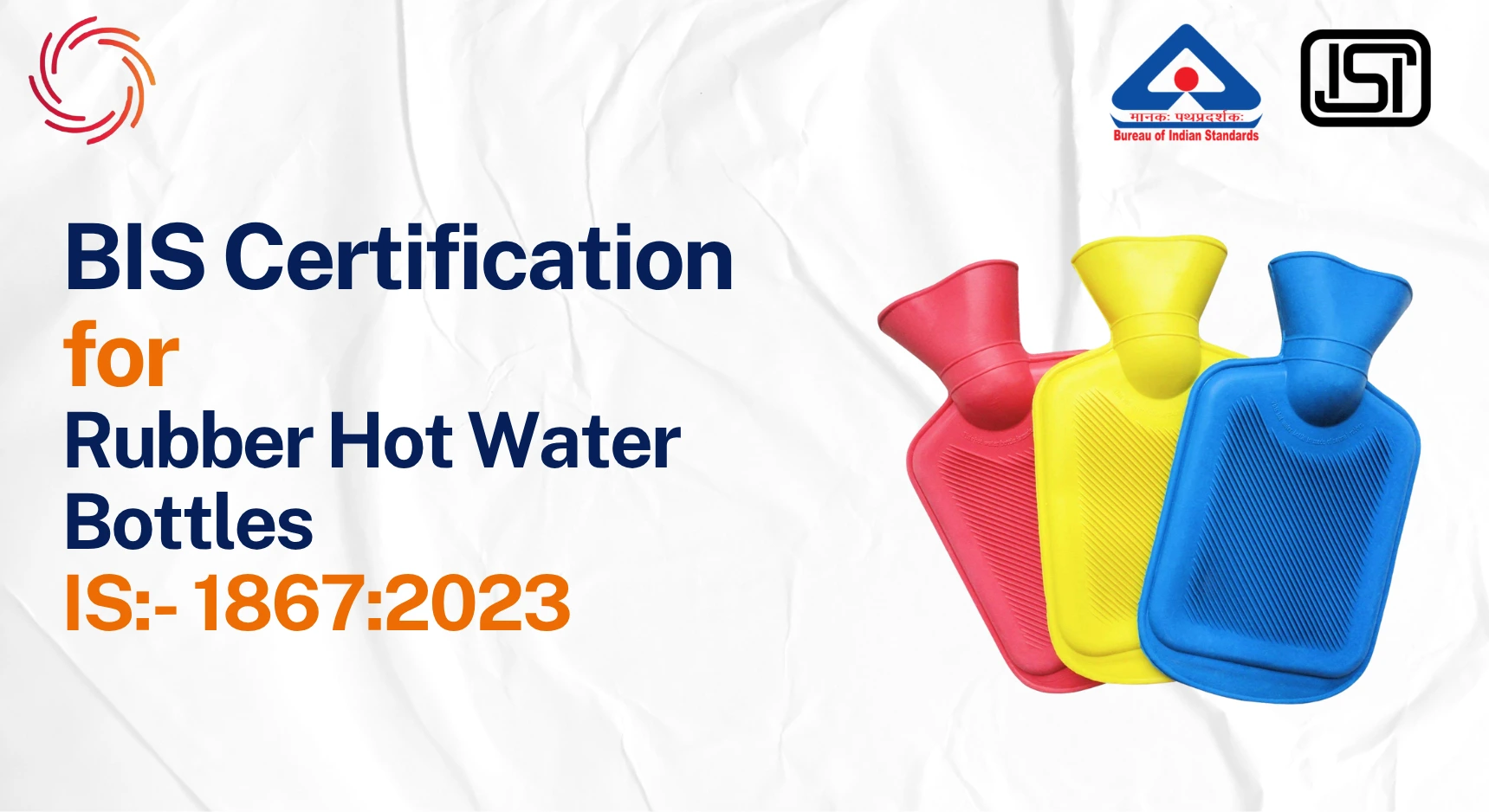
A BIS Certificate for Rubber Hot Water Bottles confirms that the product complies with IS 1867:2023, the Indian Standard specified for safety, quality, construction, performance, and testing requirements. Manufacturers must obtain a BIS Certification for Rubber Hot Water Bottles before selling products covered under the applicable Quality Control Order (QCO). The certification allows eligible manufacturers to use the ISI Mark, demonstrating that the product meets prescribed Indian safety and quality standards.
Rubber hot water bottles have remained one of the most commonly used products for heat therapy, pain relief, and personal comfort. They are widely used in homes, hospitals, physiotherapy clinics, nursing facilities, and healthcare institutions. Whether used to relieve muscle stiffness, menstrual cramps, joint pain, or simply to provide warmth during winter, these products come into direct contact with the human body. Because of this, product quality and safety cannot be compromised.
A poorly manufactured hot water bottle may leak, burst, crack, or fail under pressure, leading to burns and serious injuries. Such risks make quality assurance an essential requirement rather than an optional feature. This is where the BIS Certificate for Rubber Hot Water Bottles plays an important role.
The BIS Certification for Rubber Hot Water Bottles demonstrates that a product has been manufactured in accordance with IS 1867:2023, the latest Indian Standard specifying quality, performance, construction, material, and testing requirements. Products complying with this standard undergo rigorous evaluation before receiving permission to bear the ISI Mark.
For manufacturers, obtaining a BIS License for Rubber Hot Water Bottles is more than a regulatory formality. It reflects a commitment to product safety, customer satisfaction, and compliance with Indian quality regulations. Certified products generally enjoy greater acceptance among distributors, retailers, healthcare buyers, and institutional purchasers because the ISI Mark represents a trusted benchmark of quality.
This guide has been prepared for:
- Indian manufacturers planning to obtain a BIS licence.
- Foreign manufacturers intending to export Rubber Hot Water Bottles to India.
- Importers sourcing compliant products.
- Brand owners and private label manufacturers.
- Healthcare suppliers and distributors.
- E-commerce sellers dealing in regulated products.
- Businesses seeking information about the BIS certification process for Rubber Hot Water Bottles, documentation, testing requirements, and certification costs.
Throughout this guide, you will also learn about the BIS application process for Rubber Hot Water Bottles, important compliance requirements, applicable testing procedures, and the documents generally required for certification under IS 1867:2023.
What is BIS Certification?
The Bureau of Indian Standards (BIS) is India's National Standards Body responsible for developing Indian Standards and operating product certification schemes that help ensure the safety, reliability, and quality of products sold in the country.
BIS establishes technical standards for thousands of industrial and consumer products covering manufacturing processes, raw materials, testing procedures, product performance, packaging, marking requirements, and safety parameters. These standards help create consistency across industries while protecting consumers from unsafe or substandard products.
When a product successfully complies with the applicable Indian Standard and satisfies all certification requirements, BIS grants permission to the manufacturer to use the ISI Mark on the certified product.
What is a BIS Certificate?
A BIS Certificate is an official authorization issued by the Bureau of Indian Standards confirming that a manufacturing facility consistently produces products conforming to the applicable Indian Standard.
For Rubber Hot Water Bottles, the certification verifies that manufacturing practices, quality control systems, testing facilities, raw materials, and finished products comply with the requirements prescribed under IS 1867:2023.
Rather than certifying a single product sample, BIS evaluates the manufacturer's capability to consistently manufacture compliant products over time. This includes an assessment of production processes, quality management systems, testing infrastructure, and routine inspection procedures.
Understanding the ISI Mark
The ISI Mark is one of India's most recognized quality symbols. It signifies that a product has been manufactured under a valid BIS licence and conforms to the applicable Indian Standard.
For consumers, the ISI Mark provides confidence that the product has undergone standardized quality evaluation and meets prescribed safety and performance requirements.
For manufacturers, displaying the ISI Mark offers several advantages:
- Demonstrates compliance with Indian Standards.
- Enhances consumer confidence.
- Strengthens brand credibility.
- Supports participation in government and institutional procurement.
- Improves market acceptance across India.
- Differentiates certified products from non-certified alternatives.
It is important to understand that manufacturers may use the ISI Mark only after obtaining a valid BIS Licence for Rubber Hot Water Bottles. Unauthorized use of the mark may attract regulatory action under the Bureau of Indian Standards Act.
Why is BIS Certification Important for Rubber Hot Water Bottles?
Rubber Hot Water Bottles are designed to contain hot water at elevated temperatures while remaining safe for direct human use. Their performance depends on several critical factors, including material quality, wall thickness, seam strength, closure integrity, heat resistance, and resistance to leakage.
If any of these parameters fail, the product can become hazardous. A defective bottle may rupture unexpectedly, leak boiling water, or deteriorate prematurely, posing risks of burns and injuries.
Obtaining a BIS Certification for Rubber Hot Water Bottles helps ensure that:
- Appropriate rubber compounds are used during manufacturing.
- The bottle can withstand specified operating conditions.
- Seams and joints possess adequate strength.
- Caps and stoppers provide secure sealing.
- Products meet prescribed safety and performance benchmarks.
- Manufacturing quality remains consistent across production batches.
These quality controls are essential because Rubber Hot Water Bottles are often used by children, elderly individuals, patients recovering from injuries, and people requiring heat therapy for medical conditions.
Applicable BIS Standard for Rubber Hot Water Bottles
The applicable Indian Standard for Rubber Hot Water Bottles is:
IS 1867:2023 – Rubber Hot Water Bottles – Specification
This standard specifies the technical requirements that manufacturers must follow while designing, producing, inspecting, testing, marking, and packaging Rubber Hot Water Bottles intended for sale in the Indian market.
IS 1867:2023 replaces earlier requirements with updated provisions that align with current manufacturing practices, safety expectations, and quality assurance principles. The standard provides a comprehensive framework to ensure that every certified product delivers consistent performance under normal conditions of use.
Scope of IS 1867:2023
The scope of IS 1867:2023 covers Rubber Hot Water Bottles manufactured for storing hot water for therapeutic, domestic, healthcare, and personal comfort applications.
The standard lays down requirements relating to:
- Selection of suitable rubber materials.
- Product design and construction.
- Dimensions and tolerances.
- Workmanship and finish.
- Physical characteristics.
- Mechanical strength.
- Leak resistance.
- Closure performance.
- Performance testing.
- Product marking.
- Packaging requirements.
- Quality control procedures.
The objective is to establish uniform manufacturing practices so that consumers receive products offering reliable safety and long service life.
Key Requirements Covered Under IS 1867:2023
Although manufacturers should always refer to the complete standard for detailed technical provisions, the standard broadly addresses several important aspects of product quality, including:
Material Quality
The rubber compound used for manufacturing should possess suitable physical properties that allow repeated exposure to hot water without significant deterioration, cracking, deformation, or leakage.
Construction Requirements
The bottle should be manufactured with uniform wall thickness, properly bonded seams, and a secure neck design capable of supporting the stopper without leakage.
Performance Requirements
The product must demonstrate adequate durability, flexibility, and resistance to failure during prescribed performance tests conducted in accordance with the standard.
Workmanship
The finished product should be free from visible defects such as cracks, air bubbles, weak joints, improper vulcanization, surface imperfections, or manufacturing flaws that could affect safety or performance.
Marking Requirements
Certified products are required to display prescribed markings, including the ISI Mark, licence number, manufacturer identification, and other details specified under the standard and BIS certification guidelines.
Why BIS Certification is Mandatory for Rubber Hot Water Bottles
The demand for safe, reliable, and durable healthcare products has increased significantly in recent years. Rubber Hot Water Bottles are widely used for therapeutic heat treatment, pain management, muscle relaxation, and personal comfort. Since these products are designed to hold hot water at elevated temperatures and come into direct contact with users, even a minor manufacturing defect can lead to leakage, bursting, or severe burn injuries.
To protect consumers from such risks, the Government of India has introduced mandatory quality requirements for several consumer products through Quality Control Orders (QCOs). Where applicable, manufacturers are required to obtain a BIS Certificate for Rubber Hot Water Bottles before manufacturing, selling, importing, or distributing the product in the Indian market.
A valid BIS Certification for Rubber Hot Water Bottles confirms that the product complies with IS 1867:2023 and has successfully met the prescribed quality, safety, and performance requirements.
Testing Requirements as per IS 1867:2023
Testing is one of the most important stages of the BIS certification process for Rubber Hot Water Bottles. Before certification is granted, product samples are evaluated to verify compliance with the technical requirements specified in IS 1867:2023.
Testing must be carried out in accordance with the methods prescribed under the standard, and where required for certification, it should be performed in BIS-recognized laboratories.
The objective of testing is to confirm that the product consistently meets essential safety, construction, and performance requirements.
Who Needs BIS Certification for Rubber Hot Water Bottles?
Understanding who is responsible for obtaining certification is essential for ensuring regulatory compliance. The obligation to obtain a BIS Certificate for Rubber Hot Water Bottles primarily rests with the manufacturer, but several stakeholders in the supply chain should also be aware of the applicable requirements.
Indian Manufacturers
Manufacturers producing Rubber Hot Water Bottles in India are responsible for obtaining the required BIS Certification for Rubber Hot Water Bottles before manufacturing or selling products covered under the applicable regulatory framework.
The licence is issued for the manufacturing facility where the product is produced.
Foreign Manufacturers
Overseas manufacturers intending to export Rubber Hot Water Bottles to India must comply with the relevant BIS certification requirements before their products can be placed on the Indian market.
Depending on the applicable certification scheme, foreign manufacturers may also need to appoint an Authorized Indian Representative (AIR) to coordinate with BIS.
Importers
Importers should ensure that the products they source from overseas manufacturers are covered by a valid BIS licence wherever certification is mandatory.
Importing non-compliant products may lead to customs clearance issues, regulatory action, or restrictions on sale in the Indian market.
Brand Owners and Private Label Companies
Businesses selling Rubber Hot Water Bottles under their own brand name should verify that the manufacturing unit supplying the product holds the necessary BIS licence.
This helps protect the brand from compliance issues and enhances customer confidence.
Distributors, Wholesalers, and Retailers
Although distributors and retailers are generally not responsible for obtaining the licence themselves, they should ensure that the products they stock and sell comply with the applicable BIS requirements.
Selling certified products helps reduce regulatory risks and strengthens customer trust.
E-commerce Sellers
Online marketplaces and e-commerce sellers should verify that Rubber Hot Water Bottles offered through their platforms comply with applicable Indian regulations.
Listing products backed by a valid BIS Licence for Rubber Hot Water Bottles supports regulatory compliance and helps build consumer confidence in online purchases.
The final part of this guide will cover the key benefits of BIS certification, common mistakes manufacturers should avoid, answers to frequently asked questions, and a comprehensive conclusion to help businesses better understand compliance with IS 1867:2023.
Conclusion
Obtaining a BIS Certificate for Rubber Hot Water Bottles is an essential step for manufacturers seeking to supply safe, reliable, and compliant products in the Indian market. Since these products are intended to hold hot water and are used directly for therapeutic and household purposes, maintaining high standards of quality and safety is critical.
Compliance with IS 1867:2023 helps ensure that Rubber Hot Water Bottles meet the prescribed requirements for material quality, construction, performance, and testing. Through the BIS Certification for Rubber Hot Water Bottles, manufacturers demonstrate their ability to consistently produce products that conform to Indian Standards while meeting regulatory expectations.
Whether you are planning to apply for a BIS License for Rubber Hot Water Bottles, understanding the BIS application process for Rubber Hot Water Bottles, estimating the BIS certification cost for Rubber Hot Water Bottles, or preparing the BIS certification documents for Rubber Hot Water Bottles, a systematic approach to compliance can simplify the certification journey and reduce unnecessary delays.
By implementing robust quality control systems, maintaining complete documentation, conducting testing through BIS-recognized laboratories, and complying with the applicable certification requirements, manufacturers can strengthen customer confidence, improve market acceptance, and ensure long-term regulatory compliance under IS 1867:2023.
Frequently Asked Questions (FAQs)
1. What is the applicable Indian Standard for Rubber Hot Water Bottles?
The applicable Indian Standard is IS 1867:2023, which specifies the requirements for the design, construction, performance, testing, marking, and quality of Rubber Hot Water Bottles.
2. Is BIS Certification mandatory for Rubber Hot Water Bottles?
If Rubber Hot Water Bottles are covered under the applicable Quality Control Order (QCO), manufacturers must obtain the required BIS certification before manufacturing, importing, or selling the product in India.
3. Who can apply for a BIS Certificate for Rubber Hot Water Bottles?
The application is generally submitted by the manufacturer. Indian manufacturers, foreign manufacturers exporting to India, and eligible manufacturing units can apply under the applicable BIS certification scheme.
4. How long does the BIS certification process take?
The timeline depends on several factors, including document readiness, product testing, factory inspection, and application review by BIS. Complete and accurate documentation can help reduce processing time.
5. What documents are required for BIS Certification?
Manufacturers generally need business registration documents, factory details, manufacturing process information, quality control records, testing equipment details, product specifications, and applicable test reports.
6. What is the BIS certificate cost for Rubber Hot Water Bottles?
There is no fixed certification cost. The overall cost depends on BIS fees, testing charges, inspection expenses, licence fees, and any professional consultancy services engaged during the certification process.
7. Can foreign manufacturers obtain BIS Certification?
Yes. Foreign manufacturers supplying Rubber Hot Water Bottles to the Indian market may apply under the applicable BIS certification scheme and, where required, appoint an Authorized Indian Representative (AIR).
8. Can traders or retailers apply for a BIS Licence?
No. A BIS licence is generally issued to the manufacturer of the product. However, traders and retailers should ensure that the products they sell are manufactured under a valid BIS licence where certification is mandatory.
9. What happens if a manufacturer sells non-compliant products?
Manufacturing or selling regulated products without the required BIS certification may result in regulatory action, product recalls, penalties, restrictions on sale, or other legal consequences under the Bureau of Indian Standards Act and applicable regulations.
10. Why is the ISI Mark important for Rubber Hot Water Bottles?
The ISI Mark indicates that the product has been manufactured under a valid BIS licence and complies with IS 1867:2023. It serves as a recognised symbol of quality, safety, and conformity with Indian Standards.
Related Resources
Many of our users also read
This compliance advisory was vetted by our Senior Consultant (Enforcement & Vigilance), a former BIS Director (Enforcement). He specializes in post-certification compliance, helping companies navigate surveillance audits and legal adherence to BIS mandates.
Dhruv Aggarwal
Head of Operations at Sun Certifications India
Experience: 10+ years & Handled 1000+ projects
Awarded by many Indian and International organisations









PT Quty Karunia, BIS Licensee in Vietnam
“Sun Certifications India provided excellent BIS Certification services. Their unparalleled service and sincerity gained our trust. One of the best BIS consultants in India!”

Thantawan Industries Ltd, BIS Licensee in Thailand
“Sun Certifications India supported us throughout the BIS certification process. Their responsive customer service and punctuality are exceptional. Highly recommend for hassle-free BIS certification.”

Leaderart Industries, BIS Licensee in Malaysia
“Sun Certifications India helped us acquire BIS Certification, doubling our engagement in India. Their services are fast, genuine, and up-to-date with latest BIS norms.”

Aluminium Bahrain (ALBA), BIS Licensee in Bahrain
“Excellent BIS certification support, highly reliable consultants.”

Bahrain Aluminium Manufacturing Company, BIS Licensee in Bahrain
“Smooth BIS registration process with expert consultants.”

Daiki Aluminium Japan, BIS Licensee in Japan
“Efficient BIS license assistance, great consultants.”

Trimble Navigation, BIS Licensee in USA
“Seamless BIS certification and registration support.”

Remsa Italia, BIS Licensee in Italy
“Helpful BIS consultants, simplified license process.”

Aquazzura, BIS Licensee in Italy
“We got our BIS certificate well within the timelines and at affordable prices, great work team Sun!”

PT Quty, BIS Licensee in Indonesia
“Excellent BIS registration service, highly recommended.”

Danu Vina, BIS Licensee in Vietnam
“Reliable BIS license consultants, fast process.”

Hanh My Production Company, BIS Licensee in Vietnam
“Expert BIS consultants, certification made easy.”

Sedo Vina, BIS Licensee in Vietnam
“Smooth BIS certificate registration, great support.”

Misumi Japan, BIS Licensee in Japan
“Trusted BIS consultants, quick certification process.”

Thantawan Public Industry Company, BIS Licensee in Thailand
“Professional BIS certification service, very efficient.”

Cortizo Aluminios, BIS Licensee in Spain
“Excellent BIS registration and license guidance.”

Midal Cables, BIS Licensee in Bahrain
“Expert BIS consultants, smooth certification process.”
Years Exp.
Our Clients
Success Rate
Countries Served
Our team brings 10e4+ years of experience in CDSCO and BIS compliance.
We reduce approval time by up to 40% with streamlined processes.
100% success rate with 1500+ successful registrations.
Dedicated account manager ensuring personalized service.
Leave your details below and our experts will call you back within 24 hours to discuss your regulatory compliance needs.
By submitting this form, you agree to our Privacy Policy and consent to being contacted.