BIS Certification for Stainless Steel Butt Hinges – IS 12817:2020
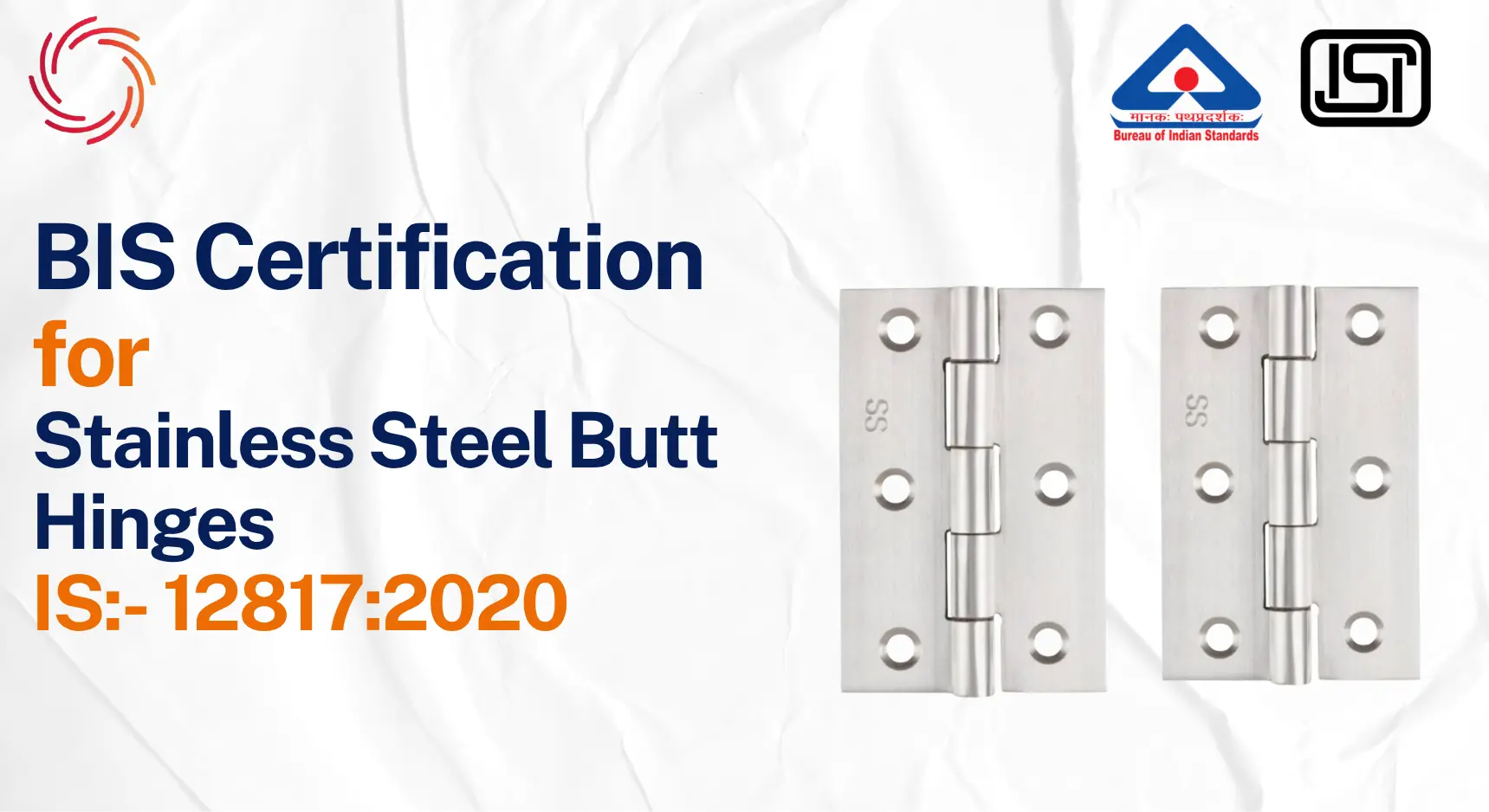
BIS certification for Stainless Steel butt hinges under IS 12817:2020 ensures that these hinges meet defined performance, corrosion resistance, and durability benchmarks required for safe and long-term use in doors, cabinets, and industrial fittings. In India, certification is essential to ensure reliability, structural strength, and consistent quality in high-load and moisture-prone applications.
Stainless steel butt hinges are widely used in residential, commercial, and industrial applications where durability, corrosion resistance, and smooth door operation are critical. From modular kitchen cabinets to heavy-duty fire doors and coastal infrastructure, these hinges play a silent yet essential role in ensuring structural integrity and user safety.
Unlike ordinary hinges, stainless steel butt hinges are expected to withstand environmental stress such as humidity, salt exposure, repeated mechanical load, and frequent opening and closing cycles. A minor defect—such as improper alignment, weak pin construction, or poor-grade stainless steel—can lead to door sagging, operational failure, or even safety hazards in high-traffic environments.
In India's evolving infrastructure landscape, where construction quality and hardware reliability are under increasing scrutiny, regulatory frameworks have become more structured. This is where BIS Certification for Stainless Steel butt hinges becomes highly relevant. It acts as a technical validation that the product has been manufactured and tested in accordance with recognized engineering standards.
For manufacturers, importers, and distributors, obtaining a BIS Certificate for Stainless Steel butt hinges is not merely a regulatory step—it is a market requirement that determines acceptance, credibility, and large-scale procurement eligibility.
Understanding BIS Certification for Stainless Steel Butt Hinges - IS 12817:2020
When discussing stainless steel butt hinges, certification is not just about marking compliance—it is about validating the hinge's performance under real-world conditions.
A hinge may appear identical externally, but its internal construction determines how it behaves over time. For example:
- A hinge used in a bathroom door must resist corrosion due to moisture exposure
- A hinge installed on a heavy wooden door must withstand repeated load without deformation
- A hinge used in industrial settings must operate smoothly despite continuous usage
The BIS Certification for Stainless Steel butt hinges ensures that all such functional expectations are consistently met.
This certification verifies multiple aspects:
- Material composition, ensuring correct grade of stainless steel such as corrosion-resistant alloys
- Dimensional accuracy, ensuring proper alignment and fitment
- Mechanical strength, ensuring load-bearing capacity without failure
- Surface finish, ensuring smooth operation and resistance to wear
Without such structured evaluation, hinges could fail prematurely, leading to operational inconvenience or safety risks.
The BIS License for Stainless Steel butt hinges acts as an assurance that every unit manufactured under that license adheres to the same tested quality benchmarks.
Applicable BIS Standard for Stainless Steel Butt Hinges - IS 12817:2020
IS 12817:2020 – Key Overview
The standard IS 12817:2020 specifically addresses the design, construction, and performance requirements for stainless steel butt hinges.
This standard has been developed to address the unique characteristics of stainless steel hardware, which differs significantly from traditional mild steel or brass hinges.
Scope of the Standard
IS 12817:2020 covers:
- Stainless steel butt hinges used in doors, windows, and cabinets
- Hinges designed for both residential and commercial applications
- Various sizes and load-bearing capacities
- Hinges with fixed pin and loose pin configurations
Product Categories Covered
The standard typically categorizes hinges based on:
- Size and thickness
- Type of application, including light-duty, medium-duty, and heavy-duty
- Mounting configuration
- Intended environmental exposure
Safety and Performance Objectives
IS 12817:2020 ensures that hinges:
- Maintain alignment under repeated load cycles
- Resist corrosion in humid or coastal environments
- Provide consistent rotational movement without jamming
- Withstand long-term mechanical wear
Design and Testing Principles
The standard emphasizes:
- Precision manufacturing to avoid misalignment
- Proper knuckle design for smooth rotation
- High-quality pin material to prevent bending or breakage
- Surface finishing techniques to prevent rust and surface degradation
In practical terms, a hinge that complies with IS 12817:2020 will perform reliably even after thousands of opening and closing cycles.
Testing Requirements as per IS 12817:2020
Testing plays a central role in ensuring that stainless steel butt hinges meet performance expectations under real-life conditions. All testing must be conducted in Bureau of Indian Standards recognized laboratories, where controlled environments simulate actual usage scenarios.
1. Safety Tests
These tests evaluate whether the hinge can safely support doors without failure, including load-bearing capacity testing, pin strength evaluation, and structural integrity checks. For example, a hinge used in a heavy door should not deform or crack under sustained load.
2. Performance Tests
Performance tests focus on operational efficiency, including smoothness of opening and closing, friction resistance, and alignment stability. A properly certified hinge should operate without noise, jerks, or misalignment even after prolonged use.
3. Durability Tests
Durability testing ensures long-term usability through cycle testing, wear resistance testing, and fatigue testing. These tests simulate years of usage within a short time to identify potential failures.
4. Corrosion Resistance Tests
Since stainless steel hinges are often used in moisture-prone environments, salt spray testing, humidity exposure testing, and surface corrosion checks are important. This ensures that the hinge maintains its appearance and strength even in harsh environments.
5. Dimensional and Quality Verification Tests
Precision is crucial for proper installation. Testing includes measurement of thickness, width, and hole alignment, verification of manufacturing tolerances, and surface finish inspection. Even slight dimensional deviations can cause improper installation or operational issues.
Conclusion
Stainless steel butt hinges may seem like small components, but their role in ensuring structural stability and user safety is significant. Whether installed in residential doors, commercial buildings, or industrial environments, their performance directly impacts durability and functionality.
The BIS Certification for Stainless Steel butt hinges under IS 12817:2020 ensures that these products meet stringent quality, durability, and safety expectations. From corrosion resistance to mechanical strength, every aspect is evaluated to ensure consistent performance.
For manufacturers and importers, obtaining a BIS Certificate for Stainless Steel butt hinges is not just about compliance—it is about building trust, ensuring product reliability, and gaining access to the Indian market.
By securing a BIS License for Stainless Steel butt hinges, businesses demonstrate their commitment to quality manufacturing and regulatory alignment, ultimately strengthening their position in a competitive and quality-conscious marketplace.
FAQs – BIS Certification for Stainless Steel Butt Hinges - IS 12817:2020
1. Why is corrosion resistance a critical factor in BIS Certification for Stainless Steel butt hinges, and how is it evaluated during compliance?
Corrosion resistance is essential for Stainless Steel butt hinges because these components are often exposed to humidity, chemicals, and varying environmental conditions, especially in kitchens, bathrooms, coastal areas, and industrial settings. During BIS Certification for Stainless Steel butt hinges, testing laboratories assess resistance to rust through salt spray tests and chemical exposure simulations. These tests ensure that the hinges maintain structural integrity and smooth operation over time without degradation, which is crucial for both safety and long-term performance.
2. How does BIS Certification for Stainless Steel butt hinges ensure long-term load-bearing capacity in real-world applications?
BIS Certification for Stainless Steel butt hinges evaluates load-bearing capacity by simulating repeated door opening and closing cycles under different weights. Hinges used for heavy doors, such as wooden or fire-rated doors, must withstand sustained stress without bending or loosening. The certification process includes endurance testing, where hinges are subjected to thousands of cycles to ensure they retain alignment and strength. This prevents issues like door sagging, uneven closing, or sudden hinge failure in real-world conditions.
3. What role does surface finishing play in BIS compliance for Stainless Steel butt hinges?
Surface finishing is not just about aesthetics—it directly impacts durability and safety. BIS Certification for Stainless Steel butt hinges ensures that the finishing process, such as polishing or coating, does not introduce defects like micro-cracks or uneven layers. A high-quality finish prevents corrosion initiation points and ensures smooth hinge movement. Additionally, the standard verifies that edges are free from sharp burrs, reducing the risk of injury during installation or use.
4. How do manufacturing inconsistencies affect BIS Certification for Stainless Steel butt hinges?
Manufacturing inconsistencies, such as uneven thickness, improper hole alignment, or poor welding, can lead to failure during testing. BIS Certification for Stainless Steel butt hinges requires strict dimensional accuracy and uniformity. Even minor deviations can affect hinge performance, causing improper door alignment or reduced load capacity. To meet certification requirements, manufacturers must implement quality control systems that ensure consistent production across batches.
5. Can imported Stainless Steel butt hinges qualify for BIS Certification, and what additional steps are involved?
Yes, imported Stainless Steel butt hinges can obtain BIS Certification, but the process includes additional compliance requirements. Foreign manufacturers must appoint an Authorized Indian Representative (AIR) who acts as the local contact for regulatory communication. Samples must be tested in BIS-recognized laboratories in India, and the manufacturing facility may undergo inspection. This ensures that imported products meet the same quality benchmarks as domestically produced hinges.
6. What are the most common reasons for failure in BIS testing for Stainless Steel butt hinges?
Failures during BIS Certification for Stainless Steel butt hinges typically occur due to poor material composition, inadequate corrosion resistance, dimensional inaccuracies, or weak mechanical strength. For example, using substandard stainless steel grades can result in rust formation during testing. Similarly, improper assembly of hinge components can lead to failure in endurance tests. Addressing these issues requires better raw material sourcing, improved manufacturing processes, and pre-testing before submission.
7. How does BIS Certification for Stainless Steel butt hinges impact large-scale construction projects?
In large-scale construction projects, such as commercial buildings, hotels, or hospitals, consistent hardware quality is critical. BIS Certification for Stainless Steel butt hinges ensures that all hinges used across the project meet uniform performance standards. This reduces maintenance costs, prevents operational failures, and ensures safety compliance. Builders and contractors often prefer certified hinges because they minimize the risk of defects that could lead to structural or functional issues.
8. What is the significance of dimensional accuracy in BIS Certification for Stainless Steel butt hinges?
Dimensional accuracy ensures that hinges fit properly with doors and frames without requiring adjustments. BIS Certification for Stainless Steel butt hinges includes strict checks on size, thickness, hole spacing, and alignment. Accurate dimensions ensure smooth installation, proper door movement, and even load distribution. Inaccurate hinges can cause misalignment, increased wear, and reduced lifespan, making dimensional precision a critical aspect of certification.
9. How often must manufacturers renew or maintain BIS Certification for Stainless Steel butt hinges?
BIS Certification for Stainless Steel butt hinges is not a one-time approval. Manufacturers must maintain compliance through periodic surveillance audits and testing. The certification is typically granted for a specific validity period, after which renewal is required. During this time, manufacturers must ensure that production quality remains consistent with the approved samples. Any significant changes in design, material, or process must be reported and re-evaluated.
10. Does BIS Certification for Stainless Steel butt hinges cover different hinge types and sizes within the same license?
A single BIS License for Stainless Steel butt hinges may cover multiple sizes and variants, provided they fall within the defined scope of the approved standard and manufacturing process. However, each variation must be tested or technically justified to ensure it meets the same performance criteria. If a manufacturer introduces significantly different designs or materials, additional evaluation may be required to extend the certification coverage.
QCO for Stainless Steel Butt Hinges
Related Resources
Many of our users also read
This compliance advisory was vetted by our Senior Consultant (Enforcement & Vigilance), a former BIS Director (Enforcement). He specializes in post-certification compliance, helping companies navigate surveillance audits and legal adherence to BIS mandates.
Dhruv Aggarwal
Head of Operations at Sun Certifications India
Experience: 10+ years & Handled 1000+ projects
Awarded by many Indian and International organisations








PT Quty Karunia, BIS Licensee in Vietnam
“Sun Certifications India provided excellent BIS Certification services. Their unparalleled service and sincerity gained our trust. One of the best BIS consultants in India!”

Thantawan Industries Ltd, BIS Licensee in Thailand
“Sun Certifications India supported us throughout the BIS certification process. Their responsive customer service and punctuality are exceptional. Highly recommend for hassle-free BIS certification.”

Leaderart Industries, BIS Licensee in Malaysia
“Sun Certifications India helped us acquire BIS Certification, doubling our engagement in India. Their services are fast, genuine, and up-to-date with latest BIS norms.”

Aluminium Bahrain (ALBA), BIS Licensee in Bahrain
“Excellent BIS certification support, highly reliable consultants.”

Bahrain Aluminium Manufacturing Company, BIS Licensee in Bahrain
“Smooth BIS registration process with expert consultants.”

Daiki Aluminium Japan, BIS Licensee in Japan
“Efficient BIS license assistance, great consultants.”

Trimble Navigation, BIS Licensee in USA
“Seamless BIS certification and registration support.”

Remsa Italia, BIS Licensee in Italy
“Helpful BIS consultants, simplified license process.”

Aquazzura, BIS Licensee in Italy
“We got our BIS certificate well within the timelines and at affordable prices, great work team Sun!”

PT Quty, BIS Licensee in Indonesia
“Excellent BIS registration service, highly recommended.”

Danu Vina, BIS Licensee in Vietnam
“Reliable BIS license consultants, fast process.”

Hanh My Production Company, BIS Licensee in Vietnam
“Expert BIS consultants, certification made easy.”

Sedo Vina, BIS Licensee in Vietnam
“Smooth BIS certificate registration, great support.”

Misumi Japan, BIS Licensee in Japan
“Trusted BIS consultants, quick certification process.”

Thantawan Public Industry Company, BIS Licensee in Thailand
“Professional BIS certification service, very efficient.”

Cortizo Aluminios, BIS Licensee in Spain
“Excellent BIS registration and license guidance.”

Midal Cables, BIS Licensee in Bahrain
“Expert BIS consultants, smooth certification process.”
Years Exp.
Our Clients
Success Rate
Countries Served
Our team brings 10e4+ years of experience in CDSCO and BIS compliance.
We reduce approval time by up to 40% with streamlined processes.
100% success rate with 1500+ successful registrations.
Dedicated account manager ensuring personalized service.
Leave your details below and our experts will call you back within 24 hours to discuss your regulatory compliance needs.
By submitting this form, you agree to our Privacy Policy and consent to being contacted.