BIS Certification for Tables and Desks (IS 17633:2022) – Complete ISI Mark Certification Guide
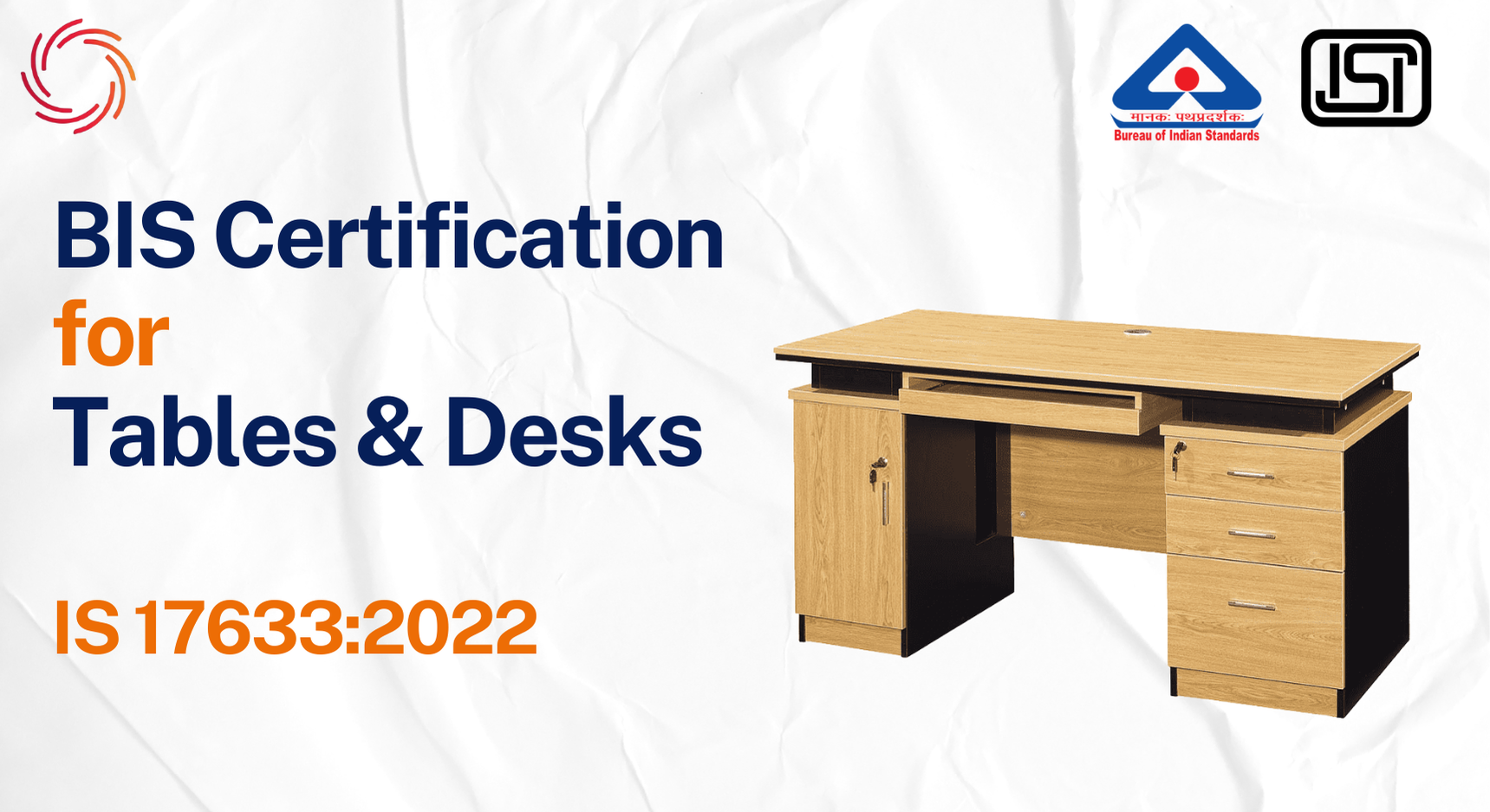
BIS Certification for Tables and Desks as per IS 17633:2022 is applicable for furniture goods covered under the Indian Standard and respective Furniture Quality Control Order (QCO). Manufacturers of covered tables and desks need to comply with the relevant BIS requirements before introducing such products into the Indian market.
Tables and Desks are extensively utilized in offices, educational institutions, commercial companies, government organizations and residential areas. Compliance to the relevant Indian Standard is a key requirement for makers of covered products as these products are required to be able to withstand normal usage and maintain acceptable strength, stability, durability and safety.
IS 17633:2022 defines the performance and safety criteria for tables and workstations for adult users in sitting and standing applications. Certification encompasses product examination, testing, manufacturing quality controls, documentation and factory assessment, depending on the standards applicable.
This article explains BIS Certification for Tables and Desks, BIS Licence and ISI Mark requirements as per IS 17633:2022. It covers product application, scope, technical criteria, testing, certification process, papers required and compliance requirements for Indian and foreign manufacturers.
Key Highlights of BIS Certification for Tables and Desks
What is BIS Certification for Tables and Desks?
BIS Certification for Tables and Desks is the applicable conformity assessment process for products covered under IS 17633:2022 and the relevant mandatory compliance requirements. The certification process is intended to establish that the tables or desks manufactured at the applicable manufacturing unit conform to the relevant requirements of the Indian Standard.
For covered products, BIS certification may involve product testing, assessment of the manufacturer's manufacturing and quality control arrangements, review of relevant documentation and factory inspection or assessment, as applicable under the certification process. After fulfilment of the applicable requirements, BIS may grant a licence to the manufacturer for the relevant manufacturing unit.
A valid BIS Licence for Tables and Desks permits the manufacturer to use the applicable BIS Standard Mark/ISI Mark in accordance with the terms and conditions of the licence. The manufacturer must also continue to maintain conformity with the applicable standard and fulfil relevant post-certification requirements.
What Does a BIS Licence for Tables and Desks Mean?
A BIS Licence for Tables and Desks refers to the licence granted by BIS to an eligible manufacturer after the applicable certification requirements have been successfully fulfilled for products covered under IS 17633:2022. The licence is associated with the relevant manufacturing unit and approved product scope.
The licence does not simply confirm that a single sample has been tested. The manufacturer is also required to maintain the applicable production and quality control arrangements so that the products manufactured under the licence continue to conform to the requirements of the Indian Standard.
What is IS 17633:2022 for Tables and Desks?
IS 17633 : 2022 Indian Standard Table and Desks. It specifies requirements for performance and safety of tables and desks intended to be used by adults in sitting and/or standing positions. The standard covers important aspects of product performance such as strength, stability and durability.
It applies to fully manufactured or fabricated tables and desks, as well as to ready-to-assemble units. The requirements are assessed on the assembled product. This makes IS 17633 : 2022 relevant for the manufacturers manufacturing tables and desks of different designs and configurations as per the scope defined in it.
As per IS 17633:2022, tables and desks are classified into appropriate performance categories for BIS certification like Office Tables and Domestic Tables. 7. While applying for BIS Licence for Tables and Desks, the manufacturer shall indicate the relevant product category and applicable scope therein.
Key Areas Covered Under IS 17633:2022
The standard focuses on several important performance characteristics, including:
- Strength Requirements — Tables and desks must withstand expected loads during normal use without failure or excessive deformation.
- Stability Requirements — Furniture must remain stable in use and resist tipping under foreseeable loading conditions.
- Durability Requirements — Products must retain performance and structural integrity after repeated use over an extended period.
- Safety Requirements — Design and construction must minimize risks from instability, sharp edges, unsafe build, or structural failure.
- Workmanship & Construction Quality — Workmanship, assembly, joints, fasteners, and overall build are assessed for reliable long-term performance.
Is BIS Certification for Tables and Desks Mandatory in India?
BIS certification is mandatory for Tables and Desks covered under IS 17633:2022 where the product falls within the scope of the applicable Furniture Quality Control Order and is subject to its implementation provisions. IS 17633:2022 is listed by the Bureau of Indian Standards under the compulsory certification framework for Furniture, together with subsequent amendments and transition-related regulatory provisions.
Therefore, manufacturers should not rely only on the product name “table” or “desk” when determining compliance requirements. They should verify whether their specific product falls within the scope of IS 17633:2022 and review the latest applicable QCO, amendments, exemptions, transition provisions and implementation requirements before manufacturing, importing or placing the covered product on the Indian market.
Where BIS certification is applicable, the manufacturer must obtain the required BIS licence for the relevant manufacturing unit and comply with the applicable requirements for product conformity, marking, quality control and continued compliance.
What Does Mandatory BIS Certification Mean for Manufacturers?
For manufacturers of covered Tables and Desks, mandatory BIS certification means that the product must conform to the applicable requirements of IS 17633:2022 and the relevant certification conditions before it is placed on the market where the QCO applies. The certification process is manufacturer-based and may involve application, product testing, assessment of manufacturing and quality control arrangements, factory inspection and grant of a BIS licence, as applicable.
The BIS licence is not merely a one-time product test certificate. Manufacturers are required to maintain the applicable conformity and quality control arrangements for products manufactured under the licence. BIS guidance for IS 17633:2022 specifically provides for a Quality Assurance Plan and ongoing controls for Tables and Desks bearing the Standard Mark.
In short: If your Table or Desk falls within the scope of IS 17633:2022 and is covered by the applicable mandatory provisions, BIS certification and compliance with the relevant BIS requirements are necessary before placing the product on the Indian market.
Also check Furniture Products Covered Under Mandatory BIS Certification — BIS Certification for furniture
Product Scope Covered Under IS 17633:2022
IS 17633:2022 applies to tables and desks for use by adults in seated and/or standing positions. The standard sets out relevant requirements on performance and safety concerning strength, stability and durability etc. for the products covered by the scope.
The scope includes full tables and desks, fully fabricated or manufactured, and assembled units. For ready-to-assemble products the requirements applicable are assessed on the assembled unit.
Performance Categories of Tables and Desks
For BIS certification and product grouping purposes, tables and desks covered under IS 17633:2022 are classified into applicable performance categories. These include:
Office Tables
Office Tables may include products intended for office work areas, meeting or conference use, pantry areas and similar professional or commercial applications, depending on the product design and declared use.
Domestic Tables
Domestic Tables may include tables and desks intended for bedroom, living room, study and other domestic uses, depending on the product design and declared use.
Examples of products commonly covered include:
- Office, study, and computer desks
- Workstations and multi-purpose desks
- Conference and meeting tables
- Institutional and laboratory tables
- Co-working and commercial-use furniture
Manufacturers should carefully review the product specifications and intended use to determine whether their products fall within the scope of IS 17633:2022.
How Is the Product Scope Determined for BIS Certification?
The manufacturer shall declare the concerned model or models of Tables and Desks and specify the performance category applicable for BIS certification. Grouping of products may be on the basis of material, construction and other essential product characteristics as identified under the applicable BIS certification requirements.
Key Technical Requirements Under IS 17633:2022
To obtain BIS certification, tables and desks must satisfy various performance and safety requirements specified by the standard.
- Structural Integrity — Products must perform under prescribed loads; joints and supporting structures stay secure during testing.
- Load-Bearing Performance — Tables and desks must support specified loads without unacceptable deformation, damage, or failure.
- Stability Performance — Furniture must remain stable in use and reduce tipping risks that could cause injury or property damage.
- Durability Performance — Products must withstand repeated usage cycles while maintaining acceptable performance.
- Material & Workmanship — Materials, finishing, and assembly methods must meet quality controls for consistent production.
- Safety Considerations — Design must minimize hazards from furniture use for consumers and institutional buyers.
Why Does BIS Certification Matter for Table and Desk Manufacturers?
Manufacturers of tables and desks covered under IS 17633:2022 need BIS certification to ensure regulatory compliance and market access. Where the applicable Furniture Quality Control Order applies, manufacturers must ensure that covered products are compliant with relevant Indian Standard and meet applicable BIS certification requirements.
The importance of BIS certification isn’t just about obtaining a license. Manufacturers shall have the necessary arrangements for production and quality control to ensure that the tables and desks manufactured under the BIS licence continue to conform to the relevant requirements of IS 17633:2022.
For furniture manufacturers, early compliance planning may also help to reduce delays associated with product testing, documentation, factory readiness and the BIS certification process. This is especially true for a number of manufacturers that produce a variety of models or types of tables and desks.
Obtaining BIS certification helps manufacturers:
- Prove compliance with applicable Indian standards
- Boost product credibility and brand reputation
- Win customer and institutional buyer confidence
- Improve acceptance in government and corporate procurement
- Strengthen in-house quality management practices
- Stay ahead of evolving regulatory requirements
For manufacturers seeking long-term growth, BIS certification is often viewed as both a compliance requirement and a strategic business advantage.
Testing Requirements for Tables and Desks Under IS 17633:2022
Before a manufacturer can obtain BIS certification, product samples must be evaluated against the applicable requirements of IS 17633:2022 through testing at a BIS-recognized laboratory.
The objective of testing is to verify that the furniture meets the prescribed standards for safety, stability, strength, durability, and overall performance.
While the exact test parameters may vary depending on product design and certification requirements, manufacturers are generally assessed for the following characteristics:
- Design & Workmanship — Construction quality, assembly, finishing, and overall product integrity are examined for safe long-term use.
- Dimensional Verification — Critical measurements are checked against the standard and approved product specifications.
- Stability Testing — Confirms the product stays stable in normal use and flags tipping or structural weaknesses.
- Static Load Testing — Verifies load-bearing capacity without failure, excessive deformation, or damage.
- Strength Testing — Assesses frames, joints, and supports under operational stresses during regular use.
- Durability Assessment — Checks performance retention after repeated usage cycles.
- Safety Assessment — Rules out avoidable risks from instability, defects, or unsafe design features.
BIS Certification Process for Tables and Desks
Manufacturers seeking BIS certification under IS 17633:2022 must follow a structured certification process established by the Bureau of Indian Standards.
Although specific requirements may vary based on the applicant type and manufacturing location, the general process remains similar.
Step 1: Product Scope Assessment
The first step involves determining whether the product falls within the scope of IS 17633:2022 and the applicable Quality Control Order. A technical review of the product specifications, intended use, materials, and construction is usually carried out before initiating the certification process.
Step 2: Documentation Preparation
The manufacturer prepares the required documentation, including company information, manufacturing details, product specifications, quality control procedures, and supporting technical records. Proper documentation is critical because deficiencies at this stage can delay certification.
Step 3: Product Testing
Product samples are tested at a BIS-recognized laboratory to verify compliance with the requirements of IS 17633:2022. The test report serves as one of the primary technical documents supporting the certification application.
Step 4: Application Submission
The BIS application is submitted along with supporting documents, test reports, manufacturing information, and quality management records. The application is reviewed by BIS for completeness and technical compliance.
Step 5: Factory Assessment
BIS may conduct a factory inspection to evaluate:
- Manufacturing infrastructure and production capabilities
- Quality control systems and in-house testing facilities
- Raw material controls and product traceability mechanisms
The objective is to verify the manufacturer's ability to consistently produce compliant products.
Step 6: Evaluation and Review
BIS reviews the application, inspection findings, and laboratory test reports before making a certification decision. Any observations raised during the review process must be addressed by the applicant.
Step 7: Grant of BIS Licence
Upon successful completion of all requirements, BIS grants the licence and authorizes the manufacturer to use the ISI Mark on certified tables and desks.
BIS Certification for Indian Manufacturers
Indian manufacturers generally apply under the domestic certification procedure prescribed by BIS. The process typically includes:
- Product testing at a BIS-recognized laboratory
- Application submission with supporting documents
- Factory inspection and technical review by BIS
- Grant of BIS licence and ISI Mark authorization
Once certified, manufacturers must continue complying with BIS requirements and maintain consistent product quality throughout the licence period.
BIS Certification for Foreign Manufacturers
Foreign manufacturers intending to export tables and desks to India must also obtain BIS certification before supplying products covered under the applicable Quality Control Order.
The certification process generally involves:
- Appointment of an Authorized Indian Representative (AIR)
- Product testing and factory assessment overseas
- Documentation review and BIS certification approval
Foreign manufacturers must ensure ongoing compliance with BIS requirements to maintain certification validity.
Documents Required for BIS Certification of Tables and Desks
Documentation requirements may vary depending on the manufacturer and certification route. However, the following documents are commonly required during the certification process.
Business and Legal Documents
- Company registration, manufacturing licence, and GST (if applicable)
- Authorized signatory details and identity proof
Manufacturing Information
- Process flow chart, factory layout, and machinery details
- Production infrastructure and capacity records
Product Information
- Product specifications, technical drawings, and catalogue
- Bill of materials and material/component details
Quality Control Documents
- Internal testing, inspection, and QC procedures
- Quality control records and equipment calibration reports
Certification Documents
- Laboratory test reports and completed BIS application forms
- Declarations, undertakings, and other BIS-prescribed documents
Manufacturers should ensure that all documentation is accurate, complete, and consistent before submission.
Common Challenges During BIS Certification
Although the certification process is straightforward when properly managed, manufacturers often encounter several challenges.
- Technical interpretation — Mapping IS 17633:2022 requirements to specific product designs can be difficult without expert guidance.
- Testing failures — Weak joints, poor stability, or material issues often lead to lab test rejection.
- Documentation gaps — Incomplete or mismatched records are a frequent cause of application delays.
- Factory compliance — QC systems, traceability, or production controls may need upgrading before licence grant.
- Regulatory coordination — Aligning lab testing, inspections, and BIS follow-ups takes time without structured support.
Benefits of Professional BIS Certification Assistance
Working with an experienced BIS consultant can help manufacturers avoid costly delays and streamline the certification journey.
Professional support typically includes:
- Product scope review and standard interpretation
- Documentation preparation and application filing
- Lab testing and factory inspection coordination
- Ongoing compliance and post-certification support
This allows manufacturers to focus on production while ensuring regulatory requirements are addressed efficiently.
Why Choose Sun Certifications India?
Sun Certifications India is a regulatory compliance consultancy assisting manufacturers, importers, exporters, and businesses with certification and approval requirements across India.
Our experts provide end-to-end support for BIS Certification for Tables and Desks under IS 17633:2022.
Our Services Include
- Product applicability assessment and BIS compliance consulting
- Documentation support and application management
- Testing coordination and factory inspection assistance
- Regulatory communication and post-certification compliance support
Our goal is to help businesses navigate the certification process efficiently while minimizing delays and compliance challenges.
Conclusion
BIS Certification for Tables and Desks under IS 17633:2022 is an important requirement for manufacturers seeking to supply compliant furniture products in the Indian market. The certification helps ensure that tables and desks meet established standards relating to safety, stability, durability, strength, and quality.
By obtaining BIS Certification and using the ISI Mark, manufacturers can demonstrate compliance with Indian standards, improve customer confidence, strengthen their market position, and support long-term business growth.
If you are planning to obtain BIS Certification for Tables and Desks under IS 17633:2022, Sun Certifications India can assist you with end-to-end compliance support, helping you navigate the certification process efficiently and confidently.
FAQs – BIS Certification for Tables and Desks (IS 17633:2022)
1. What is IS 17633:2022?
IS 17633:2022 is the Indian Standard published by the Bureau of Indian Standards (BIS) that sets minimum performance, stability, durability, and safety requirements for tables and desks intended for adult users in sitting and standing applications.
2. Is BIS certification mandatory for tables and desks?
Yes — for products covered under the applicable Furniture Quality Control Order (QCO). Manufacturers and importers must hold a valid BIS licence and comply with IS 17633:2022 before manufacturing, importing, selling, or distributing such furniture in India.
3. Which certification mark is applicable to tables and desks?
Certified tables and desks are authorized to bear the ISI Mark under the BIS Product Certification Scheme, indicating that the product conforms to the applicable Indian Standard.
4. Who can apply for BIS certification?
Both Indian manufacturers and foreign manufacturers may apply, provided their tables and desks fall within the scope of the applicable QCO and meet the requirements of IS 17633:2022.
5. What is the purpose of BIS certification?
BIS certification confirms that furniture meets nationally recognized benchmarks for safety, structural performance, durability, and workmanship — helping protect end users and maintain quality standards across the market.
6. What products are covered under IS 17633:2022?
The standard covers adult-use tables and desks used in offices, educational institutions, commercial establishments, and workplace environments — including office desks, workstations, study tables, conference tables, and similar furniture categories.
7. Is laboratory testing mandatory?
Yes. Product samples must be tested at a BIS-recognized laboratory, and the resulting test report is a key document in the certification application to demonstrate compliance with IS 17633:2022.
8. Can imported tables and desks be sold without BIS certification?
No. Imported products that fall under mandatory certification cannot be legally supplied in India without valid BIS approval. Importers must ensure compliance with the applicable standard before placing products on the market.
9. What is the role of a factory inspection?
BIS conducts factory assessment to verify that the manufacturer maintains adequate production infrastructure, quality control systems, and product traceability to consistently manufacture compliant tables and desks.
10. How can Sun Certifications India help?
Sun Certifications India offers end-to-end assistance — including product scope assessment, documentation preparation, laboratory testing coordination, BIS application management, factory inspection readiness, and post-certification compliance support for tables and desks under IS 17633:2022.
Related Resources
Many of our users also read
Our Senior Lead Auditor (Certification), a former BIS Scientist 'E' who served as the Head of Certification for the Northern Region. He has overseen 1,500+ factory inspections and advises on preventing common non-conformities during the application stage.
Dhruv Aggarwal
Head of Operations at Sun Certifications India
Experience: 10+ years & Handled 1000+ projects
Awarded by many Indian and International organisations








PT Quty Karunia, BIS Licensee in Vietnam
“Sun Certifications India provided excellent BIS Certification services. Their unparalleled service and sincerity gained our trust. One of the best BIS consultants in India!”

Thantawan Industries Ltd, BIS Licensee in Thailand
“Sun Certifications India supported us throughout the BIS certification process. Their responsive customer service and punctuality are exceptional. Highly recommend for hassle-free BIS certification.”

Leaderart Industries, BIS Licensee in Malaysia
“Sun Certifications India helped us acquire BIS Certification, doubling our engagement in India. Their services are fast, genuine, and up-to-date with latest BIS norms.”

Aluminium Bahrain (ALBA), BIS Licensee in Bahrain
“Excellent BIS certification support, highly reliable consultants.”

Bahrain Aluminium Manufacturing Company, BIS Licensee in Bahrain
“Smooth BIS registration process with expert consultants.”

Daiki Aluminium Japan, BIS Licensee in Japan
“Efficient BIS license assistance, great consultants.”

Trimble Navigation, BIS Licensee in USA
“Seamless BIS certification and registration support.”

Remsa Italia, BIS Licensee in Italy
“Helpful BIS consultants, simplified license process.”

Aquazzura, BIS Licensee in Italy
“We got our BIS certificate well within the timelines and at affordable prices, great work team Sun!”

PT Quty, BIS Licensee in Indonesia
“Excellent BIS registration service, highly recommended.”

Danu Vina, BIS Licensee in Vietnam
“Reliable BIS license consultants, fast process.”

Hanh My Production Company, BIS Licensee in Vietnam
“Expert BIS consultants, certification made easy.”

Sedo Vina, BIS Licensee in Vietnam
“Smooth BIS certificate registration, great support.”

Misumi Japan, BIS Licensee in Japan
“Trusted BIS consultants, quick certification process.”

Thantawan Public Industry Company, BIS Licensee in Thailand
“Professional BIS certification service, very efficient.”

Cortizo Aluminios, BIS Licensee in Spain
“Excellent BIS registration and license guidance.”

Midal Cables, BIS Licensee in Bahrain
“Expert BIS consultants, smooth certification process.”
Years Exp.
Our Clients
Success Rate
Countries Served
Our team brings 10e4+ years of experience in CDSCO and BIS compliance.
We reduce approval time by up to 40% with streamlined processes.
100% success rate with 1500+ successful registrations.
Dedicated account manager ensuring personalized service.
Leave your details below and our experts will call you back within 24 hours to discuss your regulatory compliance needs.
By submitting this form, you agree to our Privacy Policy and consent to being contacted.