BIS Certification for Tee and Strap Hinges – IS 206:2010
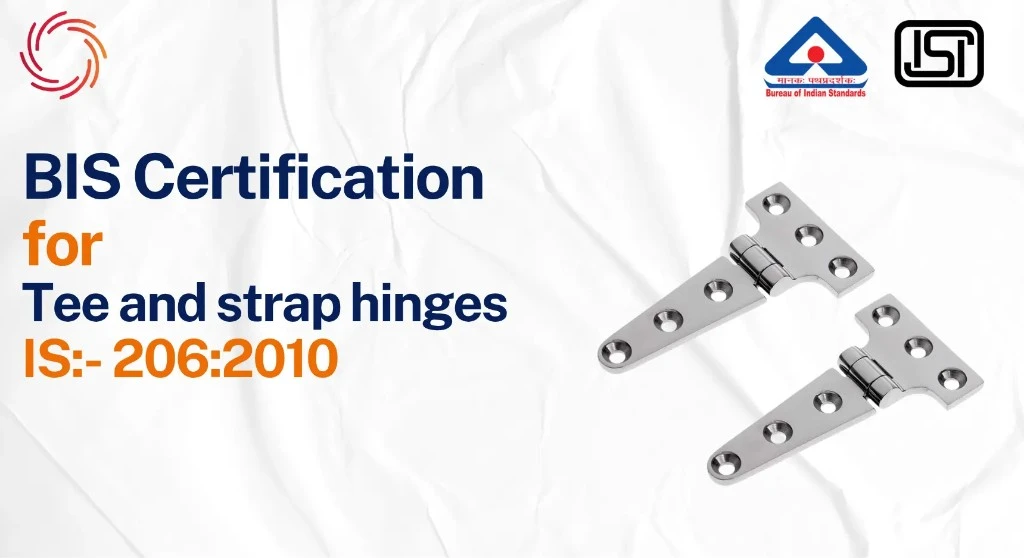
BIS Certification for Tee and strap hinges ensures that these structural hardware components meet durability, load-bearing, and corrosion resistance requirements defined under IS 206: 2010. In India, certification is required to ensure safe operation of doors, gates, and shutters, preventing mechanical failure and ensuring long-term performance in residential, industrial, and commercial applications.
Tee and strap hinges are widely used in applications where strength, stability, and extended load distribution are critical. Unlike standard butt hinges, these hinges feature elongated arms that distribute weight across a larger surface, making them ideal for wooden gates, barn doors, storage units, and industrial shutters. In rural as well as urban infrastructure across India, they are frequently used in agricultural buildings, warehouses, and residential properties.
Because these hinges often support heavy doors or structures exposed to environmental stress, even minor defects can lead to operational failure. A poorly manufactured hinge may bend under load, corrode quickly in outdoor conditions, or fail at the pivot joint, resulting in safety hazards such as falling doors or structural damage.
To prevent such issues, regulatory frameworks in India require that these hinges conform to defined specifications under IS 206: 2010. The BIS Certification for Tee and strap hinges ensures that manufacturers follow precise material selection, dimensional accuracy, and mechanical performance standards.
For manufacturers and importers, obtaining a BIS License for Tee and strap hinges is not just about regulatory compliance. It signals reliability to distributors, builders, and end-users who depend on consistent hinge performance in demanding environments.
Understanding BIS Certificate for Tee and Strap Hinges - IS 206: 2010
When dealing with structural hardware like tee and strap hinges, certification is not merely a label—it is a validation of engineering integrity. These hinges are subjected to repeated stress cycles, varying loads, and environmental exposure such as moisture, dust, and temperature changes.
The BIS Certification for Tee and strap hinges evaluates whether a product can withstand these real-world conditions without deformation, loosening, or failure. For example, a farm gate hinge must endure continuous opening and closing while carrying significant weight. If the hinge pin wears out or the strap bends, the entire gate system becomes unstable.
The certification process ensures that:
- The hinge material has adequate tensile strength and hardness
- The pivot mechanism operates smoothly without excessive friction
- Surface treatments prevent premature rusting or corrosion
- Dimensions are consistent to allow proper alignment during installation
In practical terms, certification acts as a quality checkpoint between manufacturing and end use. It ensures that the hinge performs as expected when installed in doors, gates, or panels that are frequently used and exposed to stress.
Applicable BIS Standard for Tee and Strap Hinges - IS 206: 2010
The applicable standard for this category is IS 206: 2010, which outlines detailed specifications for tee and strap hinges used in various structural and domestic applications.
Scope of the Standard
IS 206: 2010 covers hinges designed for supporting doors, shutters, and gates where extended arms are required for load distribution. The standard applies to both light-duty and heavy-duty hinges depending on their dimensions and intended use.
Product Categories Covered
The standard includes:
- Tee hinges with equal or unequal arms
- Strap hinges designed for wide doors or gates
- Hinges used in wooden, metal, or composite door systems
Safety and Performance Objectives
The main objective of IS 206: 2010 is to ensure that hinges maintain structural integrity under load. This includes:
- Preventing bending or distortion during use
- Ensuring consistent rotation without jamming
- Maintaining alignment even after repeated cycles
Design and Testing Principles
The standard emphasizes:
- Accurate thickness and width of hinge arms
- Proper pin alignment and secure fastening
- Uniform coating for corrosion resistance
- Load-bearing capability suitable for intended application
For instance, a hinge used in a warehouse door must be able to handle higher loads compared to one used in a small cabinet door. The standard ensures such distinctions are maintained.
Testing Requirements as per IS 206: 2010
To obtain the BIS Certificate for Tee and strap hinges, products must undergo rigorous testing in Bureau of Indian Standards recognized laboratories. These tests simulate real-world usage conditions to verify performance and durability.
1. Safety Tests
Safety testing focuses on structural strength and stability. Hinges are subjected to load tests to determine whether they can support specified weights without bending or breaking.
For example, a heavy-duty strap hinge used in a large gate must demonstrate its ability to hold the gate's weight without permanent deformation.
2. Performance Tests
Performance testing evaluates the hinge's operational efficiency, including smoothness of opening and closing, resistance to friction or jamming, and stability of the pivot mechanism. Repeated cycle testing is often conducted to simulate long-term use. Hinges must maintain functionality even after thousands of cycles.
3. Durability Tests
Durability tests assess how the hinge performs over time under environmental exposure. These include corrosion resistance tests, wear resistance of hinge pins and joints, and coating adhesion tests. For outdoor applications, hinges must resist rust caused by rain and humidity.
4. Quality Verification Tests
Quality checks ensure consistency in manufacturing. These include dimensional accuracy verification, material composition analysis, and surface finish inspection. Even small variations in thickness or alignment can affect installation and performance, so strict tolerance limits are enforced.
Conclusion
Tee and strap hinges play a critical role in supporting heavy doors, gates, and structural panels across residential, agricultural, and industrial applications. Their performance directly affects safety, usability, and durability. This makes adherence to IS 206: 2010 essential for ensuring reliable product behavior under real-world conditions.
Obtaining a BIS Certificate for Tee and strap hinges is not just a regulatory requirement—it is a commitment to manufacturing precision and long-term product reliability. From material selection to performance testing, every stage of certification ensures that the hinge can withstand load, resist environmental damage, and operate smoothly over time.
For manufacturers and importers, securing a BIS Certification for Tee and strap hinges or a BIS License for Tee and strap hinges strengthens market credibility, facilitates compliance with Indian regulations, and builds trust among buyers. In a competitive hardware market, certified products stand out as dependable choices, ensuring both safety and performance for end users.
FAQs – BIS Certification for Tee and Strap Hinges - IS 206: 2010
1. How does hinge size and load capacity impact BIS Certification for Tee and strap hinges?
The size and load capacity of tee and strap hinges play a crucial role in certification because different applications require different strength levels. Larger hinges used in gates or industrial doors must withstand higher loads compared to smaller hinges used in lightweight doors. During BIS Certification for Tee and strap hinges, each size category is tested separately to ensure it meets the required performance standards. If a manufacturer produces multiple sizes, each variation may need validation to confirm it performs reliably under its intended load conditions.
2. Is BIS Certification required for custom-designed Tee and strap hinges?
Yes, even custom-designed hinges must comply with IS 206: 2010 if they are intended for sale in the regulated market. Custom designs often introduce variations in dimensions, materials, or finishes, which can affect performance. BIS Certification for Tee and strap hinges ensures that these customized products still meet minimum safety and durability benchmarks. Manufacturers must provide technical drawings and testing samples to verify that the custom design performs effectively under expected usage conditions.
3. How does surface coating affect BIS approval for Tee and strap hinges?
Surface coating is critical for preventing corrosion, especially in outdoor applications. During testing, hinges are evaluated for coating thickness, adhesion, and resistance to environmental factors like humidity and rain. If the coating fails, the hinge may rust prematurely, reducing its lifespan. BIS Certification for Tee and strap hinges ensures that coatings such as galvanization or powder coating meet durability requirements, providing long-term protection and maintaining structural integrity over time.
4. Can a manufacturer use a single BIS License for multiple factories producing Tee and strap hinges?
No, BIS licensing is generally issued per manufacturing unit. Each factory must demonstrate its ability to produce hinges that meet IS 206: 2010 requirements. This includes independent inspections, testing, and quality control verification. Even if multiple factories produce identical designs, each location must obtain its own BIS License for Tee and strap hinges to ensure consistent manufacturing practices and product quality across all production units.
5. What role does raw material quality play in BIS Certification for Tee and strap hinges?
Raw material quality directly influences the hinge's strength, durability, and resistance to wear. Poor-quality steel or improper alloy composition can lead to bending, cracking, or premature failure. During the BIS certification process for Tee and strap hinges, material composition is analyzed to ensure it meets specified standards. Using high-quality raw materials helps manufacturers pass testing more easily and ensures that the final product performs reliably in demanding conditions.
6. How often is factory inspection conducted after obtaining BIS Certification?
After the initial certification, periodic surveillance audits are conducted to ensure ongoing compliance. These inspections verify that the manufacturing process, quality control systems, and product consistency remain aligned with IS 206: 2010. For BIS Certification for Tee and strap hinges, this means checking production batches, reviewing testing records, and ensuring that no deviations occur over time. Regular inspections help maintain product quality and prevent non-compliance issues.
7. What is the importance of dimensional accuracy in BIS Certification for Tee and strap hinges?
Dimensional accuracy ensures that hinges fit correctly during installation and function smoothly. Even slight variations in length, thickness, or hole placement can cause misalignment, leading to operational issues or structural stress. During BIS Certification for Tee and strap hinges, strict tolerance limits are enforced to ensure uniformity. Accurate dimensions also help installers achieve proper alignment, reducing wear and improving the overall lifespan of the hinge.
8. Are there specific packaging requirements for certified Tee and strap hinges?
Yes, packaging plays a role in maintaining product quality during transportation and storage. Hinges must be protected from moisture, scratches, and deformation. For BIS Certification for Tee and strap hinges, packaging should also include proper labelling with certification details. Good packaging ensures that the product reaches the end user in the same condition as it left the factory, preserving its performance characteristics and compliance status.
9. How does BIS Certification support bulk procurement and government tenders?
In many procurement processes, especially government or institutional tenders, certified products are often preferred or required. BIS Certification for Tee and strap hinges provides assurance that the product meets standardized performance criteria, making it easier for procurement agencies to evaluate quality. Manufacturers with certification are more likely to qualify for large-scale projects, as their products are seen as reliable and compliant with regulatory expectations.
10. Can BIS Certification be suspended or cancelled for Tee and strap hinges?
Yes, certification can be suspended or cancelled if a manufacturer fails to maintain compliance. This may happen due to consistent product failures, deviation from approved manufacturing processes, or misuse of the ISI mark. For BIS Certification for Tee and strap hinges, maintaining quality consistency and adhering to standard requirements is essential. Manufacturers must regularly monitor their processes and ensure that all products continue to meet IS 206: 2010 specifications to avoid such actions.
Quality Control Order (QCO) for Tee and Strap Hinges
Related Resources
Many of our users also read
This compliance advisory was vetted by our Senior Consultant (Enforcement & Vigilance), a former BIS Director (Enforcement). He specializes in post-certification compliance, helping companies navigate surveillance audits and legal adherence to BIS mandates.
Dhruv Aggarwal
Head of Operations at Sun Certifications India
Experience: 10+ years & Handled 1000+ projects
Awarded by many Indian and International organisations








PT Quty Karunia, BIS Licensee in Vietnam
“Sun Certifications India provided excellent BIS Certification services. Their unparalleled service and sincerity gained our trust. One of the best BIS consultants in India!”

Thantawan Industries Ltd, BIS Licensee in Thailand
“Sun Certifications India supported us throughout the BIS certification process. Their responsive customer service and punctuality are exceptional. Highly recommend for hassle-free BIS certification.”

Leaderart Industries, BIS Licensee in Malaysia
“Sun Certifications India helped us acquire BIS Certification, doubling our engagement in India. Their services are fast, genuine, and up-to-date with latest BIS norms.”

Aluminium Bahrain (ALBA), BIS Licensee in Bahrain
“Excellent BIS certification support, highly reliable consultants.”

Bahrain Aluminium Manufacturing Company, BIS Licensee in Bahrain
“Smooth BIS registration process with expert consultants.”

Daiki Aluminium Japan, BIS Licensee in Japan
“Efficient BIS license assistance, great consultants.”

Trimble Navigation, BIS Licensee in USA
“Seamless BIS certification and registration support.”

Remsa Italia, BIS Licensee in Italy
“Helpful BIS consultants, simplified license process.”

Aquazzura, BIS Licensee in Italy
“We got our BIS certificate well within the timelines and at affordable prices, great work team Sun!”

PT Quty, BIS Licensee in Indonesia
“Excellent BIS registration service, highly recommended.”

Danu Vina, BIS Licensee in Vietnam
“Reliable BIS license consultants, fast process.”

Hanh My Production Company, BIS Licensee in Vietnam
“Expert BIS consultants, certification made easy.”

Sedo Vina, BIS Licensee in Vietnam
“Smooth BIS certificate registration, great support.”

Misumi Japan, BIS Licensee in Japan
“Trusted BIS consultants, quick certification process.”

Thantawan Public Industry Company, BIS Licensee in Thailand
“Professional BIS certification service, very efficient.”

Cortizo Aluminios, BIS Licensee in Spain
“Excellent BIS registration and license guidance.”

Midal Cables, BIS Licensee in Bahrain
“Expert BIS consultants, smooth certification process.”
Years Exp.
Our Clients
Success Rate
Countries Served
Our team brings 10e4+ years of experience in CDSCO and BIS compliance.
We reduce approval time by up to 40% with streamlined processes.
100% success rate with 1500+ successful registrations.
Dedicated account manager ensuring personalized service.
Leave your details below and our experts will call you back within 24 hours to discuss your regulatory compliance needs.
By submitting this form, you agree to our Privacy Policy and consent to being contacted.