BIS Certification for Asbestos Cement Cable Conduits and Troughs - IS 8870:1978
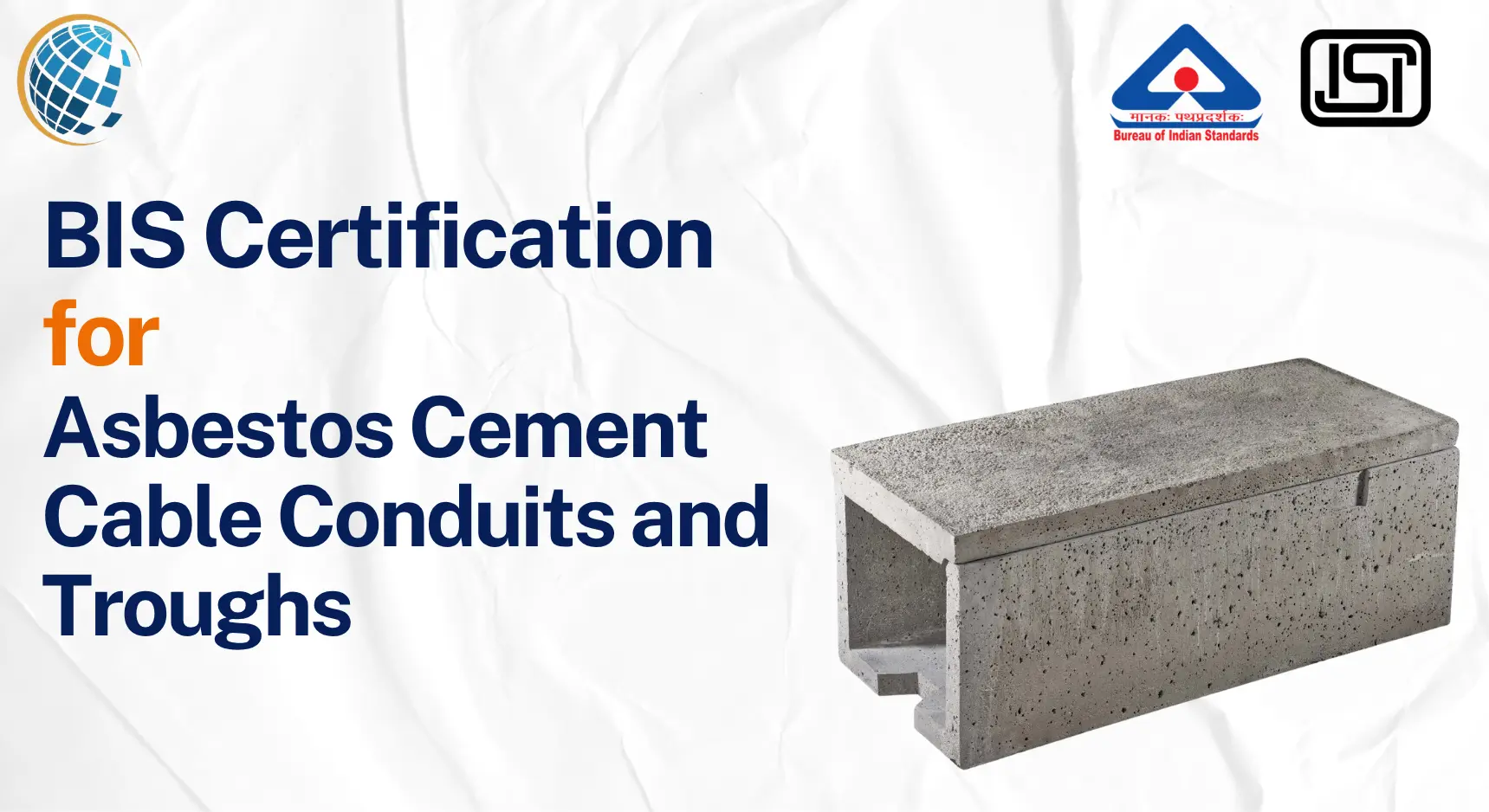
BIS Certification for Asbestos Cement Cable Conduits and Troughs under IS 8870: 1978 confirms that these products meet defined standards for structural strength, insulation support, and durability. Certification is required in India to ensure safe cable protection, minimize infrastructure risks, and maintain consistent performance in electrical and utility installations.
Also Read the QCO Notification for Asbestos or Fibre Cement based Products.
Asbestos Cement Cable Conduits and Troughs are widely used in infrastructure projects to protect and route electrical cables safely. These products are commonly installed in underground cable networks, industrial facilities, power distribution systems, and telecom infrastructure. Their primary function is to shield cables from mechanical damage, moisture, and environmental exposure while ensuring organized cable management.
Unlike metallic conduits, asbestos cement conduits offer corrosion resistance and thermal stability. They are especially useful in outdoor and underground environments where exposure to soil moisture, chemicals, or varying temperatures can degrade conventional materials. However, the inclusion of asbestos fibres introduces both technical and safety considerations. If manufacturing processes are not properly controlled, the structural integrity of conduits may be compromised, and improper handling can create health hazards.
In large-scale infrastructure projects, even minor defects in cable conduits can lead to serious issues. Cracks, breakage, or dimensional inconsistencies may expose cables to damage, causing electrical faults or service interruptions. This makes standardization and quality verification essential before these products are deployed in real-world applications.
This is where the BIS Certification for Asbestos Cement Cable Conduits and Troughs becomes critical. It ensures that each product batch meets predefined technical requirements and performs reliably in demanding environments. For manufacturers, importers, and suppliers, obtaining a BIS License for Asbestos Cement Cable Conduits and Troughs is not just a compliance step - it is a validation of product quality, safety, and performance. When you plan the licence route itself, it helps to align product-specific work with how Indian BIS operates overall — Check complete details about documentation, cost, and process etc.
Understanding BIS Certification for Asbestos Cement Cable Conduits and Troughs - IS 8870: 1978
When discussing certification for this product category, it is important to focus on how it directly impacts functionality and safety. Cable conduits are not passive components - they actively protect electrical systems from physical damage and environmental stress.
One of the primary concerns is mechanical strength. Conduits must withstand external loads such as soil pressure, traffic loads (in underground installations), and handling stress during installation. A weak or poorly manufactured conduit can crack under pressure, exposing cables to damage.
Another critical factor is dimensional consistency. Cable conduits must align properly during installation. Variations in diameter or wall thickness can lead to improper jointing, gaps, or misalignment, which can compromise cable protection.
Certification also evaluates material composition. The balance between cement and reinforcing fibres must be maintained to achieve optimal strength and durability. Inconsistent composition can lead to brittle conduits or premature degradation.
From a regulatory standpoint, the BIS Certification for Asbestos Cement Cable Conduits and Troughs ensures that manufacturers follow controlled processes and produce consistent output. Instead of relying on site-level inspection, the system verifies product quality before it reaches the market.
For contractors and engineers, this certification provides assurance that the conduits will perform as expected, reducing the risk of cable failures, maintenance issues, and costly repairs.
Applicable BIS Standard for Asbestos Cement Cable Conduits and Troughs - IS 8870: 1978
The governing standard for this product is IS 8870: 1978, which outlines the technical specifications for asbestos cement cable conduits and troughs.
This standard defines the scope of products covered, including conduits used for housing electrical and communication cables in both above-ground and underground installations. It establishes requirements for dimensions, mechanical strength, and construction quality.
The scope includes conduits and troughs designed for cable protection in infrastructure projects such as power distribution networks, industrial plants, and urban utility systems. The standard ensures that these products can withstand environmental stress while maintaining structural stability.
Performance objectives under IS 8870:1978 focus on durability and load-bearing capacity. Conduits must resist cracking, deformation, and environmental degradation over time. Since they are often buried underground, they must also withstand soil pressure and moisture exposure.
Design principles addressed in the standard include uniform wall thickness, smooth internal surfaces, and proper jointing compatibility. These features ensure that cables can be installed without damage and that conduits can be connected securely.
By adhering to IS 8870:1978, manufacturers ensure that their products meet established benchmarks, making it possible to obtain a BIS Certificate for Asbestos Cement Cable Conduits and Troughs.
Testing Requirements as per IS 8870: 1978
Testing includes mechanical strength tests to ensure conduits can withstand external loads. Dimensional checks verify uniformity and compatibility during installation.
Durability tests assess resistance to environmental factors such as moisture and temperature variations. Quality verification tests ensure consistency across production batches.
All testing must be conducted in BIS-recognized laboratories.
Conclusion
The BIS Certification for Asbestos Cement Cable Conduits and Troughs under IS 8870:1978 plays a crucial role in ensuring that these products meet defined technical and safety requirements. From manufacturing control to performance testing, certification validates that conduits can protect cables effectively in real-world conditions.
For businesses, obtaining a BIS Certificate for Asbestos Cement Cable Conduits and Troughs is a strategic step toward regulatory compliance, improved market access, and long-term credibility.
FAQs - BIS Certificate for Asbestos Cement Cable Conduits and Troughs - IS 8870: 1978
1. What factors affect the BIS certification cost for Asbestos Cement Cable Conduits and Troughs?
The cost of BIS certification for Asbestos Cement Cable Conduits and Troughs depends on testing requirements, factory size, and documentation complexity. Since conduits must undergo strength and durability testing, laboratory fees can vary. Additional costs include inspection charges and application fees. Proper preparation and internal quality checks can help control overall certification expenses.
2. How does BIS certification impact the durability of asbestos cement cable conduits used in underground installations?
BIS Certification for Asbestos Cement Cable Conduits and Troughs ensures that the product is tested for long-term durability under real installation conditions such as soil pressure, moisture exposure, and temperature variation. The standard IS 8870: 1978 includes checks for structural integrity and resistance to cracking. This ensures that conduits used underground do not collapse or degrade prematurely, reducing maintenance costs and ensuring uninterrupted cable protection over years.
3. Is BIS certification required for customized or project-specific asbestos cement cable conduits?
Yes, even customized or project-specific designs must comply with BIS Certification for Asbestos Cement Cable Conduits and Troughs if they fall within the defined scope of IS 8870: 1978. Variations in size or shape do not exempt products from compliance. Manufacturers must ensure that all customized variants are tested and documented properly, as deviations without approval can lead to rejection during certification or regulatory scrutiny.
4. What role does BIS certification play in ensuring fire resistance of cable conduits and troughs?
Cable conduits often house electrical wiring, making fire resistance a critical factor. BIS Certification for Asbestos Cement Cable Conduits and Troughs ensures that materials used can withstand heat exposure without structural failure. IS 8870: 1978 indirectly addresses fire performance through material composition and structural stability tests, ensuring that conduits do not contribute to fire spread or release hazardous substances during high temperatures.
5. Can a manufacturer use one BIS license for multiple manufacturing units producing the same conduits?
No, BIS Certification for Asbestos Cement Cable Conduits and Troughs is granted per manufacturing location. Each unit must undergo separate evaluation, including factory inspection and testing. This is because production conditions, machinery, and quality control systems may differ between facilities. A separate BIS License for Asbestos Cement Cable Conduits and Troughs ensures consistent quality regardless of where the product is manufactured.
6. What are the risks of using non-certified asbestos cement conduits in infrastructure projects?
Using products without BIS Certification for Asbestos Cement Cable Conduits and Troughs can lead to serious risks such as structural failure, poor cable protection, and reduced lifespan. Non-certified conduits may crack under pressure or degrade quickly in harsh environments. Additionally, infrastructure projects using non-compliant materials may face legal penalties, project delays, and rejection by regulatory authorities.
7. How often does BIS conduct surveillance after granting the license?
After issuing the BIS License for Asbestos Cement Cable Conduits and Troughs, periodic surveillance inspections are conducted to ensure continued compliance. These may include random sampling, factory audits, and testing. The purpose is to verify that manufacturers maintain consistent production quality over time and do not deviate from approved specifications outlined in IS 8870: 1978.
8. How does BIS certification support large-scale infrastructure and smart city projects in India?
BIS Certification for Asbestos Cement Cable Conduits and Troughs plays a significant role in infrastructure development by ensuring uniform quality across projects. In large-scale developments like smart cities, reliable cable management systems are essential. Certified conduits ensure durability, safety, and performance consistency, which is critical for long-term urban infrastructure planning and minimizing maintenance disruptions.
9. How does BIS certification ensure load-bearing strength in asbestos cement cable troughs used in heavy-duty applications?
BIS Certification for Asbestos Cement Cable Conduits and Troughs ensures that products can withstand external loads such as soil pressure, vehicular loads, or structural weight when installed in industrial or urban environments. IS 8870: 1978 includes strength-related evaluations to verify that troughs do not crack or deform under stress. This is particularly important in underground cable routing where structural failure can damage cables and disrupt essential services.
10. Can BIS-certified cable conduits be used in both underground and above-ground installations?
Yes, BIS Certification for Asbestos Cement Cable Conduits and Troughs ensures that the products are suitable for various installation environments, including underground trenches and above-ground cable management systems. The standard ensures resistance to environmental exposure, mechanical stress, and aging. However, installation conditions must align with the design specifications tested during certification to maintain compliance and performance.
Many of our users also read
Our Principal Regulatory Consultant, a former BIS Deputy Director General (Standardization). With over 30 years of service, he specializes in interpreting the Bureau of Indian Standards Act and simplifying complex certification workflows for Indian manufacturers.
Dhruv Aggarwal
Head of Operations at Sun Certifications India
Experience: 10+ years & Handled 1000+ projects
Awarded by many Indian and International organisations








PT Quty Karunia, BIS Licensee in Vietnam
“Sun Certifications India provided excellent BIS Certification services. Their unparalleled service and sincerity gained our trust. One of the best BIS consultants in India!”

Thantawan Industries Ltd, BIS Licensee in Thailand
“Sun Certifications India supported us throughout the BIS certification process. Their responsive customer service and punctuality are exceptional. Highly recommend for hassle-free BIS certification.”

Leaderart Industries, BIS Licensee in Malaysia
“Sun Certifications India helped us acquire BIS Certification, doubling our engagement in India. Their services are fast, genuine, and up-to-date with latest BIS norms.”

Aluminium Bahrain (ALBA), BIS Licensee in Bahrain
“Excellent BIS certification support, highly reliable consultants.”

Bahrain Aluminium Manufacturing Company, BIS Licensee in Bahrain
“Smooth BIS registration process with expert consultants.”

Daiki Aluminium Japan, BIS Licensee in Japan
“Efficient BIS license assistance, great consultants.”

Trimble Navigation, BIS Licensee in USA
“Seamless BIS certification and registration support.”

Remsa Italia, BIS Licensee in Italy
“Helpful BIS consultants, simplified license process.”

Aquazzura, BIS Licensee in Italy
“We got our BIS certificate well within the timelines and at affordable prices, great work team Sun!”

PT Quty, BIS Licensee in Indonesia
“Excellent BIS registration service, highly recommended.”

Danu Vina, BIS Licensee in Vietnam
“Reliable BIS license consultants, fast process.”

Hanh My Production Company, BIS Licensee in Vietnam
“Expert BIS consultants, certification made easy.”

Sedo Vina, BIS Licensee in Vietnam
“Smooth BIS certificate registration, great support.”

Misumi Japan, BIS Licensee in Japan
“Trusted BIS consultants, quick certification process.”

Thantawan Public Industry Company, BIS Licensee in Thailand
“Professional BIS certification service, very efficient.”

Cortizo Aluminios, BIS Licensee in Spain
“Excellent BIS registration and license guidance.”

Midal Cables, BIS Licensee in Bahrain
“Expert BIS consultants, smooth certification process.”
Years Exp.
Our Clients
Success Rate
Countries Served
Our team brings 10e4+ years of experience in CDSCO and BIS compliance.
We reduce approval time by up to 40% with streamlined processes.
100% success rate with 1500+ successful registrations.
Dedicated account manager ensuring personalized service.
Leave your details below and our experts will call you back within 24 hours to discuss your regulatory compliance needs.
By submitting this form, you agree to our Privacy Policy and consent to being contacted.