BIS Certification for Hydraulically Regulated Door Closers – Complete Guide to IS 3564:1995
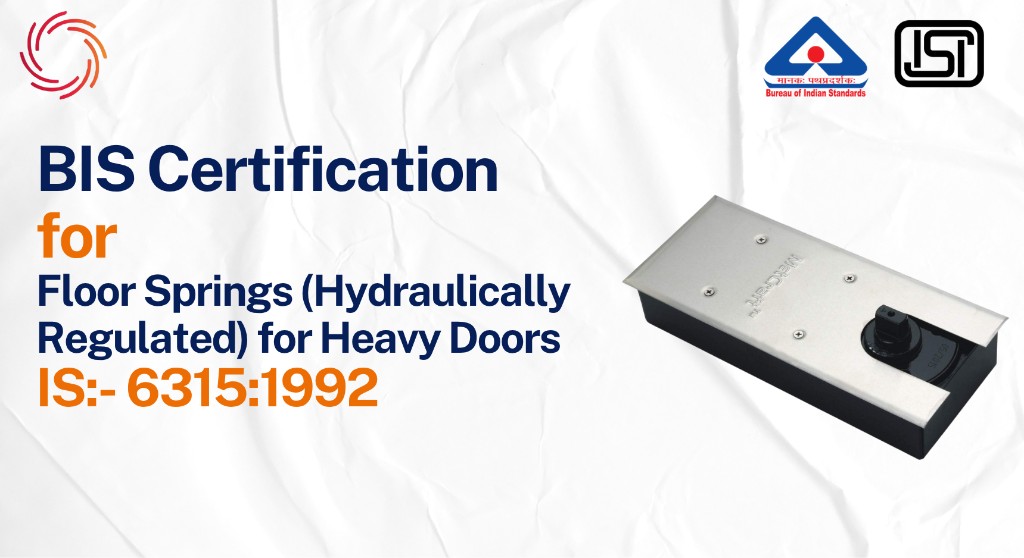
BIS Certification for Hydraulically Regulated Door Closers under IS 3564:1995 confirms that the product meets Indian performance and durability requirements for controlled door closing systems. In India, certification is important because poorly designed door closers can lead to unsafe door movement, premature hydraulic leakage, improper closing force, and reduced safety in residential, commercial, and institutional buildings.
Hydraulically regulated door closers have become an essential component in modern infrastructure projects across India. From hospitals and shopping complexes to hotels, office towers, airports, schools, and residential apartments, these devices help control the movement of doors by ensuring smooth opening and automatic closing. Their role is not limited to convenience; they are directly connected to safety, energy efficiency, fire compartmentalization, accessibility, and long-term hardware reliability.
A malfunctioning door closer can create serious operational issues. A heavy door that slams shut may injure users, damage glass partitions, weaken hinges, or create panic in emergency situations. On the other hand, a door that fails to close properly can compromise fire safety zones, air-conditioning efficiency, and restricted-access security systems. Because of these risks, India places technical and quality expectations on hydraulically regulated door closers used in public and private buildings.
The growing construction industry, smart infrastructure projects, and increasing adoption of commercial hardware systems have significantly increased demand for standardized architectural hardware products. Builders, architects, facility management companies, and government procurement departments now prefer certified products that offer predictable performance under repeated usage conditions.
This is where BIS Certification for Hydraulically Regulated Door Closers becomes highly important. The certification framework linked with IS 3564:1995 evaluates whether the product can withstand repeated operational cycles, maintain hydraulic regulation, operate safely under load conditions, and deliver consistent door-closing performance.
For manufacturers and importers, obtaining a BIS Certificate for Hydraulically Regulated Door Closers is not only about regulatory alignment but also about proving engineering reliability. Certified products gain stronger acceptance in infrastructure tenders, institutional procurement contracts, and large-scale commercial construction projects.
Understanding BIS Certification for Hydraulically Regulated Door Closers - IS 3564:1995
Hydraulically regulated door closers are precision-controlled mechanical devices. Unlike ordinary hinges or simple spring systems, these products depend on carefully calibrated hydraulic action to regulate the speed and force of door movement. Even minor defects in internal valves, seals, springs, pistons, or casting assemblies can affect performance.
BIS Certification for Hydraulically Regulated Door Closers evaluates whether these products consistently operate within defined technical parameters. The certification process focuses on real-world usage conditions where doors may be opened and closed thousands of times every month.
For example, in a hospital corridor, door closers must allow smooth operation without sudden resistance. In commercial buildings, they must prevent doors from remaining partially open. In fire-rated door assemblies, the closer must reliably shut the door after every use to preserve compartmentalized fire protection.
The BIS framework for this product category addresses several practical concerns:
- Controlled closing speed
- Hydraulic fluid retention
- Mechanical durability
- Corrosion resistance
- Structural stability
- Operational consistency
- Safety during repeated usage
The BIS License for Hydraulically Regulated Door Closers assures buyers that the product has undergone technical verification under Indian standard requirements rather than being sold solely based on appearance or marketing claims.
Manufacturers also benefit because certification encourages process discipline in areas such as:
- Pressure calibration
- Hydraulic chamber sealing
- Material selection
- Spring tension control
- Surface treatment quality
- Assembly precision
Without standardized production practices, door closers may develop fluid leakage, irregular movement, noisy operation, or sudden closing impact after installation. BIS compliance minimizes such performance failures.
Applicable BIS Standard for Hydraulically Regulated Door Closers - IS 3564:1995
The applicable Indian Standard for this product category is IS 3564:1995. This standard specifies technical requirements for hydraulically regulated door closers used in various building applications. The standard covers functional characteristics, construction quality, durability expectations, dimensional considerations, operational efficiency, and testing methods.
Scope of IS 3564:1995
IS 3564:1995 applies to hydraulically controlled door-closing devices designed for controlled automatic closing of doors after manual opening. These products are commonly installed in:
- Commercial complexes
- Educational institutions
- Hospitals
- Hotels
- Industrial buildings
- Residential apartments
- Public infrastructure projects
The standard generally addresses door closers intended for heavy and medium-duty applications where smooth and regulated movement is necessary.
Product Categories Covered
The standard may apply to various door closer configurations including:
- Surface-mounted door closers
- Heavy-duty hydraulic closers
- Adjustable speed door closers
- Commercial door-closing systems
- Architectural hardware closers
Safety and Performance Objectives
IS 3564:1995 focuses on ensuring that door closers:
- Provide controlled door movement
- Prevent abrupt slamming
- Maintain operational consistency
- Resist premature mechanical failure
- Withstand repetitive opening and closing cycles
- Maintain hydraulic integrity
Design and Testing Principles
The standard evaluates:
- Spring functionality
- Hydraulic regulation systems
- Leakage resistance
- Cycle endurance
- Mechanical strength
- Corrosion resistance
- Dimensional conformity
These requirements help ensure that the product remains dependable throughout prolonged installation periods in high-traffic environments.
Testing Requirements as per IS 3564:1995
Testing is one of the most important parts of BIS Certification for Hydraulically Regulated Door Closers.
Safety Tests
Safety-related evaluations ensure the closer regulates door movement properly without causing unsafe closing force or abrupt impact.
Performance Tests
Performance testing checks:
- Closing speed regulation
- Operational smoothness
- Hydraulic consistency
- Opening resistance
Durability Tests
Durability assessments simulate repeated door operation cycles to verify long-term reliability. This is particularly important for high-traffic installations such as malls, hospitals, and airports.
Quality Verification Tests
Additional testing may include:
- Corrosion resistance
- Leakage testing
- Mechanical load testing
- Dimensional inspection
All testing must be conducted in Bureau of Indian Standards recognized laboratories.
Conclusion
Hydraulically regulated door closers play a vital role in building safety, controlled access, user convenience, and operational reliability. Their performance directly affects daily movement in commercial complexes, hospitals, educational institutions, hotels, and public infrastructure facilities. Poor-quality door closers may create safety hazards, operational failures, and maintenance issues that impact both property owners and end users.
Obtaining a BIS Certificate for Hydraulically Regulated Door Closers under IS 3564:1995 demonstrates that the product has been evaluated against recognized Indian technical requirements for performance, durability, and operational consistency. For manufacturers, importers, and suppliers, BIS Certification for Hydraulically Regulated Door Closers supports regulatory compliance, improves commercial acceptance, and strengthens long-term market credibility.
Whether you are seeking a BIS License for Hydraulically Regulated Door Closers for domestic manufacturing or imported products, maintaining compliance with IS 3564:1995 helps establish trust, improve product reliability, and support responsible participation in India's growing infrastructure and architectural hardware sector.
FAQs – BIS Certification for Hydraulically Regulated Door Closers - IS 3564:1995
1. Why is BIS Certification important for hydraulically regulated door closers used in commercial buildings?
Commercial buildings experience high-frequency door usage throughout the day. A low-quality hydraulic closer may fail under repetitive stress, causing uncontrolled closing movement or leakage. BIS Certification for Hydraulically Regulated Door Closers confirms that the product has been evaluated for durability, operational stability, and long-term performance under Indian standard requirements.
2. What is the typical bis certification process for Hydraulically Regulated Door Closers?
The bis certification process for Hydraulically Regulated Door Closers generally includes product identification, application filing, document submission, sample testing in BIS recognized laboratories, factory inspection, and final approval. The process verifies both product performance and the manufacturer's capability to maintain consistent production quality.
3. What factors affect the bis certification cost for Hydraulically Regulated Door Closers?
The bis certification cost for Hydraulically Regulated Door Closers depends on laboratory testing charges, factory audit expenses, number of product variants, application fees, and consultancy support requirements. Costs may also increase if additional testing or corrective actions are required after initial evaluation.
4. Which tests are commonly conducted under IS 3564:1995?
Testing under IS 3564:1995 may include endurance testing, hydraulic leakage evaluation, operational performance testing, corrosion resistance checks, and dimensional inspections. These tests help determine whether the product can maintain consistent closing action and structural reliability over long-term usage.
5. Can imported hydraulic door closers obtain BIS Certification in India?
Yes. Foreign manufacturers supplying hydraulic door closers to India can apply for BIS Certification through applicable certification procedures. Imported products must still comply with IS 3564:1995 and undergo required testing, documentation review, and compliance verification before entering the Indian market.
6. What documents are required for BIS Certification for Hydraulically Regulated Door Closers?
Manufacturers generally need factory registration documents, technical drawings, quality control plans, calibration certificates, product specifications, business licenses, and application forms. Proper preparation of bis certification documents for Hydraulically Regulated Door Closers helps avoid unnecessary delays during scrutiny and inspection stages.
7. How long does it take to obtain a BIS License for Hydraulically Regulated Door Closers?
The timeline may vary depending on document readiness, laboratory testing schedules, and factory inspection outcomes. In many cases, the process may take several weeks to a few months. Delays often occur when product samples fail testing or supporting documents are incomplete.
8. Are small manufacturers also required to comply with BIS requirements?
Yes. Product size or production scale does not eliminate compliance responsibilities. Even smaller manufacturers producing hydraulic door closers for local or regional markets may require certification if the product category falls within applicable regulatory requirements or procurement specifications.
9. What happens if a manufacturer uses the ISI mark without authorization?
Unauthorized use of the ISI mark may result in regulatory action, financial penalties, product seizure, or legal proceedings. Authorities may also restrict future licensing opportunities for businesses found misrepresenting compliance status in the market.
10. How does BIS Certification improve business opportunities for hydraulic door closer manufacturers?
A BIS Certificate for Hydraulically Regulated Door Closers increases buyer confidence among builders, architects, procurement agencies, and infrastructure developers. Certified products often receive preference in institutional projects, commercial tenders, and large-scale construction contracts where standardized hardware performance is critical.
Quality Control Order (QCO) for Hydraulically Regulated Door Closers
Related Resources
Many of our users also read
This compliance advisory was vetted by our Senior Consultant (Enforcement & Vigilance), a former BIS Director (Enforcement). He specializes in post-certification compliance, helping companies navigate surveillance audits and legal adherence to BIS mandates.
Dhruv Aggarwal
Head of Operations at Sun Certifications India
Experience: 10+ years & Handled 1000+ projects
Awarded by many Indian and International organisations










PT Quty Karunia, BIS Licensee in Vietnam
“Sun Certifications India provided excellent BIS Certification services. Their unparalleled service and sincerity gained our trust. One of the best BIS consultants in India!”

Thantawan Industries Ltd, BIS Licensee in Thailand
“Sun Certifications India supported us throughout the BIS certification process. Their responsive customer service and punctuality are exceptional. Highly recommend for hassle-free BIS certification.”

Leaderart Industries, BIS Licensee in Malaysia
“Sun Certifications India helped us acquire BIS Certification, doubling our engagement in India. Their services are fast, genuine, and up-to-date with latest BIS norms.”

Aluminium Bahrain (ALBA), BIS Licensee in Bahrain
“Excellent BIS certification support, highly reliable consultants.”

Bahrain Aluminium Manufacturing Company, BIS Licensee in Bahrain
“Smooth BIS registration process with expert consultants.”

Daiki Aluminium Japan, BIS Licensee in Japan
“Efficient BIS license assistance, great consultants.”

Trimble Navigation, BIS Licensee in USA
“Seamless BIS certification and registration support.”

Remsa Italia, BIS Licensee in Italy
“Helpful BIS consultants, simplified license process.”

Aquazzura, BIS Licensee in Italy
“We got our BIS certificate well within the timelines and at affordable prices, great work team Sun!”

PT Quty, BIS Licensee in Indonesia
“Excellent BIS registration service, highly recommended.”

Danu Vina, BIS Licensee in Vietnam
“Reliable BIS license consultants, fast process.”

Hanh My Production Company, BIS Licensee in Vietnam
“Expert BIS consultants, certification made easy.”

Sedo Vina, BIS Licensee in Vietnam
“Smooth BIS certificate registration, great support.”

Misumi Japan, BIS Licensee in Japan
“Trusted BIS consultants, quick certification process.”

Thantawan Public Industry Company, BIS Licensee in Thailand
“Professional BIS certification service, very efficient.”

Cortizo Aluminios, BIS Licensee in Spain
“Excellent BIS registration and license guidance.”

Midal Cables, BIS Licensee in Bahrain
“Expert BIS consultants, smooth certification process.”
Years Exp.
Our Clients
Success Rate
Countries Served
Our team brings 10e4+ years of experience in CDSCO and BIS compliance.
We reduce approval time by up to 40% with streamlined processes.
100% success rate with 1500+ successful registrations.
Dedicated account manager ensuring personalized service.
Leave your details below and our experts will call you back within 24 hours to discuss your regulatory compliance needs.
By submitting this form, you agree to our Privacy Policy and consent to being contacted.