BIS Certification for Door Handles – Complete Guide to IS 208:2020
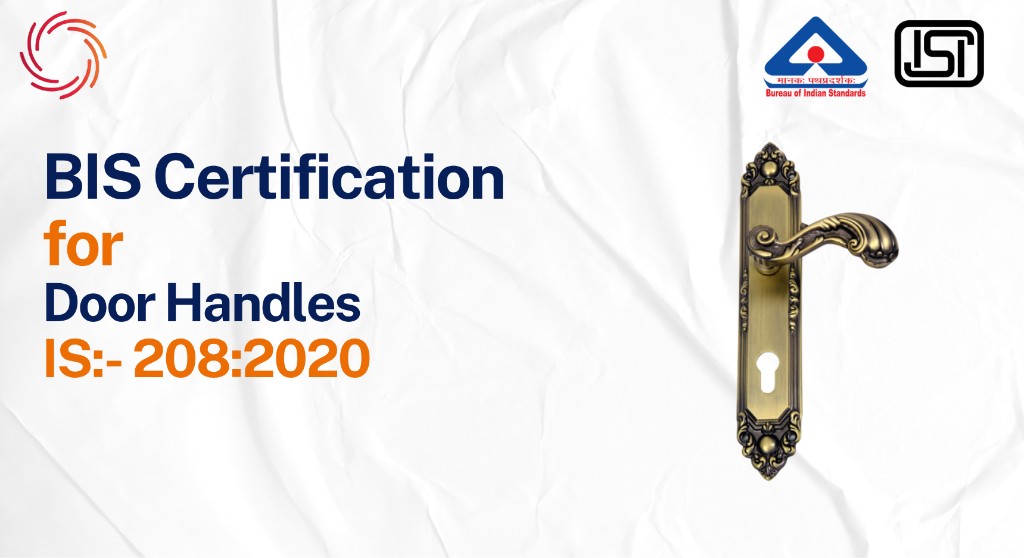
BIS Certification for Door Handles under IS 208:2020 confirms that the handles meet Indian requirements related to dimensional accuracy, corrosion resistance, mechanical durability, finish quality, and operational performance. In India, compliance with IS 208:2020 helps manufacturers, importers, and suppliers supply reliable architectural hardware suitable for residential, commercial, hospitality, and institutional infrastructure projects.
Door handles are among the most frequently used architectural hardware components in residential apartments, office buildings, hospitals, hotels, schools, malls, factories, and public infrastructure projects. Although they appear to be simple fittings, their performance directly affects user convenience, door security, accessibility, hygiene, and long-term maintenance. A poorly manufactured handle may loosen within months, corrode in humid environments, crack under repetitive force, or fail to support locking systems correctly. In high-footfall areas, such failures create operational inconvenience and even safety concerns.
India's construction and real estate sector has experienced rapid growth in recent years, increasing demand for reliable builders' hardware. Modern infrastructure projects now expect hardware products to maintain functionality over thousands of opening-and-closing cycles while also matching aesthetic requirements. Door handles used in hospitals and commercial buildings are expected to resist rust, support ergonomic operation, and maintain structural integrity despite continuous usage. Because of these expectations, standardized manufacturing practices have become increasingly important.
This is where the BIS Certification for Door Handles becomes highly relevant. The certification framework linked with IS 208:2020 establishes technical benchmarks covering construction quality, materials, dimensions, performance parameters, surface finish, and durability requirements for door handles supplied in the Indian market. Instead of relying solely on visual appearance, the standard evaluates whether the product can perform consistently under actual usage conditions.
For manufacturers, obtaining a BIS Certificate for Door Handles demonstrates that their production systems are capable of maintaining consistent quality across batches. For importers and distributors, compliance helps reduce the risk of product complaints, corrosion issues, installation failures, and rejection during institutional procurement. Government tenders, commercial projects, and organized retail chains increasingly prefer certified hardware products because they simplify quality verification and build buyer confidence.
The BIS License for Door Handles is also significant from a regulatory and commercial standpoint. Construction companies, architects, facility managers, and procurement agencies often prioritize certified hardware because it reduces maintenance costs and ensures compatibility with Indian specifications. Products carrying the ISI mark gain greater acceptance in competitive infrastructure markets where durability and compliance are critical purchase factors.
In addition, modern consumers are becoming more quality-conscious. Buyers no longer judge hardware only by appearance or price. They now evaluate strength, coating quality, grip comfort, corrosion resistance, and operational life. BIS Certification for Door Handles therefore supports not only regulatory alignment but also brand positioning and long-term market trust.
Understanding BIS Certificate for Door Handles - IS 208:2020
Door handles are exposed to continuous mechanical stress every day. Unlike decorative hardware that may remain mostly untouched, handles are constantly pulled, pushed, rotated, and impacted during operation. This repeated usage creates wear on internal fittings, fastening points, springs, and surface coatings. If manufacturing quality is inconsistent, handles may develop looseness, wobbling, finish deterioration, or structural breakage.
The BIS Certification for Door Handles addresses these real-world operational concerns through a structured compliance mechanism linked with IS 208:2020. The certification process evaluates whether the product is suitable for routine residential use as well as demanding commercial environments.
One important aspect of the standard is dimensional consistency. Door handles must align properly with locking systems, mortice assemblies, and installation hardware. Minor deviations in dimensions can create operational problems during installation or affect long-term usability. Through standardization, manufacturers maintain interchangeability and installation compatibility across projects.
Another critical concern is corrosion resistance. Door handles installed in coastal regions, humid areas, kitchens, hospitals, and outdoor-access locations often face exposure to moisture and cleaning chemicals. Inferior coatings may peel or rust quickly, negatively affecting appearance and structural stability. The BIS License for Door Handles therefore focuses on protective finishing quality and surface durability.
Mechanical strength is equally important. In commercial buildings, hotel corridors, educational institutions, and public offices, handles may be operated thousands of times every month. Weak materials or poor assembly methods can result in breakage or loosening. Certification testing evaluates the product's ability to withstand repetitive operational loads and usage cycles.
The regulatory objective behind BIS Certification for Door Handles is also linked with broader infrastructure quality improvement. Construction hardware affects building functionality, user experience, and maintenance costs. Standardized door hardware reduces premature replacements and supports safer building operation over extended periods.
The BIS Licence for Door Handles additionally encourages process discipline inside manufacturing units. Manufacturers seeking certification are expected to maintain quality control systems, calibrated testing equipment, inspection records, raw material verification procedures, and traceability documentation. This improves consistency across production batches.
Consumers and procurement agencies also benefit from certification because the ISI mark acts as a visible indicator that the product has undergone technical evaluation under Indian standards. Instead of depending entirely on supplier claims, buyers can rely on standardized verification parameters.
Applicable BIS Standard for Door Handles - IS 208:2020
IS 208:2020
IS 208:2020 is the applicable Indian Standard associated with the BIS Certification for Door Handles. The standard establishes technical requirements for door handles intended for architectural and building applications. It covers aspects related to dimensions, construction, material quality, workmanship, protective coatings, operational performance, and testing procedures.
The scope of IS 208:2020 includes door handles used in residential, institutional, hospitality, commercial, and industrial buildings. The standard applies to products manufactured from various approved materials and intended for regular operational use with door locking systems and fittings.
One of the important objectives of IS 208:2020 is ensuring operational reliability. Door handles are functional hardware products, not merely decorative accessories. The standard therefore focuses on parameters that affect usability during daily operation, including grip stability, fastening integrity, alignment, and resistance to operational wear.
The standard also addresses manufacturing quality related to casting, fabrication, machining, and finishing. Poor-quality manufacturing may lead to burrs, uneven surfaces, cracks, weak fastening points, or defective coating adhesion. IS 208:2020 establishes workmanship expectations to reduce such defects.
Surface protection is another major area covered under the standard. Since door handles are often exposed to humidity, perspiration, environmental contaminants, and cleaning chemicals, protective finishes play a significant role in product life. The standard evaluates coating consistency and resistance against corrosion-related deterioration.
The BIS Certificate for Door Handles under IS 208:2020 therefore becomes particularly valuable for projects requiring durable hardware systems. Builders, architects, and procurement professionals often prefer products aligned with recognized standards because they simplify specification compliance and reduce operational risk.
IS 208:2020 additionally supports quality harmonization within India's architectural hardware industry. It creates a common technical benchmark that enables fair quality comparison between manufacturers and suppliers operating in different regions.
Testing Requirements as per IS 208:2020
Testing under IS 208:2020 evaluates whether the product can perform reliably during real-world operational use. All testing must be conducted in Bureau of Indian Standards recognized laboratories.
Safety Tests
Safety-related evaluations may include structural integrity checks, edge smoothness assessment, mounting stability verification, and load-bearing capability examination.
Performance Tests
Performance testing examines operational reliability during repeated opening and closing cycles. The objective is to ensure that the handle maintains proper functionality without excessive looseness or mechanical deterioration.
Durability Tests
Door handles used in commercial buildings experience continuous physical interaction. Durability testing therefore evaluates resistance against wear, coating degradation, deformation, and environmental exposure.
Quality Verification Tests
Additional testing verifies dimensional conformity, finish quality, coating consistency, material suitability, and workmanship standards specified under IS 208:2020.
Conclusion
Door handles are essential architectural hardware products that directly affect usability, security, operational convenience, and building maintenance performance. Whether installed in homes, hospitals, hotels, offices, educational institutions, or industrial facilities, these products are expected to withstand repeated usage while maintaining structural integrity and finish quality.
The BIS Certification for Door Handles under IS 208:2020 helps establish technical reliability through standardized testing, manufacturing discipline, and quality verification procedures. A BIS Certificate for Door Handles supports confidence among builders, architects, procurement agencies, distributors, and end users by demonstrating compliance with recognized Indian requirements.
For manufacturers and importers, obtaining a BIS License for Door Handles strengthens market credibility, improves regulatory alignment, and supports broader commercial acceptance. Businesses seeking long-term growth in India's architectural hardware sector should prioritize BIS Certification for Door Handles not only for compliance purposes but also for building stronger product trust and sustainable market positioning.
FAQs – BIS Certification for Door Handles - IS 208:2020
1. Why is BIS Certification for Door Handles important in large commercial construction projects?
Commercial buildings such as hotels, hospitals, office towers, shopping malls, and educational institutions experience extremely high door usage every day. Certified door handles are preferred in these projects because they are evaluated for durability, operational reliability, and corrosion resistance. Builders and consultants often specify certified products to reduce long-term maintenance and replacement costs.
2. How does IS 208:2020 help improve the performance life of door handles in humid or coastal areas?
Door handles installed near coastal regions or high-humidity environments are exposed to moisture, salt particles, cleaning chemicals, and environmental contaminants. IS 208:2020 includes requirements related to surface finish quality and corrosion resistance. Compliance helps manufacturers produce hardware that maintains appearance and functionality for longer operational periods.
3. What factors influence the bis certification cost for Door Handles?
The bis certification cost for Door Handles depends on product variants, testing requirements, factory size, documentation complexity, inspection expenses, and surveillance obligations. Manufacturers producing multiple handle designs or finishes may incur additional testing and compliance expenses because each variation may require technical evaluation.
4. Can imported door handles be sold in India without BIS compliance under IS 208:2020?
Imported architectural hardware intended for regulated applications may face procurement restrictions if it does not satisfy applicable Indian compliance expectations. Importers supplying products to organized retail chains, institutional buyers, or government projects generally prefer certified products because they improve acceptance and reduce regulatory complications.
5. What are the most common reasons for failure during laboratory testing of door handles?
Testing failures usually occur because of poor coating quality, weak assembly structures, dimensional inconsistency, improper material composition, or inadequate durability performance. Manufacturers can reduce rejection risks by improving process control, raw material inspection, and in-house testing before submitting samples to BIS recognized laboratories.
6. How long does the bis certification process for Door Handles usually take?
The bis certification process for Door Handles depends on document readiness, laboratory testing timelines, factory audit scheduling, and corrective action requirements. Delays often occur when technical records are incomplete or product samples fail initial testing. Proper preparation significantly improves approval timelines.
7. What types of documents are required during the BIS application process for door handles?
Applicants generally require manufacturing licenses, factory registration records, quality manuals, product drawings, material specifications, calibration certificates, process flow details, testing arrangements, and business registration documents. Accurate bis certification documents for Door Handles help reduce application scrutiny delays and inspection observations.
8. Why do institutional buyers and architects prefer certified door handles over non-certified products?
Institutional buyers prioritize durability, compatibility, corrosion resistance, and operational reliability because hardware failures increase maintenance costs and negatively affect building usability. Certified products provide greater confidence regarding manufacturing quality and technical consistency, making them more suitable for high-value infrastructure projects.
9. Does BIS Certification apply only to manufacturers, or do distributors and private label brands also need compliance?
Compliance responsibility may extend beyond manufacturers. Importers, private label brands, distributors, and businesses marketing products under their own trade names may also need to ensure that supplied products comply with applicable certification and labeling requirements under Indian regulations.
10. What happens if a manufacturer continues selling non-compliant door handles after regulatory action?
Supplying non-compliant products after regulatory enforcement may result in product seizures, penalties, market restrictions, legal proceedings, and reputational damage. Businesses may also lose opportunities in government tenders and organized infrastructure procurement projects where certified hardware products are preferred.
Quality Control Order (QCO) for Door Handles
Related Resources
Many of our users also read
This compliance advisory was vetted by our Senior Consultant (Enforcement & Vigilance), a former BIS Director (Enforcement). He specializes in post-certification compliance, helping companies navigate surveillance audits and legal adherence to BIS mandates.
Dhruv Aggarwal
Head of Operations at Sun Certifications India
Experience: 10+ years & Handled 1000+ projects
Awarded by many Indian and International organisations










PT Quty Karunia, BIS Licensee in Vietnam
“Sun Certifications India provided excellent BIS Certification services. Their unparalleled service and sincerity gained our trust. One of the best BIS consultants in India!”

Thantawan Industries Ltd, BIS Licensee in Thailand
“Sun Certifications India supported us throughout the BIS certification process. Their responsive customer service and punctuality are exceptional. Highly recommend for hassle-free BIS certification.”

Leaderart Industries, BIS Licensee in Malaysia
“Sun Certifications India helped us acquire BIS Certification, doubling our engagement in India. Their services are fast, genuine, and up-to-date with latest BIS norms.”

Aluminium Bahrain (ALBA), BIS Licensee in Bahrain
“Excellent BIS certification support, highly reliable consultants.”

Bahrain Aluminium Manufacturing Company, BIS Licensee in Bahrain
“Smooth BIS registration process with expert consultants.”

Daiki Aluminium Japan, BIS Licensee in Japan
“Efficient BIS license assistance, great consultants.”

Trimble Navigation, BIS Licensee in USA
“Seamless BIS certification and registration support.”

Remsa Italia, BIS Licensee in Italy
“Helpful BIS consultants, simplified license process.”

Aquazzura, BIS Licensee in Italy
“We got our BIS certificate well within the timelines and at affordable prices, great work team Sun!”

PT Quty, BIS Licensee in Indonesia
“Excellent BIS registration service, highly recommended.”

Danu Vina, BIS Licensee in Vietnam
“Reliable BIS license consultants, fast process.”

Hanh My Production Company, BIS Licensee in Vietnam
“Expert BIS consultants, certification made easy.”

Sedo Vina, BIS Licensee in Vietnam
“Smooth BIS certificate registration, great support.”

Misumi Japan, BIS Licensee in Japan
“Trusted BIS consultants, quick certification process.”

Thantawan Public Industry Company, BIS Licensee in Thailand
“Professional BIS certification service, very efficient.”

Cortizo Aluminios, BIS Licensee in Spain
“Excellent BIS registration and license guidance.”

Midal Cables, BIS Licensee in Bahrain
“Expert BIS consultants, smooth certification process.”
Years Exp.
Our Clients
Success Rate
Countries Served
Our team brings 10e4+ years of experience in CDSCO and BIS compliance.
We reduce approval time by up to 40% with streamlined processes.
100% success rate with 1500+ successful registrations.
Dedicated account manager ensuring personalized service.
Leave your details below and our experts will call you back within 24 hours to discuss your regulatory compliance needs.
By submitting this form, you agree to our Privacy Policy and consent to being contacted.