BIS Certification for Floor Springs (Hydraulically Regulated) for Heavy Doors – Complete Guide to IS 6315:1992
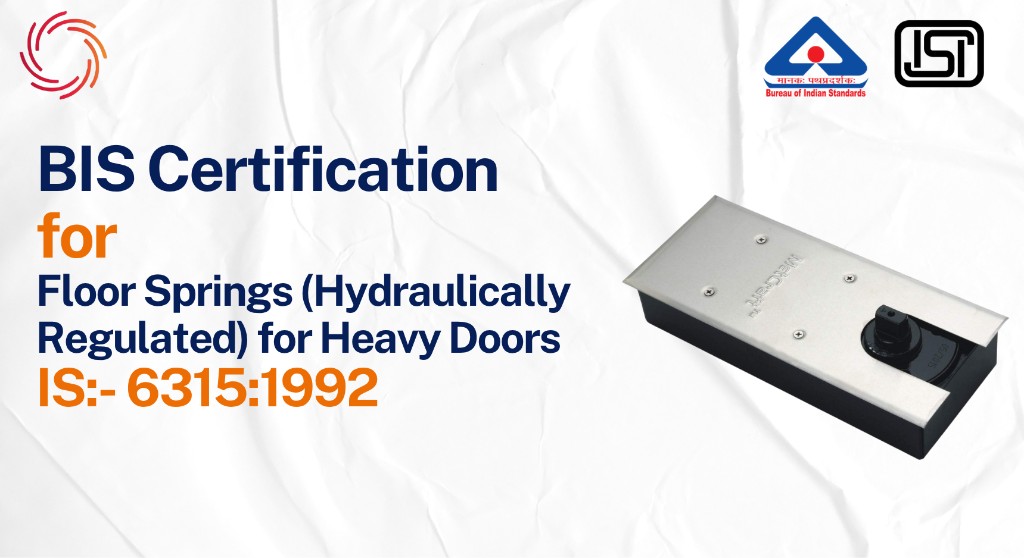
BIS Certification for Floor springs (hydraulically regulated) for heavy doors confirms that the product complies with IS 6315:1992, the Indian Standard governing performance, durability, and operational safety requirements for heavy-duty door control systems. In India, certification is important because these products are widely used in commercial buildings, hospitals, malls, airports, and industrial facilities where controlled door movement and long-term reliability directly affect user safety and building functionality.
Heavy doors installed in commercial complexes, hotels, hospitals, educational institutions, metro stations, industrial buildings, and public infrastructure projects require dependable closing systems that can manage continuous movement without sudden slamming, misalignment, or operational failure. Floor springs play a critical role in controlling the opening and closing action of such doors. Unlike ordinary hinges, hydraulically regulated floor springs are engineered to support the weight of heavy glass, metal, wooden, or aluminium doors while ensuring smooth movement and controlled closing speed.
As modern architecture increasingly adopts frameless glass doors and large entry systems, the demand for precision-engineered floor springs has expanded rapidly across India. Builders, architects, and infrastructure developers prefer products that provide stability, longevity, silent operation, and resistance to wear under frequent usage conditions. In high-footfall environments such as shopping malls or airports, even a minor failure in door-closing mechanisms can create safety hazards, property damage, or accessibility issues.
This is where regulatory quality assessment becomes essential. The BIS Certificate for Floor springs (hydraulically regulated) for heavy doors helps verify that the product can withstand operational stress, maintain hydraulic efficiency, and perform reliably under prescribed testing conditions. Manufacturers and importers seeking entry into the Indian hardware and construction market often require BIS Certification for Floor springs (hydraulically regulated) for heavy doors to establish compliance credibility and improve acceptance among institutional buyers.
The certification framework linked with IS 6315:1992 focuses not only on structural performance but also on dimensional consistency, hydraulic regulation, endurance capability, corrosion resistance, and installation safety. Since these products are embedded into flooring structures and integrated with heavy doors, poor-quality floor springs can lead to dangerous operational defects, including abrupt door closure, leakage of hydraulic fluid, uneven movement, and mechanical failure.
For suppliers, contractors, and infrastructure procurement agencies, the BIS License for Floor springs (hydraulically regulated) for heavy doors acts as a technical assurance that the product has undergone proper evaluation according to Indian compliance parameters. Similarly, the BIS Licence for Floor springs (hydraulically regulated) for heavy doors strengthens market trust and supports participation in government and institutional procurement projects where standardized hardware products are preferred.
Understanding BIS Certificate for Floor Springs (Hydraulically Regulated) for Heavy Doors - IS 6315:1992
Hydraulically regulated floor springs are mechanical devices installed below the floor surface to control the movement of heavy swing doors. These products are designed to absorb motion energy and regulate door closure speed through hydraulic pressure systems. Because they directly influence the movement of heavy entry doors, product failure can create serious safety and operational problems.
The BIS Certification for Floor springs (hydraulically regulated) for heavy doors evaluates whether these products are capable of maintaining stable operation under repeated mechanical stress. A floor spring installed in a busy commercial building may operate thousands of times every week. Continuous load cycles can affect hydraulic seals, spring tension, pivot alignment, and closing control mechanisms. Certification therefore becomes important for validating long-term reliability.
Unlike decorative hardware, floor springs perform a functional safety role. Improperly manufactured products may result in:
- Sudden door slamming
- Inconsistent closing speed
- Hydraulic oil leakage
- Pivot instability
- Misalignment of heavy glass doors
- Reduced door holding capacity
- Premature component wear
The BIS License for Floor springs (hydraulically regulated) for heavy doors ensures that manufacturers maintain proper production controls for hydraulic assembly, spring calibration, material selection, and dimensional precision.
Certification also supports consistency in architectural installations. Large commercial projects often require hundreds of identical floor spring units with uniform performance characteristics. Even slight variations in hydraulic resistance or closing speed may create operational inconsistency across building access points.
Another important aspect of BIS Certification for Floor springs (hydraulically regulated) for heavy doors is consumer protection. Since these products are generally concealed beneath floor coverings, internal defects are difficult to identify visually after installation. Certification therefore acts as a preventive quality mechanism before products reach the market.
The regulatory objective behind IS 6315:1992 is to ensure that manufacturers follow established engineering benchmarks relating to:
- Mechanical durability
- Hydraulic regulation
- Corrosion resistance
- Functional endurance
- Structural integrity
- Safe operational control
Products carrying the BIS Licence for Floor springs (hydraulically regulated) for heavy doors are generally considered more reliable by builders, architects, contractors, and institutional buyers because the manufacturing system undergoes technical assessment and quality monitoring.
Applicable BIS Standard for Floor Springs (Hydraulically Regulated) for Heavy Doors
IS 6315:1992 – Scope and Technical Relevance
IS 6315:1992 specifies the requirements for hydraulically regulated floor springs intended for use with heavy doors. The standard establishes engineering and performance parameters for products designed to regulate the opening and closing movement of doors in commercial and industrial environments.
The standard generally covers floor springs used for:
- Heavy wooden doors
- Aluminum doors
- Glass doors
- Metal-framed entry doors
- Commercial building entrance systems
- Institutional access doors
The scope of IS 6315:1992 includes critical design and operational factors such as:
- Mechanical strength
- Hydraulic efficiency
- Closing force regulation
- Endurance performance
- Dimensional compatibility
- Material quality
- Functional adjustment systems
One of the most important objectives of this standard is ensuring controlled door movement. Heavy doors without properly regulated closing systems can become hazardous in crowded environments. Excessive closing force may injure users, while weak control may leave doors partially open and compromise security or air-conditioning efficiency.
The standard also addresses durability because floor springs are expected to function under continuous operational cycles for extended periods. In locations such as hospitals, office towers, shopping complexes, and airports, door hardware is subjected to constant movement throughout the day. Products that lose hydraulic control prematurely may require expensive floor dismantling and replacement.
IS 6315:1992 also supports dimensional standardization. Proper alignment between the floor spring spindle, door pivot, and frame assembly is critical for stable operation. Inaccurate dimensions can cause uneven door movement, hinge stress, or installation failure.
Manufacturers applying for the BIS Certificate for Floor springs (hydraulically regulated) for heavy doors must ensure their products comply with the construction, testing, and marking provisions prescribed under the standard.
Testing Requirements as per IS 6315:1992
Testing under IS 6315:1992 focuses on operational reliability and long-term hydraulic performance. Testing must be conducted in Bureau of Indian Standards recognized laboratories.
Safety Tests
Safety evaluations examine whether the floor spring maintains controlled door movement without abrupt closing or unstable operation.
Performance Tests
Performance testing verifies opening and closing efficiency, spindle movement, adjustment capability, and hydraulic response.
Durability Tests
Endurance testing simulates repeated operational cycles to evaluate long-term wear resistance.
Quality Verification Tests
Quality verification includes dimensional accuracy, finish assessment, corrosion resistance, and assembly integrity evaluation.
Manufacturers seeking BIS Certification for Floor springs (hydraulically regulated) for heavy doors must ensure consistent compliance across all production batches.
Conclusion
Hydraulically regulated floor springs are critical mechanical systems that influence the safety, functionality, and operational stability of heavy doors installed across commercial, institutional, and industrial buildings. Since these products operate continuously under high-load conditions, technical reliability and manufacturing precision are essential.
The BIS Certificate for Floor springs (hydraulically regulated) for heavy doors demonstrates that the product complies with IS 6315:1992 and meets prescribed requirements relating to durability, hydraulic control, structural performance, and operational safety. For manufacturers, importers, and suppliers, obtaining BIS Certification for Floor springs (hydraulically regulated) for heavy doors supports regulatory compliance, improves market credibility, and enhances acceptance in infrastructure and commercial construction projects.
Whether businesses are seeking guidance on the bis certification process for Floor springs (hydraulically regulated) for heavy doors, understanding the cost of bis certification for Floor springs (hydraulically regulated) for heavy doors, or preparing bis certification documents for Floor springs (hydraulically regulated) for heavy doors, proper compliance planning remains essential for sustainable market growth and long-term product trust in India.
FAQs – BIS Certification for Floor Springs (Hydraulically Regulated) for Heavy Doors - IS 6315:1992
1. Why is BIS Certification important for hydraulically regulated floor springs used in heavy doors?
Floor springs installed in heavy commercial doors are subjected to constant operational stress and public usage. Poor-quality hydraulic systems may cause uncontrolled door movement, leakage, or premature failure. BIS Certification for Floor springs (hydraulically regulated) for heavy doors helps ensure that the products meet performance and endurance requirements suitable for long-term building applications.
2. What is the relevance of IS 6315:1992 for floor spring manufacturers?
IS 6315:1992 establishes technical requirements for hydraulic regulation, endurance capability, dimensional compatibility, and operational efficiency. Manufacturers must design products according to these engineering parameters to ensure smooth and safe door movement in commercial and institutional environments.
3. What factors influence the bis certification cost for Floor springs (hydraulically regulated) for heavy doors?
The bis certification cost for Floor springs (hydraulically regulated) for heavy doors depends on testing scope, number of product variants, factory inspection expenses, application fees, and ongoing surveillance charges. Costs may also vary depending on whether the applicant is a domestic manufacturer or foreign supplier.
4. Which documents are required during the BIS application process?
Applicants generally need factory registration documents, manufacturing process details, machinery lists, technical drawings, calibration records, quality manuals, trademark authorization, and product specifications. Proper bis certification documents for Floor springs (hydraulically regulated) for heavy doors help reduce delays during technical evaluation.
5. Are imported floor springs also required to comply with Indian BIS requirements?
Yes, imported products intended for the Indian market may also need compliance with applicable BIS requirements. Foreign manufacturers and importers supplying heavy-duty hydraulic floor springs are often expected to demonstrate conformity with IS 6315:1992 before market distribution.
6. What types of laboratory tests are conducted on floor springs?
Laboratory testing generally includes endurance testing, operational performance evaluation, hydraulic efficiency checks, dimensional verification, corrosion resistance assessment, and structural examination. Testing is conducted in BIS recognized laboratories to confirm product reliability under practical usage conditions.
7. How long does the bis certification process for Floor springs (hydraulically regulated) for heavy doors usually take?
The bis certification process for Floor springs (hydraulically regulated) for heavy doors depends on documentation readiness, laboratory testing timelines, product complexity, and factory inspection scheduling. Delays often occur when technical files are incomplete or product samples fail initial testing requirements.
8. What are the common reasons for failure during BIS testing?
Common issues include hydraulic oil leakage, inconsistent closing speed, dimensional inaccuracies, weak endurance performance, poor spindle alignment, and corrosion-related defects. Manufacturers can reduce rejection risks by implementing strict production controls and pre-dispatch testing procedures.
9. Can multiple product models be covered under one BIS License?
Coverage depends on product design similarity, operational capacity, and technical configuration. Products with major variations in hydraulic systems, dimensions, or load capacities may require separate evaluation under the BIS License for Floor springs (hydraulically regulated) for heavy doors.
10. How does BIS Certification improve commercial opportunities for manufacturers?
Certified products are often preferred in government projects, infrastructure developments, commercial construction contracts, and institutional procurement systems. The BIS Licence for Floor springs (hydraulically regulated) for heavy doors also strengthens brand reliability and improves acceptance among architects, builders, and hardware distributors.
QCO for Floor springs (hydraulically regulated) for heavy doors
Related Resources
Many of our users also read
This compliance advisory was vetted by our Senior Consultant (Enforcement & Vigilance), a former BIS Director (Enforcement). He specializes in post-certification compliance, helping companies navigate surveillance audits and legal adherence to BIS mandates.
Dhruv Aggarwal
Head of Operations at Sun Certifications India
Experience: 10+ years & Handled 1000+ projects
Awarded by many Indian and International organisations









PT Quty Karunia, BIS Licensee in Vietnam
“Sun Certifications India provided excellent BIS Certification services. Their unparalleled service and sincerity gained our trust. One of the best BIS consultants in India!”

Thantawan Industries Ltd, BIS Licensee in Thailand
“Sun Certifications India supported us throughout the BIS certification process. Their responsive customer service and punctuality are exceptional. Highly recommend for hassle-free BIS certification.”

Leaderart Industries, BIS Licensee in Malaysia
“Sun Certifications India helped us acquire BIS Certification, doubling our engagement in India. Their services are fast, genuine, and up-to-date with latest BIS norms.”

Aluminium Bahrain (ALBA), BIS Licensee in Bahrain
“Excellent BIS certification support, highly reliable consultants.”

Bahrain Aluminium Manufacturing Company, BIS Licensee in Bahrain
“Smooth BIS registration process with expert consultants.”

Daiki Aluminium Japan, BIS Licensee in Japan
“Efficient BIS license assistance, great consultants.”

Trimble Navigation, BIS Licensee in USA
“Seamless BIS certification and registration support.”

Remsa Italia, BIS Licensee in Italy
“Helpful BIS consultants, simplified license process.”

Aquazzura, BIS Licensee in Italy
“We got our BIS certificate well within the timelines and at affordable prices, great work team Sun!”

PT Quty, BIS Licensee in Indonesia
“Excellent BIS registration service, highly recommended.”

Danu Vina, BIS Licensee in Vietnam
“Reliable BIS license consultants, fast process.”

Hanh My Production Company, BIS Licensee in Vietnam
“Expert BIS consultants, certification made easy.”

Sedo Vina, BIS Licensee in Vietnam
“Smooth BIS certificate registration, great support.”

Misumi Japan, BIS Licensee in Japan
“Trusted BIS consultants, quick certification process.”

Thantawan Public Industry Company, BIS Licensee in Thailand
“Professional BIS certification service, very efficient.”

Cortizo Aluminios, BIS Licensee in Spain
“Excellent BIS registration and license guidance.”

Midal Cables, BIS Licensee in Bahrain
“Expert BIS consultants, smooth certification process.”
Years Exp.
Our Clients
Success Rate
Countries Served
Our team brings 10e4+ years of experience in CDSCO and BIS compliance.
We reduce approval time by up to 40% with streamlined processes.
100% success rate with 1500+ successful registrations.
Dedicated account manager ensuring personalized service.
Leave your details below and our experts will call you back within 24 hours to discuss your regulatory compliance needs.
By submitting this form, you agree to our Privacy Policy and consent to being contacted.