Best and most trusted BIS certification Consultant in South Korea – Sun Certifications India
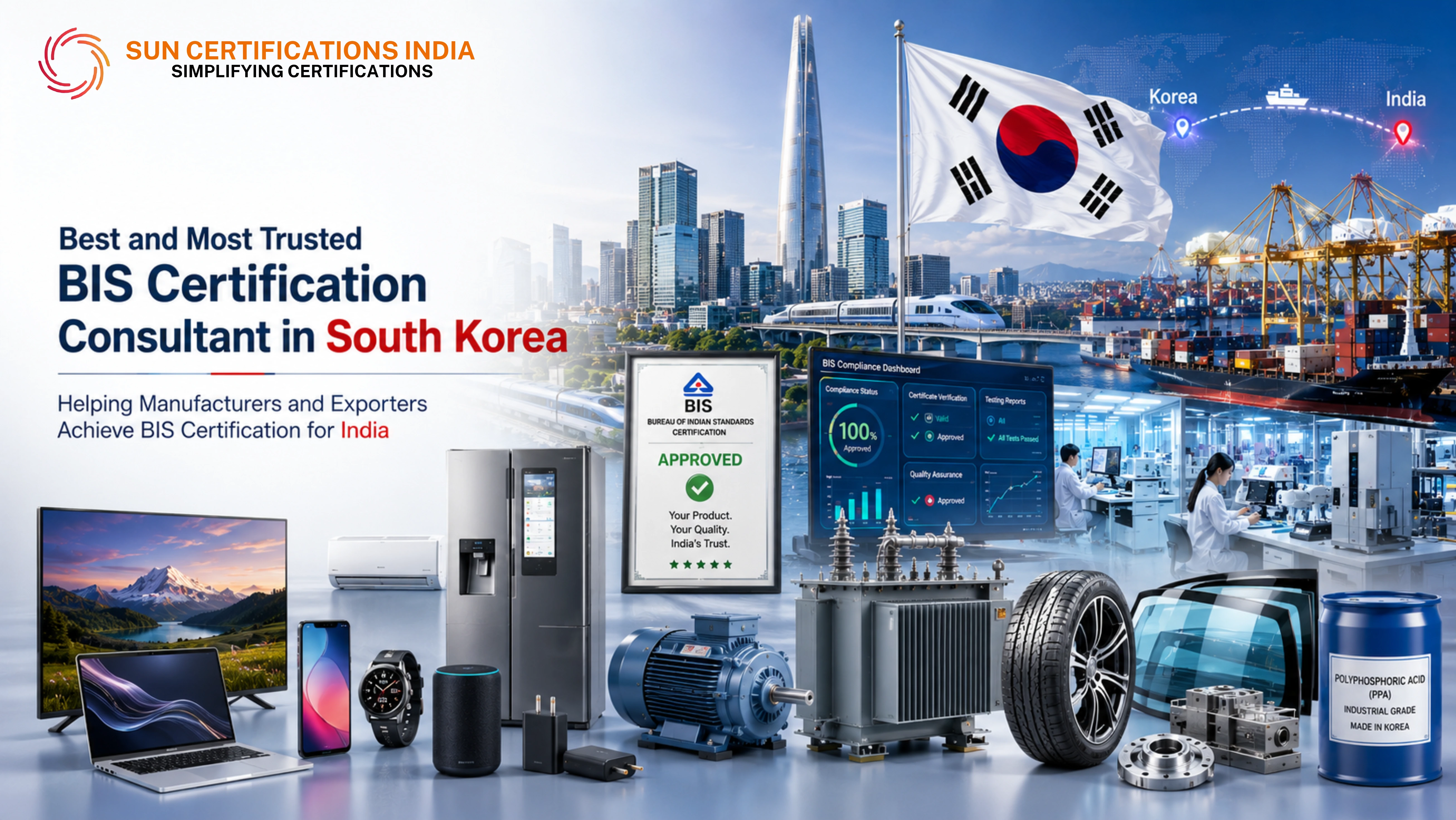
South Korea and India signed one of Asia's most consequential trade deals in 2010 — yet Korean electronics, steel, and appliance brands are still losing Indian market share to competitors who secured BIS certification faster.
The India-Korea CEPA reduced import duties. It did not reduce BIS requirements. And for Korean manufacturers — from Suwon-based Samsung divisions to LG's Changwon appliance factories, from POSCO's Pohang steel operations to SK Hynix's semiconductor fabs — BIS certification remains the single most operationally demanding compliance requirement for the Indian market.
The reason is volume. No country faces the sheer scale of BIS registration complexity that Korean electronics manufacturers do. Samsung alone launches dozens of product models annually in India — every new Galaxy variant, every new television series, every new home appliance model requires its own BIS CRS registration. LG's home appliance line — refrigerators, washing machines, air conditioners, dishwashers, microwaves — runs across hundreds of model variants, each requiring separate BIS tracking. A single delayed CRS registration means a product cannot legally launch in India on schedule, regardless of how much marketing investment sits behind it.
The KC Mark — Korea's mandatory national certification scheme — is not the problem. Korean manufacturers understand mandatory certification. The problem is that KC Mark has zero equivalence with BIS, and the BIS portal, IS standards, and KOLAS report acceptance logic operate on Indian regulatory terms that require an experienced Indian hand to navigate efficiently.
At Sun Certifications India, we have been managing BIS registrations for foreign manufacturers since 2016. We understand high-volume CRS registration pipelines, KOLAS lab report evaluation, and FMCS audit preparation for Korean factories. If your Korean company is selling — or wants to sell — in India, this page tells you exactly how we handle it.
Why India — The Opportunity for South Korean Manufacturers
Korea's domestic market is sophisticated but saturated — and Korean conglomerates understood this before most. Samsung, LG, Hyundai, and POSCO did not invest billions in India because India was convenient. They invested because India is the world's most consequential long-term consumer market, and early positioning creates durable advantages.
That thesis has proven correct. And the opportunity has only deepened.
Why Korean manufacturers beyond the conglomerates are prioritising BIS certification now:
- India's PLI scheme for electronics is attracting Samsung, LG, and Dixon Technologies to domestic manufacturing — pulling Korean Tier-1 and Tier-2 component suppliers toward India-facing BIS compliance
- India's electric vehicle transition is creating demand for Korean lithium battery technology from Samsung SDI, LG Energy Solution, and SK On — all requiring BIS for Indian market batteries and energy storage systems
- India's steel and infrastructure boom is sustaining POSCO's India operations and creating demand for Korean high-tensile and specialty steel products beyond what POSCO India manufactures locally
- Korean home appliance brands — LG, Samsung, Coway, Winia — are competing directly for India's rapidly growing premium appliance market against Chinese and European brands where BIS registration speed is a direct competitive variable
BIS Certification Overview — What Korean Manufacturers Need to Know
BIS (Bureau of Indian Standards) is India's national standards body under the Ministry of Consumer Affairs. Products under mandatory Quality Control Orders (QCOs) cannot legally enter, be sold, or be distributed in India without valid BIS certification — regardless of KC Mark status, KS certification, or any other Korean compliance credential.
How Korea's certifications relate to BIS — precisely:
- KC Mark ≠ BIS certification. The KC (Korea Certification) Mark is South Korea's mandatory national safety certification — administered by the National Radio Research Agency (NRA) and Korea Testing Laboratory (KTL). KC Mark certifies compliance with Korean Standards (KS) for the Korean market. BIS certifies compliance with Indian Standards (IS numbers) for the Indian market. Both are mandatory national schemes — but they have zero mutual recognition. A product holding a valid KC Mark must still obtain separate BIS certification for India, starting from the beginning.
- KS (Korean Industrial Standards) ≠ IS (Indian Standards). Korean Standards and Indian Standards are developed independently. Technical parameters, test methods, and performance benchmarks differ between KS and IS — sometimes substantially. A product that passes KS testing may not meet IS parameters for the same characteristic, and vice versa. IS-specific testing is required regardless of KS compliance.
- KOLAS-accredited lab reports may be accepted for CRS. The Korea Laboratory Accreditation Scheme (KOLAS) is Korea's national laboratory accreditation framework under KATS (Korean Agency for Technology and Standards). For CRS registrations (electronics and IT products), KOLAS-accredited laboratory test reports may be accepted by BIS under mutual recognition — a significant advantage for Korean electronics manufacturers with comprehensive existing test documentation. Sun Certifications India evaluates KOLAS report acceptability per product before recommending any retesting — avoiding unnecessary cost for manufacturers with large test libraries.
- KC Mark test reports are not KOLAS reports. KC Mark testing and KOLAS-accredited laboratory testing are separate processes. KC Mark test reports from KTL, UL Korea, or Bureau Veritas Korea are not the same as KOLAS-accredited IS-parameter test reports. This distinction matters practically — Korean manufacturers should not assume KC test documentation automatically qualifies for BIS KOLAS evaluation.
- Foreign manufacturers cannot apply to BIS directly. Korean companies must appoint an Authorized Indian Representative (AIR) — a legally registered Indian entity that files BIS applications, signs all documents, and manages all correspondence with BIS. For high-volume Korean electronics brands, the AIR relationship is operational and ongoing — not a one-time formality.
BIS Certification Schemes Applicable to Korean Manufacturers
1. Compulsory Registration Scheme
The dominant BIS scheme for Korean manufacturers — and the one that creates the most operational complexity given Korea's electronics product volume and launch velocity. No factory audit required — but BIS-recognized laboratory testing is mandatory for every registered product model.
2. Foreign Manufacturers Certification Scheme (ISI Mark)
For Korean manufacturers whose products fall under mandatory ISI Mark QCO categories — POSCO steel, LG Chem chemicals, battery products, and automotive components.
3. BIS Scheme X
For Korean industrial machinery and capital equipment manufacturers — expanding under mandatory QCOs.
BIS Certification documents for South Korea companies
KOLAS report usability is evaluated per product before any testing is recommended. Sun Certifications India provides a customised document checklist after initial consultation — including KS-to-IS gap analysis.
- Company registration / incorporation certificate (South Korea)
- Product technical file — specifications, drawings, bill of materials
- Test reports from BIS-approved or mutually recognized laboratory
- Manufacturing process flow chart
- List of plant, machinery, and testing equipment with calibration records
- Quality control plan and in-house testing procedures
- Appointment letter for Authorized Indian Representative (AIR)
- Authorization letter on company letterhead
BIS Certification Process for South Korean Manufacturers
Step 1 — Product Portfolio Assessment and Prioritisation
We map your product portfolio, launch priorities, and applicable BIS schemes before any application work begins.
Step 2 — Appoint an Authorized Indian Representative (AIR)
Sun Certifications India can serve as your ongoing AIR across all products and schemes.
Step 3 — KOLAS Report Evaluation and Testing Strategy
We assess existing KOLAS reports per product before recommending any retesting.
Step 4 — Map existing KS technical files, KC certification documentation, and KOLAS test data against IS requirements
We identify exactly where KS and IS differ for your product — minimising unnecessary documentation rework.
Step 5 — BIS Application Filing
We prepare and file complete applications through the BIS portal and manage all official correspondence.
Step 6 — BIS Factory Audit in Korea
For ISI Mark and Scheme X certifications, BIS officials travel to the Korean manufacturing facility. We coordinate and prepare your team for the inspection.
Step 7 — Licence Grant and Certification
Once all requirements are met, BIS grants your certification and your products can legally enter the Indian market.
Why Sun Certifications India is best and most trusted BIS consultant in South Korea
Korean manufacturers need a BIS consultant who understands high-volume CRS registration pipelines, KOLAS report evaluation, and the operational reality of managing BIS compliance across a product portfolio that refreshes every 6–12 months.
| What We Offer | What It Means for Korean Manufacturers |
|---|---|
| 10+ years of BIS experience | Deep knowledge of CRS, FMCS, and Scheme X requirements across every Korean export category |
| High-volume CRS management | We handle simultaneous multi-product, multi-model CRS pipelines — Samsung/LG scale is not a challenge |
| KOLAS report evaluation | We assess every existing KOLAS report before recommending retesting — maximising cost efficiency |
| AIR services — ongoing | We serve as your permanent Authorized Indian Representative across all products and all schemes |
| KC-to-IS documentation mapping | We identify exactly where KS and IS differ for your product — no unnecessary rework |
| Launch calendar alignment | We align BIS registration timelines to Indian product launch schedules |
| FMCS audit preparation | IS-specific mock audits for Korean factories — not KC or ISO audit formats |
| Multi-ministry compliance | BIS + LMPC + WPC + CDSCO + PESO — all in-house |
| Post-certification portfolio management | Renewals, new model registrations, surveillance audits — managed as an ongoing programme |
Conclusion
Korea's electronics dominance in India is real — and it is built entirely on BIS-registered products.
Every Samsung Galaxy in an Indian pocket has a CRS registration behind it. Every LG refrigerator in an Indian kitchen carries an ISI Mark. Every POSCO steel coil in an Indian factory went through BIS. The conglomerates understood this early — and built their India market leadership in part by treating BIS compliance as a competitive tool rather than a compliance burden.
The same logic applies to every Korean manufacturer entering India today. A faster CRS registration means an earlier launch date. An earlier launch date means market share captured before the competitor. In India's electronics market — where Samsung and Chinese brands fight for every percentage point — BIS registration speed is not administrative. It is strategic.
Frequently Asked Questions
Can we use our KC Mark test reports for BIS CRS registration?
KC Mark test reports and KOLAS-accredited test reports are different documents. KC Mark testing certifies compliance with Korean Standards (KS) for the Korean market — these reports are not accepted by BIS.
We have 50+ product models launching in India this year — how do we manage BIS registration at this scale?
This is exactly the operational challenge that distinguishes Korean electronics brands from manufacturers in other categories. Sun Certifications India manages high-volume CRS portfolios as a structured programme — not as individual applications.
Does the India-Korea CEPA reduce or eliminate BIS certification requirements?
No. The CEPA reduces import duties on eligible Korean products — it has no effect on BIS mandatory certification requirements.
Can our Korean headquarters manage BIS without an India office?
Yes — and this is the standard operating model for most Korean manufacturers. BIS requires an Authorized Indian Representative (AIR) — a legally registered Indian entity — to file and manage applications on the Korean manufacturer's behalf.
Samsung India and LG India already have BIS certifications — do Korean component suppliers to these companies also need separate BIS?
It depends on whether the Korean supplier is the declared manufacturer of a product sold in India.
Also check our BIS expertise in other countries
- BIS Consultant in India
- BIS Consultant in France
- BIS Consultant in Germany
- BIS Consultant in Italy
- BIS Consultant in Netherlands
- BIS Consultant in Indonesia
- BIS Consultant in Japan
- BIS Consultant in Thailand
- BIS Consultant in Spain
- BIS Consultant in Vietnam
- BIS Consultant in China
- BIS Consultant in Gulf countries
Also check our BIS expertise in other countries in their local Languages
- Consultant en certification BIS en France
- BIS-Zertifizierungsberater in Deutschland
- Consulente di certificazione BIS in Italia
- BIS-certificeringsconsultant in Nederland
- Konsultan sertifikasi BIS di Indonesia
- 日本のBIS認証コンサルタント
- 한국의 BIS 인증 컨설턴트
- ที่ปรึกษา BIS ในประเทศไทย
- Consultor de certificación BIS en España
- Tư vấn chứng nhận BIS tại Việt Nam
- 中国BIS认证顾问
- مستشار BIS في دول الخليج
Dhruv Aggarwal
Head of Operations at Sun Certifications India
Experience: 10+ years & Handled 1000+ projects
Awarded by many Indian and International organisations








PT Quty Karunia, BIS Licensee in Vietnam
“Sun Certifications India provided excellent BIS Certification services. Their unparalleled service and sincerity gained our trust. One of the best BIS consultants in India!”

Thantawan Industries Ltd, BIS Licensee in Thailand
“Sun Certifications India supported us throughout the BIS certification process. Their responsive customer service and punctuality are exceptional. Highly recommend for hassle-free BIS certification.”

Leaderart Industries, BIS Licensee in Malaysia
“Sun Certifications India helped us acquire BIS Certification, doubling our engagement in India. Their services are fast, genuine, and up-to-date with latest BIS norms.”

Aluminium Bahrain (ALBA), BIS Licensee in Bahrain
“Excellent BIS certification support, highly reliable consultants.”

Bahrain Aluminium Manufacturing Company, BIS Licensee in Bahrain
“Smooth BIS registration process with expert consultants.”

Daiki Aluminium Japan, BIS Licensee in Japan
“Efficient BIS license assistance, great consultants.”

Trimble Navigation, BIS Licensee in USA
“Seamless BIS certification and registration support.”

Remsa Italia, BIS Licensee in Italy
“Helpful BIS consultants, simplified license process.”

Aquazzura, BIS Licensee in Italy
“We got our BIS certificate well within the timelines and at affordable prices, great work team Sun!”

PT Quty, BIS Licensee in Indonesia
“Excellent BIS registration service, highly recommended.”

Danu Vina, BIS Licensee in Vietnam
“Reliable BIS license consultants, fast process.”

Hanh My Production Company, BIS Licensee in Vietnam
“Expert BIS consultants, certification made easy.”

Sedo Vina, BIS Licensee in Vietnam
“Smooth BIS certificate registration, great support.”

Misumi Japan, BIS Licensee in Japan
“Trusted BIS consultants, quick certification process.”

Thantawan Public Industry Company, BIS Licensee in Thailand
“Professional BIS certification service, very efficient.”

Cortizo Aluminios, BIS Licensee in Spain
“Excellent BIS registration and license guidance.”

Midal Cables, BIS Licensee in Bahrain
“Expert BIS consultants, smooth certification process.”
Years Exp.
Our Clients
Success Rate
Countries Served
Our team brings 10e4+ years of experience in CDSCO and BIS compliance.
We reduce approval time by up to 40% with streamlined processes.
100% success rate with 1500+ successful registrations.
Dedicated account manager ensuring personalized service.
Leave your details below and our experts will call you back within 24 hours to discuss your regulatory compliance needs.
By submitting this form, you agree to our Privacy Policy and consent to being contacted.
View This Page in Your Language







BIS Certifications for Slugging Wrenches IS 4508

BIS Certification for Ring Wrenches IS 2029
BIS Certification for Cutting Pliers IS 3650

BIS Certificate for Jaw Wrenches IS 2028s
BIS Certification for Fibre Ropes IS 4572
BIS Certification for Solar Flat Plate Collector - IS 12933
A Guide on BIS Certification by Sun Certifications India
BIS Certifications For Toys under IS 9873 & 15644
Simplifying Certification: BIS, CDSCO, LMPC, EPR, PESO, WPC & More
BIS Certification for Chipboard Screws - IS 18508:2024
BIS Certification Guide - Complete Process Overview
BIS Certification Process - Step by Step Guide
BIS Standards and Quality Requirements

BIS Foreign Manufacturer Certification
BIS Renewal and Maintenance Requirements
BIS Marking and Labeling Requirements
BIS Product Categories and Standards

BIS Consultancy Services and Support
BIS Compliance Audits and Inspections

BIS Certification Standards and Compliance Guidelines

BIS Product Certification - Requirements and Process
BIS Licensing and Registration Guide

BIS Quality Control and Testing Standards
BIS Compliance Framework for Industries
BIS Certification for Electronics and Electrical Products
BIS Documentation and Application Process
BIS Import Certification and Customs Clearance
BIS Testing and Laboratory Requirements
BIS Fees and Charges - Complete Breakdown
BIS vs International Standards

BIS Common Issues and Solutions

BIS Certification Process - Complete Guide
BIS Certification Guide - Expert Insights
BIS Standards Compliance - Complete Overview
BIS Certification Requirements
BIS Certification Overview
BIS Quality Standards Guide
BIS Certification Compliance
BIS Certification Process Guide